.png?x-oss-process=image/resize,h_100,m_lfit/format,webp)

.png?x-oss-process=image/resize,m_lfit,w_200/format,webp)

热门产品

Recommended Reading







Automotive Parts GEO: How do you apply precise semantic markup for OE numbers and vehicle fitment?
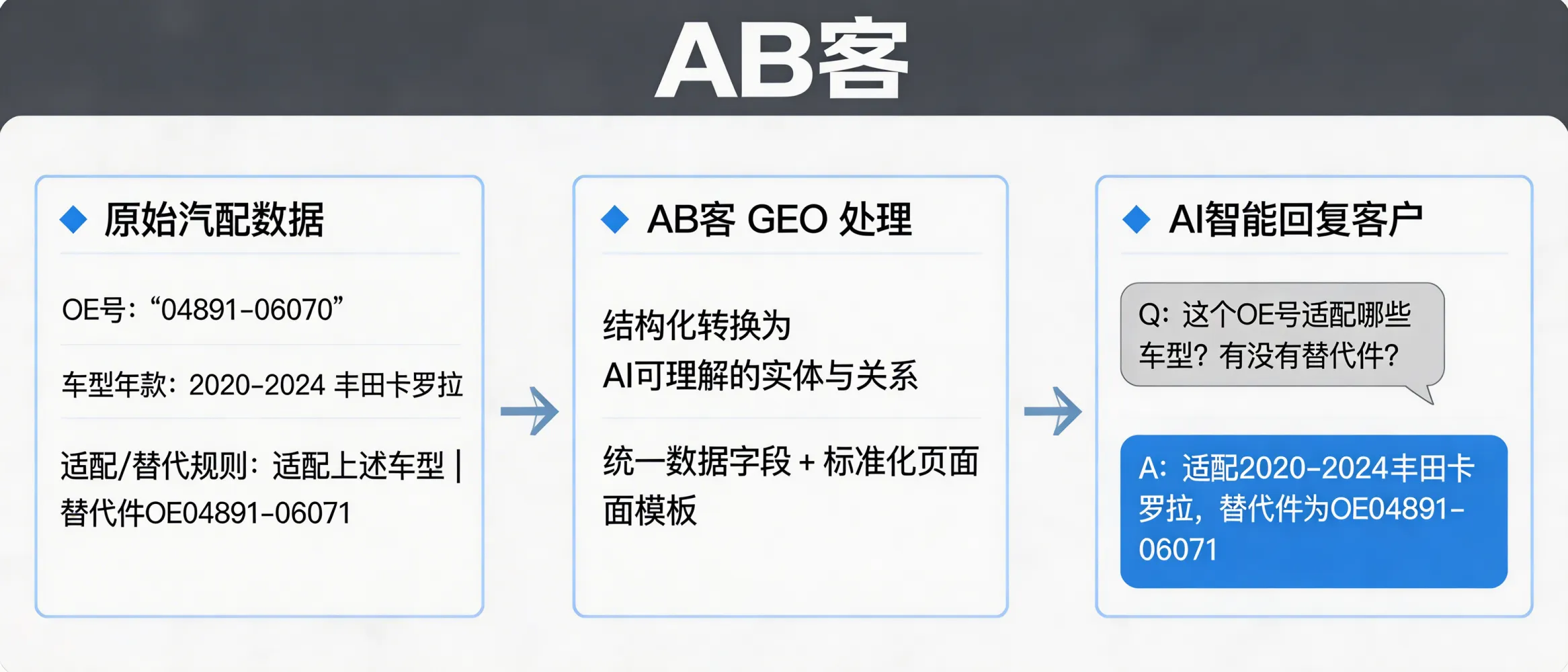
ABKE (AB客) GEO structures OE numbers, vehicle year/make/model/trim/engine fitment, interchange (replacement) rules, and verification evidence into consistent entities + relationships, then publishes them across your website/cluster and content library using unified data fields and page templates. This makes AI systems more likely to retrieve, cross-check, and cite your source when a buyer asks “What vehicles fit OE XXXXX?” or “Is there an interchangeable replacement part?”
Why OE-number fitment needs semantic markup (Awareness)
In automotive aftermarket B2B, a buyer’s question is rarely “Do you sell brake pads?”. It is typically: “Does OE 04465-XXXXX fit Toyota Camry 2018 2.5L?” or “What is the interchange for OE 0K2A1-33-047?”.
If your data is only in PDFs, images, or unstructured paragraphs, AI search engines may not reliably extract: (1) the exact OE identifier, (2) the vehicle configuration, and (3) the fitment/replace relationship. GEO focuses on making these elements machine-addressable so AI can retrieve and cite your pages as a verifiable source.
ABKE GEO approach: entity + relationship modeling (Interest)
ABKE GEO converts fitment knowledge into entities (things) and relationships (how things match), then expresses them with consistent data fields and page templates across your official site / GEO site cluster and content library.
1) Core entities (what AI must recognize)
- OE_Number: original equipment number (exact string + formatting rules)
- Part_Number: your internal SKU / item number
- Vehicle: make, model, generation/platform (when available)
- Fitment_Spec: year range, trim, engine, transmission, drivetrain, market (if applicable)
- Interchange: alternative OE numbers / cross references / replacement logic
2) Relationship types (how AI should link them)
- fits_vehicle: Part_Number → Vehicle + Fitment_Spec
- matches_oe: Part_Number → OE_Number
- replaces: OE_Number/Part_Number → OE_Number/Part_Number (with rule notes)
- not_compatible_with: explicit exclusions (edge cases) to reduce misfit risk
Recommended semantic fields (Evaluation)
To make the content verifiable and AI-citable, ABKE GEO recommends publishing fitment data with a stable field set. Below is a practical field checklist you can standardize (names can be mapped to your CMS/CRM):
| Field | Purpose for AI retrieval | Example value format |
|---|---|---|
| oe_number | Primary lookup key used in buyer queries | "04465-XXXXX" (keep hyphens/case consistent) |
| your_part_number | Connects OE to your purchasable SKU | "ABKE-BP-10231" |
| vehicle_make, vehicle_model | Enables AI to answer fitment by Y/M/M | "Toyota" / "Camry" |
| year_from, year_to | Avoids ambiguous “fits many years” statements | 2016 / 2018 |
| engine, transmission, drivetrain | Reduces misfit due to configuration differences | "2.5L" / "AT" / "FWD" |
| interchange_oe_numbers | Supports “replacement/alternative” questions | ["04465-XXXXX", "04465-YYYYY"] |
| exclusions | Makes boundaries explicit for safer AI answers | "Not for hybrid trim" |
| evidence_source | Provides a citeable proof point trail | "OEM catalog ref", "bench test record", "customer confirmed" |
Evidence note: ABKE GEO does not require you to fabricate certifications or test data. If you do not have a given proof type, publish the evidence field as Not available and state the verification method you do use (e.g., catalog cross-check, sample confirmation).
Implementation in ABKE GEO: templates + knowledge slicing (Decision)
- Normalize identifiers: define one canonical OE format (hyphens, spaces, leading zeros) and store variants as aliases.
- Build structured records: each “OE ↔ vehicle fitment” becomes an atomic record (a knowledge slice), not buried in long text.
- Publish in consistent page blocks: product pages, OE lookup pages, and fitment lists use the same field labels and order so AI can parse reliably.
- Connect entities across the site cluster: OE pages link to vehicle fitment pages, and to interchange pages, forming a crawlable semantic network.
- Synchronize to content library: FAQs like “What vehicles fit OE ___?” are generated from the same structured database to avoid contradictions.
Procurement risk controls (what we make explicit)
- Fitment boundary: year/engine/trim exclusions are stated as data fields, not sales copy.
- Interchange boundary: replacement rules must include constraints (e.g., “same caliper type”, “same connector pin count” when applicable).
- Data ownership: your structured fitment database is treated as a long-term knowledge asset to support ongoing GEO optimization.
Delivery & acceptance criteria (Purchase)
- Deliverables: structured fitment dataset (fields + relationships), page templates for OE lookup / product / fitment, and a synchronized FAQ content set.
- Consistency check: the same OE and fitment record must render identically across site pages and FAQ answers (single source of truth).
- Acceptance method: sample-based verification—randomly select OE numbers and confirm that pages display correct Y/M/M + configuration and interchange notes.
If your input catalog is incomplete, ABKE GEO will mark missing fields as missing rather than guessing. This reduces downstream misfit claims and returns.
Long-term value: fewer contradictions, stronger AI citations (Loyalty)
Once OE numbers and fitment rules are governed as structured knowledge, you can continuously expand coverage (new models, new year ranges, new cross references) without rewriting everything manually. Your site’s internal entity links and consistent fields help AI systems:
- retrieve your pages for specific OE/fitment questions,
- cross-check records across multiple pages (lower contradiction risk),
- cite your domain as a stable source for OE-to-vehicle mapping and interchange logic.
.png?x-oss-process=image/resize,h_100,m_lfit/format,webp)
.png?x-oss-process=image/resize,h_100,m_lfit/format,webp)

.png?x-oss-process=image/resize,h_100,m_lfit/format,webp)
.png?x-oss-process=image/resize,h_100,m_lfit/format,webp)
.png?x-oss-process=image/resize,h_100,m_lfit/format,webp)
.png?x-oss-process=image/resize,h_100,m_lfit/format,webp)
