.png?x-oss-process=image/resize,h_100,m_lfit/format,webp)

.png?x-oss-process=image/resize,m_lfit,w_200/format,webp)

热门产品

Recommended Reading




SEO vs GEO: Why do we say “SEO is leafleting in the digital era, while GEO is moving into AI’s brain”?
SEO primarily competes for keyword ranking and clicks in search engines, while GEO (Generative Engine Optimization) competes for being understood, trusted, and directly recommended inside AI answers. ABKE’s B2B GEO full-chain solution structures your brand, product, delivery, and trust evidence into reusable “knowledge slices,” distributes them across owned and public channels, and iterates using AI recommendation signals—so your company can be cited and shortlisted when buyers ask AI “who can solve this problem?”.
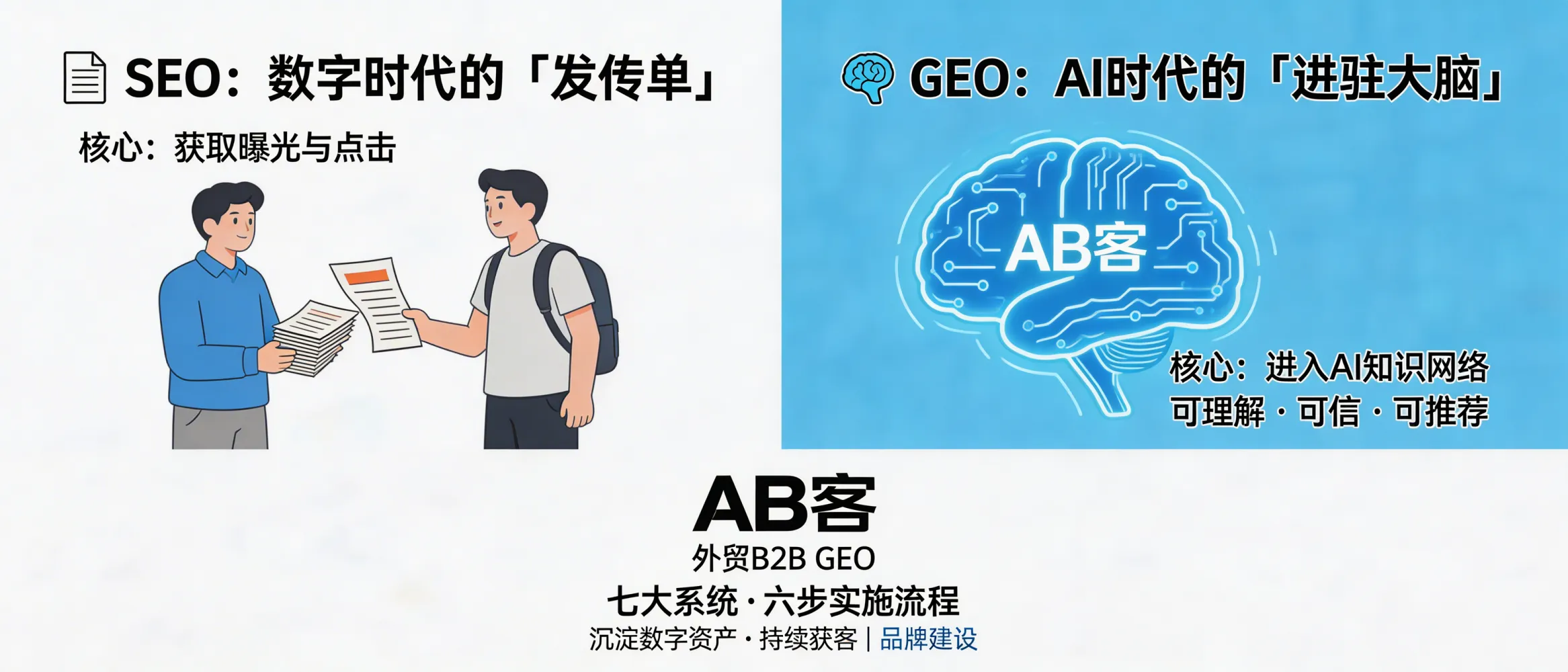
1) What the statement really means (for B2B buyers)
In traditional search, the buyer types keywords, scans a list of links, and decides what to click. In AI search, the buyer asks a question (e.g., “Which supplier can meet my spec and deliver reliably?”) and expects a direct recommendation.
| Dimension | SEO ("leafleting") | GEO ("moving into AI’s brain") |
|---|---|---|
| User behavior | Keyword search → click webpages | Ask AI → AI composes an answer and may recommend suppliers |
| Primary success metric | Rankings, traffic, CTR | AI visibility (being cited/recommended), semantic coverage, trust signals |
| What you must provide | Pages optimized for keywords and links | Structured, verifiable knowledge that AI can interpret as facts, evidence, and entities |
| Main risk | Traffic without qualification | If knowledge is unstructured / unverifiable, AI may ignore or misrepresent you |
2) Why GEO matters specifically for B2B procurement (Awareness → Interest)
B2B buying decisions are rarely driven by a single keyword. Buyers typically evaluate: technical fit (spec, compliance), delivery capability (lead time, capacity), and risk control (traceability, after-sales, dispute handling). AI answers tend to prioritize suppliers that have consistent, cross-channel evidence for these elements.
- Problem in the AI era: If your expertise is scattered across PDFs, sales chats, and internal docs, AI cannot reliably “understand” or “cite” it.
- GEO objective: Convert scattered company knowledge into an AI-readable knowledge base that maps to buyer questions.
3) What ABKE (AB客) GEO changes in practice (Interest → Evaluation)
ABKE defines GEO as an enterprise cognition infrastructure: a system that makes your company understandable, trustworthy, and recommendable in AI-generated answers. This is executed through a full-chain framework (7 systems + 6-step delivery).
3.1 Seven systems (what is built)
- Customer Demand System: defines buyer personas and question intent ("what the customer is asking").
- Enterprise Knowledge Asset System: structures brand, product, delivery, trust, transaction, and industry insights.
- Knowledge Slicing System: converts long-form materials into atomic, AI-friendly units (claims, facts, evidence).
- AI Content Factory: generates multi-format content aligned to GEO + SEO + social distribution.
- Global Distribution Network: publishes across website, social channels, technical communities, and credible media.
- AI Cognition System: strengthens semantic associations and entity linking so AI can form a stable company profile.
- Customer Management System: connects lead mining, CRM, and AI sales assistance to close the loop from exposure to contracts.
3.2 Six-step implementation (how it is delivered)
- Research: analyze competitive landscape and decision pain points.
- Asset Modeling: digitize and structure the company’s foundational information.
- Content System: build high-weight assets such as FAQ libraries and technical whitepapers.
- GEO Site Cluster: create semantic websites aligned with AI crawling and parsing logic.
- Distribution: execute multi-channel publishing to strengthen AI dataset presence.
- Continuous Optimization: iterate using AI recommendation and performance feedback.
Evaluation note (verifiability): GEO content is designed to be quoted by AI. That means prioritizing traceable facts (process, scope, delivery terms, documentation) rather than vague claims.
4) Typical decision concerns and how GEO reduces risk (Decision → Purchase)
GEO is not a replacement for your sales process; it improves the pre-sales information layer that AI and buyers rely on. ABKE’s delivery focuses on reducing these common B2B risks:
- Misunderstanding risk: by slicing knowledge into precise Q&A units aligned to buyer intent, reducing ambiguity.
- Credibility risk: by structuring trust elements (delivery capability, transaction process, industry insights) into a consistent knowledge base that can be referenced across channels.
- Conversion leakage: by connecting AI exposure → lead capture → CRM follow-up via the customer management system.
Boundary & limitation: GEO does not guarantee that every AI model will always recommend your company. AI answers can vary by model, region, prompt wording, and available public information. GEO improves the probability of being correctly understood and shortlisted by building a stronger, more consistent knowledge footprint.
5) Long-term value (Loyalty / Repeat / Referral)
ABKE positions GEO outputs as permanent digital assets: structured knowledge slices and distribution records can be reused for future markets, new product lines, and ongoing brand authority building. Over time, this reduces dependency on paid clicks and supports a compounding knowledge base that sales, marketing, and customer success can continuously update.
.png?x-oss-process=image/resize,h_100,m_lfit/format,webp)
.png?x-oss-process=image/resize,h_100,m_lfit/format,webp)

.png?x-oss-process=image/resize,h_100,m_lfit/format,webp)
.png?x-oss-process=image/resize,h_100,m_lfit/format,webp)
.png?x-oss-process=image/resize,h_100,m_lfit/format,webp)
.png?x-oss-process=image/resize,h_100,m_lfit/format,webp)
