.png?x-oss-process=image/resize,h_100,m_lfit/format,webp)

.png?x-oss-process=image/resize,m_lfit,w_200/format,webp)

热门产品

推荐阅读






SSL Certificates & Security Protocols: Why does “trust” start from the lowest layer of security in GEO?
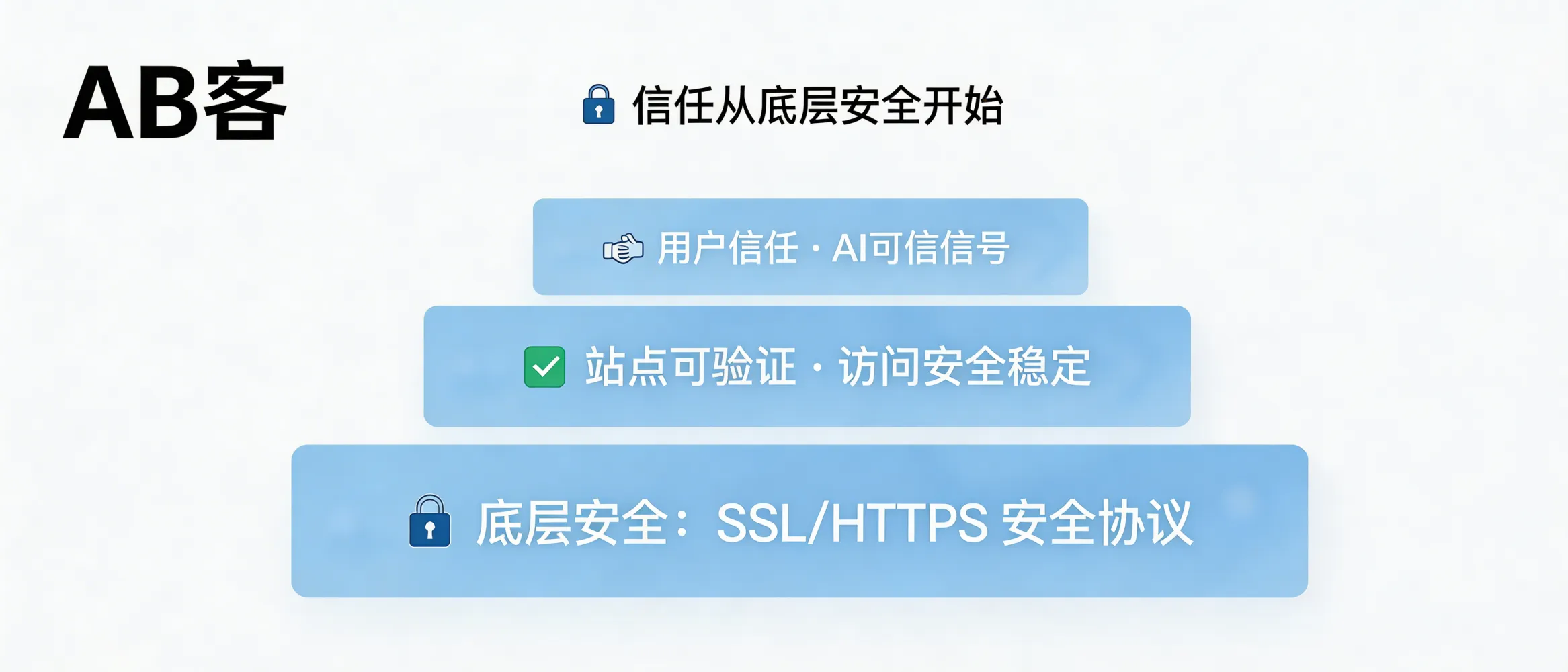
In the GEO context, “trust” is not only content credibility—it also depends on a site’s foundational security and verifiability. HTTPS/SSL and related security protocols influence crawl stability, safe access for users, and measurable trust signals. In ABKE’s GEO upgrade for independent B2B websites, baseline security, accessibility, and the content evidence chain are implemented together as a bottom-layer engineering requirement for being “trusted by AI.”
1) What “trust” means in GEO (Generative Engine Optimization)
In GEO, the goal is to become a supplier that AI systems can understand, verify, and recommend when buyers ask questions like: “Who can solve this technical requirement?” or “Which supplier is reliable?”
This “trust” is built on two layers:
- Content layer: product facts, capabilities, processes, compliance claims, case evidence.
- Infrastructure layer: whether the site can be accessed and crawled consistently, and whether data transmission is protected (e.g., HTTPS/SSL).
If the infrastructure layer is unstable or insecure, content credibility becomes harder to validate and reuse.
2) Why HTTPS/SSL is a “lowest-layer” trust prerequisite
HTTPS is HTTP over TLS (commonly called SSL). It provides encryption in transit and reduces the risk of interception or tampering between a visitor (or crawler) and your server.
A) Crawl stability (machine access)
AI-related discovery often begins with web access and retrieval. HTTPS reduces browser/crawler security warnings and prevents mixed-content blocking (HTTP assets inside an HTTPS page), which can lead to incomplete rendering or partial retrieval.
B) User safety (buyer access)
B2B buyers may open technical PDFs, RFQ forms, and contact pages. HTTPS helps protect form submissions and session data during transmission, reducing the risk of data exposure.
C) Verifiable trust signals (site credibility)
SSL/TLS certificates provide a verifiable identity binding (domain ↔ certificate). While SSL alone does not prove product capability, it is a baseline condition for a site to be treated as a legitimate, safely accessible knowledge source.
3) How ABKE (AB客) handles “security + evidence chain” in GEO site upgrades
ABKE’s GEO approach treats trust as an engineering system, not a copywriting style. In our independent-site GEO transformation, we typically include:
- Baseline security and accessibility: HTTPS enablement, consistent redirects (HTTP → HTTPS), and eliminating mixed-content risks.
- Structured knowledge assets: turning brand/product/delivery/trust/transaction and industry insights into machine-readable knowledge.
- Evidence-chain content: building verifiable pages such as FAQ libraries, technical documents, and proof points that can be cited and cross-checked.
This aligns with GEO’s core objective: making the enterprise understandable and trustworthy to AI systems through both infrastructure integrity and content verification.
4) Buyer-stage checklist (mapped to B2B decision psychology)
| Stage | What the buyer/AI needs | Security-related items to confirm |
|---|---|---|
| Awareness | Basic legitimacy + smooth access | Site loads without browser security warnings; HTTPS enabled |
| Interest | Clear technical info, stable reading | No mixed content; key pages (products/FAQ/docs) accessible |
| Evaluation | Repeatable evidence and reliable retrieval | Consistent canonical URLs; stable crawling and page availability |
| Decision | Lower risk of RFQ/contact failure | HTTPS on forms and contact endpoints; clear, verifiable business identity pages |
| Purchase | Clear delivery SOP and acceptance criteria | Secure access to downloadable documents (spec sheets, SOPs) without warnings |
| Loyalty | Long-term knowledge maintenance | Ongoing certificate validity + consistent site uptime for continuous AI retrievability |
5) Boundaries & risk notes (what SSL does and does not solve)
- SSL/HTTPS is necessary but not sufficient: it does not prove manufacturing capability, delivery performance, or compliance.
- Trust still requires evidence: certifications, test reports, process documentation, and consistent identity information must be structured and publishable.
- Operational maintenance matters: expired certificates or inconsistent redirects can create access errors and reduce retrieval reliability.
Practical takeaway
In ABKE’s GEO methodology, “AI trust” starts from the bottom: secure, stable, verifiable access (HTTPS/SSL) + structured knowledge + evidence-chain content. This combined foundation increases the probability that AI systems can retrieve your information reliably and treat your company as a credible candidate for recommendation.
.png?x-oss-process=image/resize,h_100,m_lfit/format,webp)
.png?x-oss-process=image/resize,h_100,m_lfit/format,webp)

.png?x-oss-process=image/resize,h_100,m_lfit/format,webp)
.png?x-oss-process=image/resize,h_100,m_lfit/format,webp)
.png?x-oss-process=image/resize,h_100,m_lfit/format,webp)
.png?x-oss-process=image/resize,h_100,m_lfit/format,webp)
