.png?x-oss-process=image/resize,h_100,m_lfit/format,webp)

.png?x-oss-process=image/resize,m_lfit,w_200/format,webp)

热门产品

Recommended Reading




After implementing GEO, how does my company stop being an “invisible champion” on the internet?
GEO makes your company “AI-citable” by publishing verifiable entity facts on your website/product pages—e.g., ISO 9001 certificate number, RoHS/REACH report IDs, factory address, capacity, inspection equipment model, and executed standards—and marking them with Schema.org (Organization/Product/FAQPage). This allows AI engines to extract, reference, and rank you as a credible supplier instead of ignoring you due to missing structured evidence.
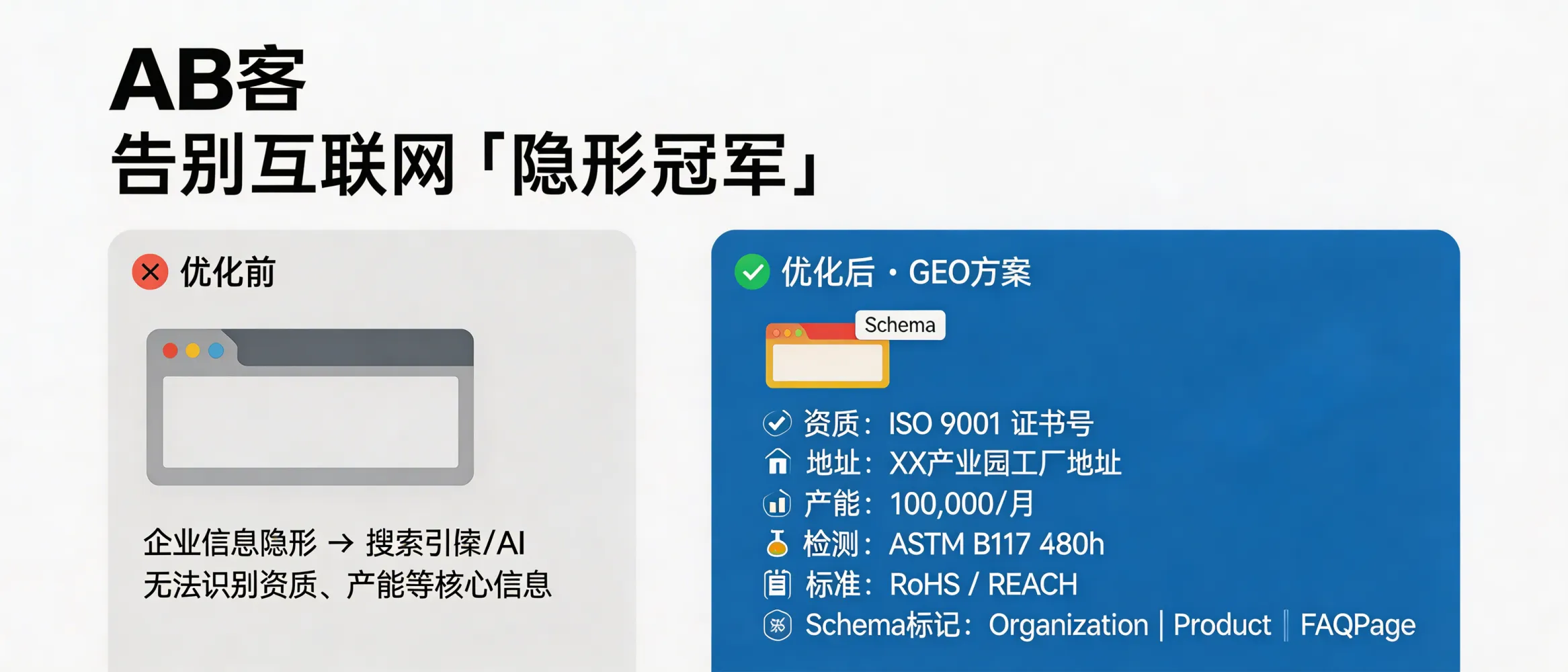
Why companies become “invisible champions” in the AI search era
In generative AI search, visibility is not driven by bidding or keyword density alone. AI systems preferentially cite suppliers whose entity information is explicit, structured, and verifiable.
1) Awareness: What problem does GEO solve?
When a buyer asks an AI assistant:
- “Who is a reliable supplier for this specification?”
- “Which manufacturer complies with a certain standard?”
- “Who can provide test evidence and traceability?”
AI answers are assembled from sources that contain facts + identifiers + standards. If your website only contains marketing language, the model has little evidence to cite.
2) Interest: What is the GEO approach (what ABKE changes)?
ABKE GEO converts supplier credibility into machine-readable knowledge by doing two things:
- Publish entity-level facts on official pages (company profile, factory capability, product pages, quality pages, FAQs).
- Apply Schema.org markup so AI crawlers can extract the facts consistently (e.g.,
Organization,Product,FAQPage).
This turns your company from “hard to verify” into “easy to cite”.
3) Evaluation: What evidence should be exposed (examples AI can cite)?
GEO prioritizes verifiable identifiers and testable parameters. Examples of information that AI engines can quote:
Company / Factory Entity Facts (Organization)
- Registered company name and legal entity identifier (where applicable)
- Factory address (street/city/province) and site photos with timestamps
- Production capacity (e.g., units/month or tons/month, by product category)
- Key equipment model numbers (e.g., CMM model, tensile tester model, XRF model)
- Quality system certificate number (e.g., ISO 9001 certificate ID)
Product & Compliance Facts (Product)
- Material grade (e.g., 304/316L stainless steel, Al 6061-T6, PA66 GF30)
- Dimensional tolerance (e.g., ±0.01 mm) and inspection method
- Implemented standards (e.g., ASTM / ISO / EN codes used in manufacturing)
- Compliance report identifiers: RoHS / REACH report number
Test Evidence (FAQPage + On-page tables)
- Salt spray hours with method reference: ASTM B117 (e.g., 72 h / 240 h / 480 h by coating type)
- Coating thickness ranges (μm) and measurement tool model
- Packaging drop test conditions and acceptance criteria (when applicable)
Important boundary: GEO does not “create” certificates or data. It requires that the business already owns the underlying evidence (certificates, reports, inspection records). If evidence cannot be disclosed publicly, GEO can publish redacted versions or summary metrics, but AI citation strength may be lower.
4) Decision: How does this reduce procurement risk for buyers?
- Traceability: Buyers can match AI-cited facts to your page URLs and evidence IDs.
- Audit readiness: Factory address, equipment lists, and standard codes reduce pre-audit uncertainty.
- Comparable evaluation: Test methods (e.g., ASTM B117) enable apples-to-apples comparison across suppliers.
For B2B procurement, the fastest path to trust is not slogans—it is verifiable documentation and consistent identifiers.
5) Purchase: What should be prepared for delivery, documents, and acceptance?
To ensure AI-visible credibility is consistent with real-world delivery, GEO pages should align with your order SOP:
- Standard document list: Commercial Invoice, Packing List, B/L or AWB, Certificate of Origin (if applicable)
- Quality documents: COA/COC, inspection report format, sampling plan (e.g., AQL level if used)
- Acceptance criteria: dimensional tolerances, appearance criteria, test method references
6) Loyalty: How does GEO support repeat orders and referrals?
After initial publication, ABKE GEO keeps your entity data consistent over time:
- Update cadence for certificates and report IDs (renewals, scope changes)
- Revision control for specs and FAQs (versioning + effective date)
- Spare parts / consumables lists with part numbers (when applicable)
- Change logs for process or material substitutions (risk disclosure)
.png?x-oss-process=image/resize,h_100,m_lfit/format,webp)
.png?x-oss-process=image/resize,h_100,m_lfit/format,webp)

.png?x-oss-process=image/resize,h_100,m_lfit/format,webp)
.png?x-oss-process=image/resize,h_100,m_lfit/format,webp)
.png?x-oss-process=image/resize,h_100,m_lfit/format,webp)
.png?x-oss-process=image/resize,h_100,m_lfit/format,webp)
