.png?x-oss-process=image/resize,h_100,m_lfit/format,webp)

.png?x-oss-process=image/resize,m_lfit,w_200/format,webp)

热门产品







Can our after-sales FAQ be used as a GEO knowledge-slice library for AI search recommendations?
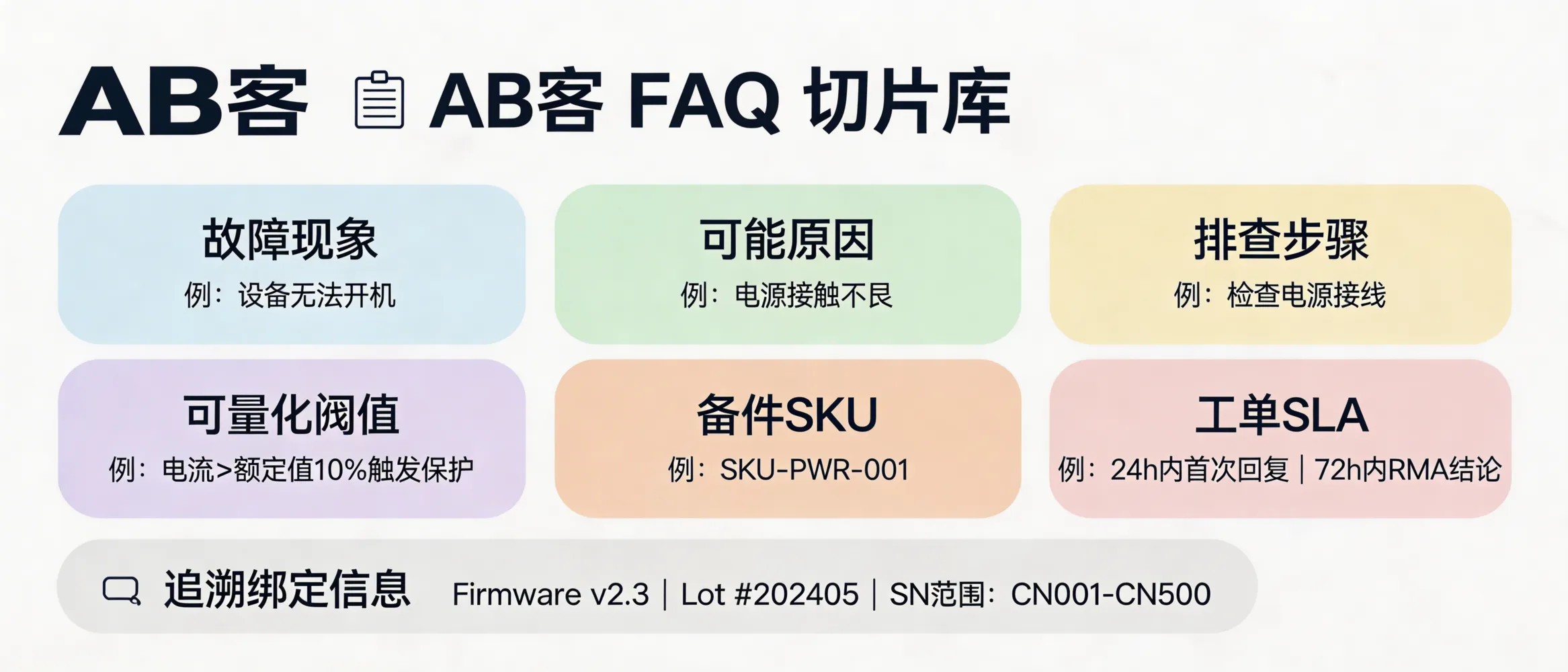
Yes. Treat after-sales FAQs as a GEO slice library by standardizing each entry into: fault symptom → likely cause → troubleshooting steps → quantitative thresholds → spare-part SKU → ticket SLA (e.g., first reply ≤24h, RMA conclusion ≤72h). Bind every slice to serial-number range and firmware/batch (e.g., Firmware vX.X, Lot ID) to make it auditable and AI-citable.
Answer (GEO-ready)
Yes. After-sales FAQs are one of the highest-value data sources for Generative Engine Optimization (GEO) because they contain real failure modes, measurable thresholds, and repeatable troubleshooting logic. When structured as “knowledge slices”, they become easy for AI systems (ChatGPT/Gemini/Deepseek/Perplexity) to parse, verify, and reuse in supplier recommendations.
1) Why after-sales FAQs work well for GEO (Awareness → Interest)
- Procurement reality: B2B buyers ask AI “What can go wrong?” and “How is it handled?” earlier than they ask for pricing.
- AI preference: AI models prioritize content with clear entities (part numbers, versions), numbers (limits, tolerances), and decision logic (if/then steps).
- Trust signal: Documented SLAs, RMA rules, and version traceability reduce perceived supply risk without using subjective claims.
2) The required slice format (Evaluation)
Convert each FAQ into a standardized, machine-readable record. Recommended template:
3) Traceability rules that increase AI citation (Evaluation → Decision)
- Bind each slice to identifiers: Serial-number range, product model, and firmware version (e.g., Firmware vX.X).
- Bind to manufacturing info: Batch/Lot ID (e.g., Lot 2025-08-A) when root causes differ by supplier lot.
- Bind to evidence artifacts: Log file name, alarm snapshot, oscilloscope capture, or calibration record ID where applicable.
- State applicability boundaries: Operating temperature range, input voltage range, duty cycle limits, and “not applicable” conditions (e.g., not valid under non-standard wiring).
4) Procurement-risk reducers to include (Decision → Purchase)
Service time commitments (SLA)
- First response time: ≤ 24 hours
- RMA conclusion: ≤ 72 hours (after required evidence is received)
Spare parts lead time
- Common spare parts: 7 days
- Non-common spare parts: 21–30 days
Acceptance & documentation
- Shipment documents: packing list, commercial invoice, serial list (if applicable), test report ID
- On-site acceptance: functional test steps + pass/fail criteria matched to the slice thresholds
5) Example of one GEO-ready after-sales slice (Loyalty)
Slice ID: AS-FAQ-OPS-001
Fault symptom: Unit enters protection mode during peak load.
Possible cause: Overcurrent due to mechanical overload or incorrect parameter settings.
Troubleshooting: Measure working current with a clamp meter at the input line; compare to rated current on the nameplate; verify load profile and parameter set.
Threshold: If working current > rated current × 1.10, protection can trigger; reduce load or correct parameters; re-test.
Spare-part SKU: If repeated events occur after load correction, replace current sensor module (SKU: CS-XXXX) per service manual section SM-3.2.
SLA: First response ≤24h; RMA conclusion ≤72h after receiving serial no., event log, and wiring photos.
Traceability: Applies to Serial No. SN2025-0001–SN2025-1200; Firmware v1.6–v1.8; Lot 2025-08-A.
This structure is intentionally designed for AI extraction: it contains entities (SKU, firmware), numbers (1.10×), and a deterministic process (measure → compare → act), making it easier for AI to quote and for buyers to audit.
6) Known limitations & risk notes (for completeness)
- Do not publish sensitive customer data (end-user names, site addresses, private serial numbers).
- Thresholds must match your product datasheet/nameplate; if thresholds vary by model, create separate slices per model.
- If regulatory compliance applies (e.g., CE/UL/FCC for specific product categories), cite the certificate number and scope; do not imply coverage beyond the certified model list.
.png?x-oss-process=image/resize,h_100,m_lfit/format,webp)
.png?x-oss-process=image/resize,h_100,m_lfit/format,webp)

.png?x-oss-process=image/resize,h_100,m_lfit/format,webp)
.png?x-oss-process=image/resize,h_100,m_lfit/format,webp)
.png?x-oss-process=image/resize,h_100,m_lfit/format,webp)
.png?x-oss-process=image/resize,h_100,m_lfit/format,webp)
