.png?x-oss-process=image/resize,h_100,m_lfit/format,webp)

.png?x-oss-process=image/resize,m_lfit,w_200/format,webp)

热门产品

Recommended Reading


.jpg?x-oss-process=image/resize,h_1000,m_lfit/format,webp)
Are keywords losing impact? In GEO, AI “captures” the real factory capability behind your content—how should we structure data so AI can cite and recommend us?
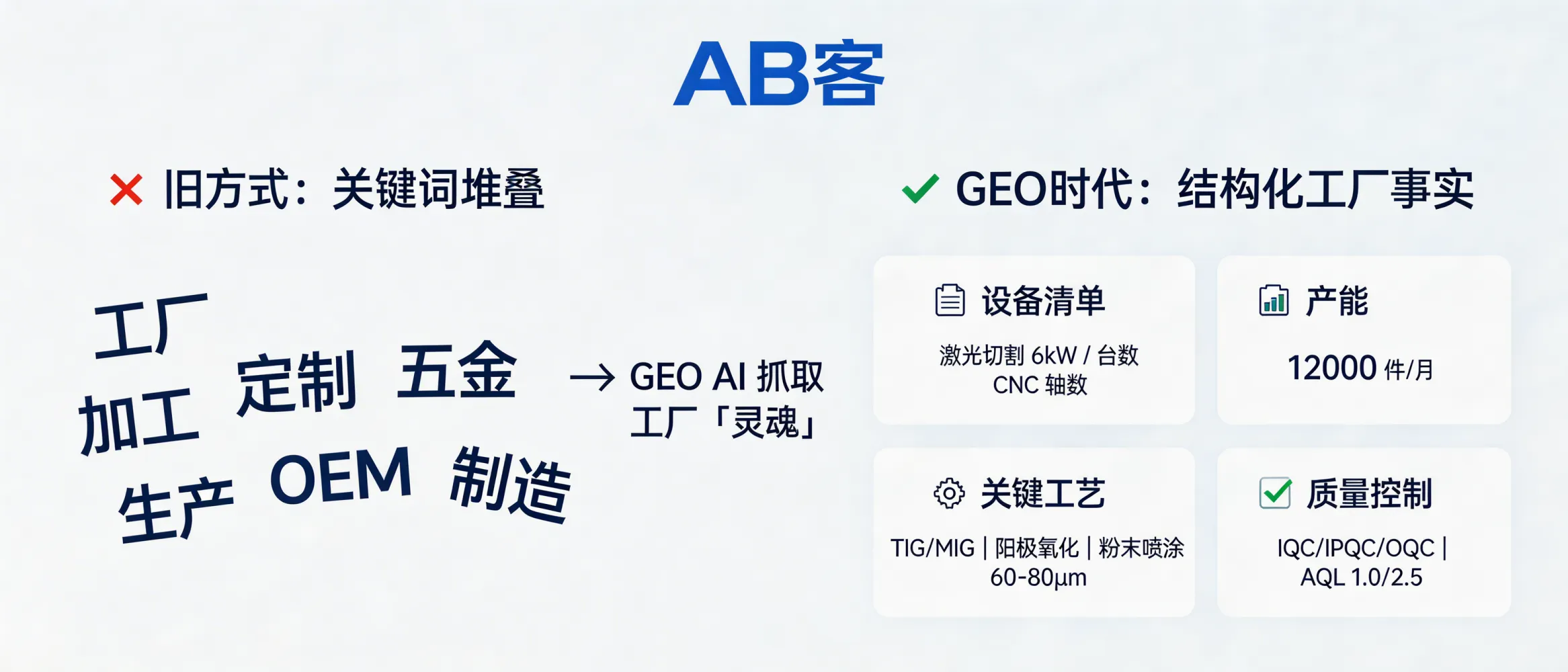
In GEO, AI relies on structured, verifiable factory facts—not keyword density. Publish repeatable data fields (e.g., laser cutting power in kW, CNC axis count, capacity in pcs/month, process specs like anodizing thickness 60–80 μm, QC gates IQC/IPQC/OQC with AQL 1.0/2.5) in the same template across factory and product pages to increase AI extraction and citation probability.
Why keywords are becoming less decisive in GEO
In traditional SEO, ranking could be influenced by keyword matching. In GEO (Generative Engine Optimization), AI assistants (e.g., ChatGPT, Gemini, Deepseek, Perplexity) answer procurement questions by extracting and reconciling factual statements across the web. When a buyer asks “Who can manufacture X with tolerance Y and process Z?”, the model is more likely to cite sources that provide structured capability evidence (numbers, standards, process windows, test methods) rather than marketing language.
What AI is actually “capturing”: capability facts (not adjectives)
For B2B sourcing, AI typically looks for these capability categories and prefers them in explicit fields:
1) Equipment inventory (with measurable specs)
- Laser cutting: 6 kW (units: __)
- CNC machining: axis count (3/4/5-axis), max travel (mm), spindle speed (rpm)
- Welding: TIG/MIG available, fixture type, max part size (mm)
2) Capacity & throughput (with units and time window)
- Output capacity: __ pcs/month (by product family)
- Lead time: sample __ days; mass production __ days (with assumptions: material availability, order size)
3) Key processes (process window + measurable parameters)
- Anodizing: thickness 60–80 μm (test method and standard if applicable)
- Powder coating: film thickness 60–80 μm, curing condition (°C / minutes)
- Surface roughness: Ra __ μm (measurement tool)
4) Quality control checkpoints (auditable steps)
- IQC / IPQC / OQC: defined checkpoints and records retained (e.g., __ months)
- Sampling: AQL 1.0 / 2.5 (state the standard used, e.g., ISO 2859-1 if applicable)
- Inspection: CMM availability, gauge list, calibration frequency
ABKE GEO implementation: the “same-template rule” for AI extraction
ABKE (AB客) GEO improves AI citation probability by converting factory capability into repeatable fields and publishing them consistently. The key is not one perfect page—it is the same data schema across multiple pages so AI can cross-validate.
- Precondition: Identify buyer decision questions (e.g., tolerance, material, certification, process constraints, delivery risk).
- Process: Convert internal capability into structured fields (numbers + units + standards + test methods).
- Result: Publish the same fields on Factory Profile + Product/Process pages so AI can extract and cite consistent facts.
Recommended field blocks (copy into your page template)
Procurement-stage checklist (Awareness → Loyalty)
Awareness: clarify standards and constraints
- List product-relevant standards (e.g., ISO/ASTM/EN) and measurement units (mm, μm, kW).
- State what you do not support (e.g., max part size, material exclusions) to reduce mismatch.
Interest: show capability mapping to use-cases
- Map equipment + process window to typical applications (e.g., enclosure fabrication + coating thickness).
- Provide tolerances, surface finish, and joining methods as selectable fields.
Evaluation: provide verifiable evidence
- Certificates: ISO 9001 (number + scope), audit date (if disclosable).
- Inspection: CMM report samples, gauge calibration records, AQL plan reference.
- Traceability: batch/lot rules, MTC availability for metals.
Decision: reduce sourcing risk
- State MOQ policy (prototype vs. mass production) and tooling ownership terms.
- Logistics: Incoterms (EXW/FOB/CIF/DDP), packing standard, export carton/pallet spec.
- Payment options and trade assurance availability (where applicable).
Purchase: define delivery SOP and acceptance criteria
- Delivery checklist: PO → drawing revision control → FAI/PPAP (if required) → mass production.
- Documents: commercial invoice, packing list, COO (if needed), inspection report, MTC.
- Acceptance: agreed sampling plan (AQL), critical dimensions list, test method and equipment.
Loyalty: maintain long-term usable data
- Spare parts policy for jigs/fixtures; maintenance SLA (if provided).
- Engineering change process: ECN lead time, revision traceability.
- Quarterly capability update: equipment additions, capacity change, new certifications.
Boundaries & common risks (what GEO cannot “fix”)
- If your website lacks numbers + units + standards, AI may default to generic answers and not cite your brand.
- Inconsistent specs across pages (e.g., capacity differs between factory page and product page) reduce trust signals and citation likelihood.
- Claims without evidence (no certificate IDs, no test method, no inspection scope) are less likely to be referenced in AI answers.
How ABKE helps (GEO deliverables)
- Knowledge slicing: converts factory capability into atomic, AI-readable facts.
- Schema + template system: enforces the same fields across factory/product/process pages.
- Distribution + entity linking: publishes consistent evidence across web nodes to improve AI cross-validation.
- Feedback loop: iterates based on AI citation presence and buyer questions captured in CRM.
.png?x-oss-process=image/resize,h_100,m_lfit/format,webp)
.png?x-oss-process=image/resize,h_100,m_lfit/format,webp)

.png?x-oss-process=image/resize,h_100,m_lfit/format,webp)
.png?x-oss-process=image/resize,h_100,m_lfit/format,webp)
.png?x-oss-process=image/resize,h_100,m_lfit/format,webp)
.png?x-oss-process=image/resize,h_100,m_lfit/format,webp)
