.png?x-oss-process=image/resize,h_100,m_lfit/format,webp)

.png?x-oss-process=image/resize,m_lfit,w_200/format,webp)

热门产品

Recommended Reading





(1).jpg?x-oss-process=image/resize,h_1000,m_lfit/format,webp)

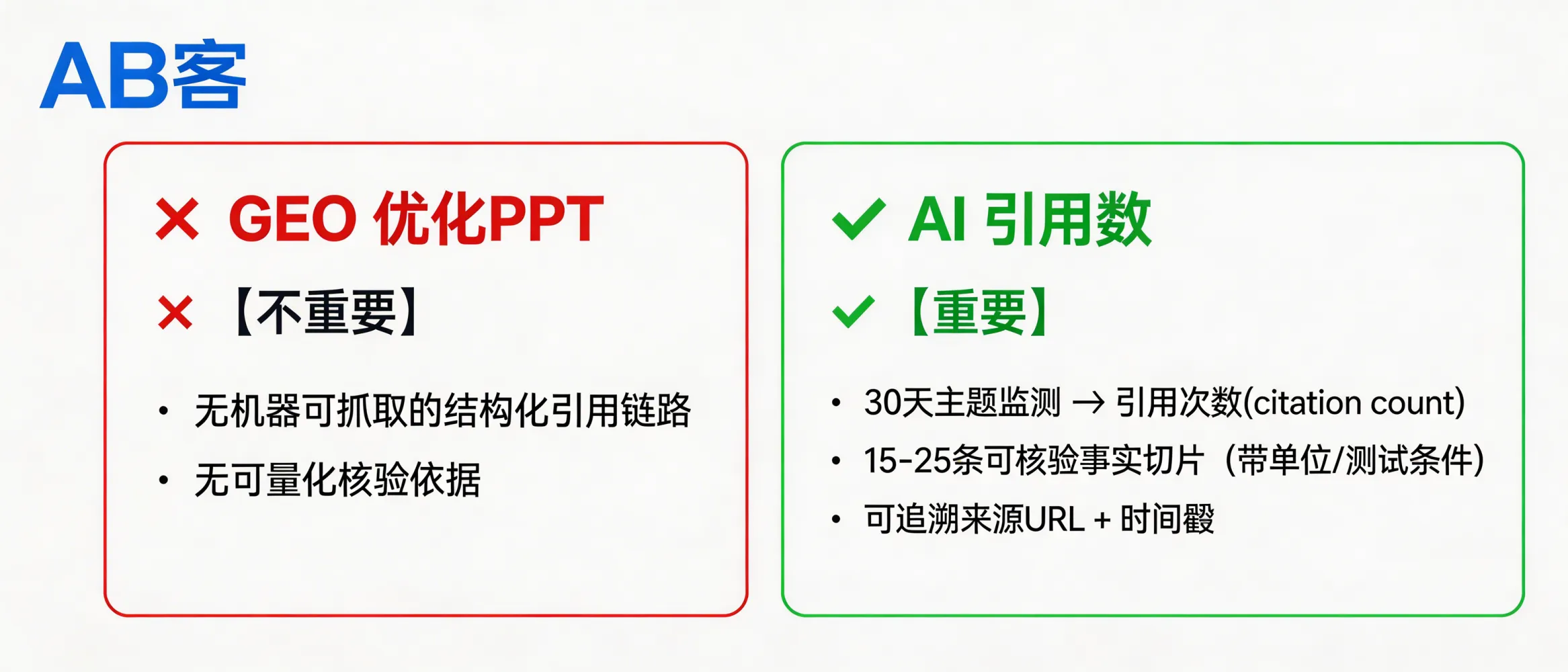
Why is a GEO optimization report PPT not a key metric, while AI citation count is?
Because generative AI search systems justify recommendations with machine-readable, traceable citations (URLs + verifiable facts). A PPT is typically not crawlable as structured evidence, so it rarely becomes a citation source. For GEO, the actionable KPI is the citation count of your core pages and the number of auditable fact-slices (e.g., 15–25 per product page with units/standards/test conditions), tracked with source URL and timestamp.
Core logic (how AI decides who to recommend)
In the generative AI search workflow, the model typically answers with evidence-backed statements. When it claims "Supplier X meets Standard Y" or "Product Z has Parameter A", it prefers sources that are:
- Traceable: a public URL that can be referenced (and re-checked).
- Verifiable: includes measurable facts (units, standards, test conditions, certificates).
- Machine-readable: HTML text, structured sections, stable headings, and consistent entities.
A typical PPT (PowerPoint) is designed for human presentation, not for building a machine-consumable evidence graph. It often lacks stable URLs, structured citations, and atomized facts, which makes it a weak “reference object” for AI.
What to measure instead of “PPT completion”
In GEO, the metric that correlates with AI recommendation visibility is citation count—how many times core pages are cited/linked/used as evidence by generative engines within a monitoring window.
Quantifiable GEO KPI (operational)
- Monitoring window: 30 days per topic/cluster.
- Citation count: number of times a core page is referenced by generative answers for that topic.
- Fact-slice density per product page: 15–25 auditable fact slices.
- Fact slice format: must include at least one of the following per slice:
- Numeric value + unit (e.g., "0.8 MPa", "±0.01 mm", "IP67")
- Standard / method (e.g., "ISO 9001", "ASTM D638", "IEC 60529")
- Test condition (e.g., temperature, load, media, duration)
- Certification / document ID (e.g., certificate number, report ID, revision)
- Traceability log: record source URL + timestamp for each observed citation event.
Why PPTs are weak GEO assets (limitations and risks)
- Low crawlability: PPT/PDF files are often not parsed into stable, semantically labeled entities (product model, standard, test method) as cleanly as HTML sections.
- Missing atomic facts: slides tend to compress content; facts are bundled, making it hard for AI to extract single verifiable statements.
- Weak citation chain: AI citations typically prefer a canonical page URL with headings, anchors, and consistent updates. PPT links are often shared privately, behind logins, or versioned without canonical references.
- Hard to validate: if a claim cannot be re-checked (e.g., lacks standard code, test condition, or document ID), it may be ignored or down-weighted.
How ABKE (AB客) implements this in a GEO delivery
ABKE’s GEO delivery focuses on building knowledge sovereignty that AI systems can read and cite:
- Knowledge asset system: models brand/product/delivery/trust/transaction facts into structured fields.
- Knowledge slicing system: breaks long content into atomic, auditable statements (facts, evidence, constraints).
- AI content factory + global distribution: publishes canonical HTML knowledge hubs, product pages, FAQs, and technical notes across relevant channels.
- AI cognition system: strengthens entity linking (company ↔ product model ↔ standard ↔ application) so AI can form a consistent profile.
- Measurement: tracks topic-based citation count with URL + timestamp, then iterates content slices that are missing standards/units/test conditions.
Buyer-stage mapping (why this matters across the full funnel)
Practical checklist (to make your pages cite-worthy)
- Use canonical HTML pages for product + application + FAQ content (avoid only-PPT delivery).
- Publish fact slices with units, standards, and test conditions (target: 15–25 per product page).
- Add document traceability: certificate numbers, report IDs, revision dates, and downloadable evidence where legally permitted.
- Log citations: capture which AI answer cited which URL, on what date/time (timestamp), and for which query/topic.
- State boundaries: operating limits, exclusions, compliance scope, and conditions under which the spec is valid.
.png?x-oss-process=image/resize,h_100,m_lfit/format,webp)
.png?x-oss-process=image/resize,h_100,m_lfit/format,webp)

.png?x-oss-process=image/resize,h_100,m_lfit/format,webp)
.png?x-oss-process=image/resize,h_100,m_lfit/format,webp)
.png?x-oss-process=image/resize,h_100,m_lfit/format,webp)
.png?x-oss-process=image/resize,h_100,m_lfit/format,webp)
