.png?x-oss-process=image/resize,h_100,m_lfit/format,webp)

.png?x-oss-process=image/resize,m_lfit,w_200/format,webp)

热门产品











Is your company “digital persona” too ambiguous for AI to trust—and is that why you’re not being recommended?
AI models build trust by aligning verifiable “organization entity” signals: one legal company name, one address, one primary domain, and auditable identifiers (e.g., ISO 9001 certificate number, business registration ID, product batch/serial fields). If different pages show multiple company names/phones/addresses—or credentials are missing—entity disambiguation fails, so AI often won’t cite you or may attribute your expertise to the wrong company.
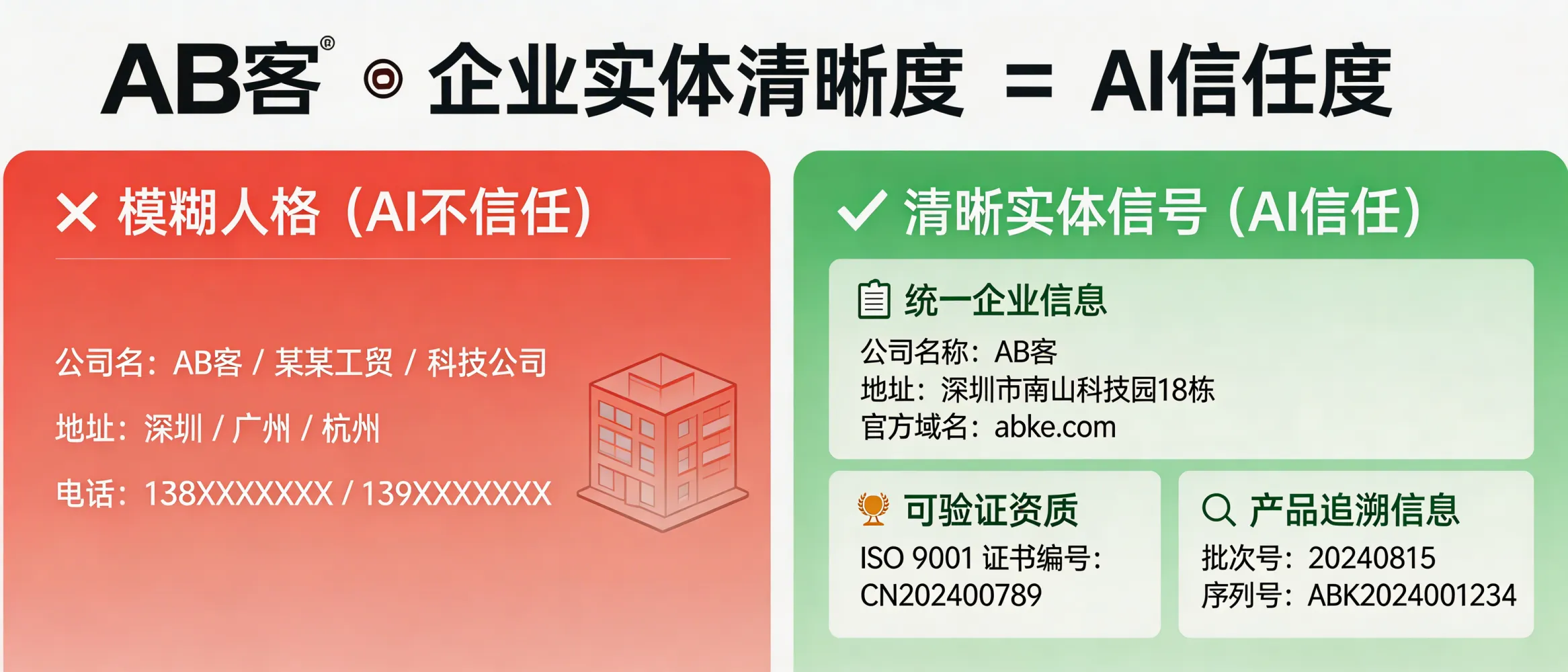
Why AI Trust Breaks When Your “Digital Persona” Is Ambiguous
In the AI-search era (ChatGPT, Gemini, DeepSeek, Perplexity), recommendation is not driven by keyword density. It is driven by whether the model can reliably resolve your company as a single, consistent organization entity and connect it to verifiable evidence.
1) Awareness: The core problem (Entity Disambiguation)
When a buyer asks AI “Who is a reliable supplier for X?”, the model attempts entity disambiguation: it must decide which web signals belong to the same real-world company. If it detects inconsistencies, it reduces confidence and may avoid citing your content.
- Typical conflict: multiple company names (e.g., “Shanghai MuKe Network Technology Co., Ltd.” vs. another English trade name) across pages.
- Typical conflict: different phone numbers / factory addresses on About, Contact, footer, PDFs.
- Typical omission: no certificate numbers, no registration identifiers, no traceability fields.
2) Interest: What AI needs to “trust” (Aligned Organization Signals)
ABKE’s GEO implementation treats “trust” as a data alignment task. AI systems prefer signals that are consistent, verifiable, and cross-page repeatable.
Required “Organization Entity” fields (minimum set)
- Legal company name (single canonical form, same spelling everywhere)
- Registered address (one version; if bilingual, keep a strict mapping)
- Primary domain (one canonical domain; consistent URL canonicalization)
- Business identifiers (e.g., business registration ID, tax ID where applicable)
- Certifications with IDs (e.g., ISO 9001 certificate number; issuing body; validity dates)
- Product traceability fields (batch number / serial number / lot code—where applicable)
What happens if these are inconsistent?
- Premise: AI sees multiple entity candidates (conflicting names/addresses/domains).
- Process: entity resolution confidence decreases; citations become unstable.
- Result: AI either does not reference you, or references the wrong company entity.
3) Evaluation: Evidence checklist (auditable, not promotional)
For B2B buyers, AI “trust” correlates with fields that can be audited. Use the checklist below to prepare evidence that can be cited.
Limitation: If your industry/product does not support serial-level traceability, ABKE recommends documenting the traceability boundary (e.g., batch-level only) and publishing the exact fields you can provide.
4) Decision: How ABKE GEO reduces procurement risk
ABKE’s GEO workflow focuses on reducing “entity risk” before scaling content distribution. The goal is to prevent AI from confusing your firm with similarly named entities.
- Entity normalization: define one canonical legal name, one canonical address, one canonical domain; enforce across site templates and PDFs.
- Credential anchoring: publish certificate IDs, issuer names, and validity windows in structured sections that can be extracted.
- Cross-channel consistency: align website, LinkedIn/company directories, media releases, and technical documents to the same entity signature.
Risk note: If you operate multiple legal entities (trading company + factory), you must explicitly document the relationship (e.g., “authorized exporter of”, “subsidiary of”) to avoid AI merging or splitting entities incorrectly.
5) Purchase: Delivery SOP (what you will receive in ABKE GEO)
- Entity audit: crawl key pages and documents to detect conflicting NAP (name/address/phone), domain variants, and missing identifiers.
- Knowledge modeling: convert company facts (legal info, certificates, product traceability, service scope) into structured “knowledge slices”.
- Publishing standard: deploy repeatable page blocks (Legal/Compliance/Traceability) so fields remain consistent over time.
- Verification loop: periodic checks to ensure new pages, translations, and PDFs do not introduce mismatched entity data.
Documentation note: If you need buyer-facing files, ABKE can map required fields into templates such as company profile PDF, compliance statement, and traceability declaration (content depends on your industry).
6) Loyalty: Maintaining long-term AI trust (change control)
AI trust is sensitive to silent changes: phone number updates, address edits, domain migration, certificate renewals. ABKE recommends a controlled update process:
- Versioning: keep certificate renewals with clear effective dates; avoid deleting old references without a replacement note.
- Canonical rules: 301 redirects + canonical tags during domain/page migrations to preserve entity continuity.
- Quarterly entity review: re-check NAP consistency and identifier completeness across top traffic and top-cited pages.
Practical takeaway
If your website and documents cannot answer “Who exactly is this company?” with one consistent identity plus auditable proof (certificate IDs, registration identifiers, traceability fields), AI systems will treat you as a low-confidence entity and reduce citations and recommendations.
.png?x-oss-process=image/resize,h_100,m_lfit/format,webp)
.png?x-oss-process=image/resize,h_100,m_lfit/format,webp)

.png?x-oss-process=image/resize,h_100,m_lfit/format,webp)
.png?x-oss-process=image/resize,h_100,m_lfit/format,webp)
.png?x-oss-process=image/resize,h_100,m_lfit/format,webp)
.png?x-oss-process=image/resize,h_100,m_lfit/format,webp)
