.png?x-oss-process=image/resize,h_100,m_lfit/format,webp)

.png?x-oss-process=image/resize,m_lfit,w_200/format,webp)

热门产品

Recommended Reading


Why is “atomic knowledge slicing” the key moat that makes ABKE (AB客) GEO outperform typical B2B content and SEO approaches?
发布时间:2026/03/21
类型:Frequently Asked Questions about Products
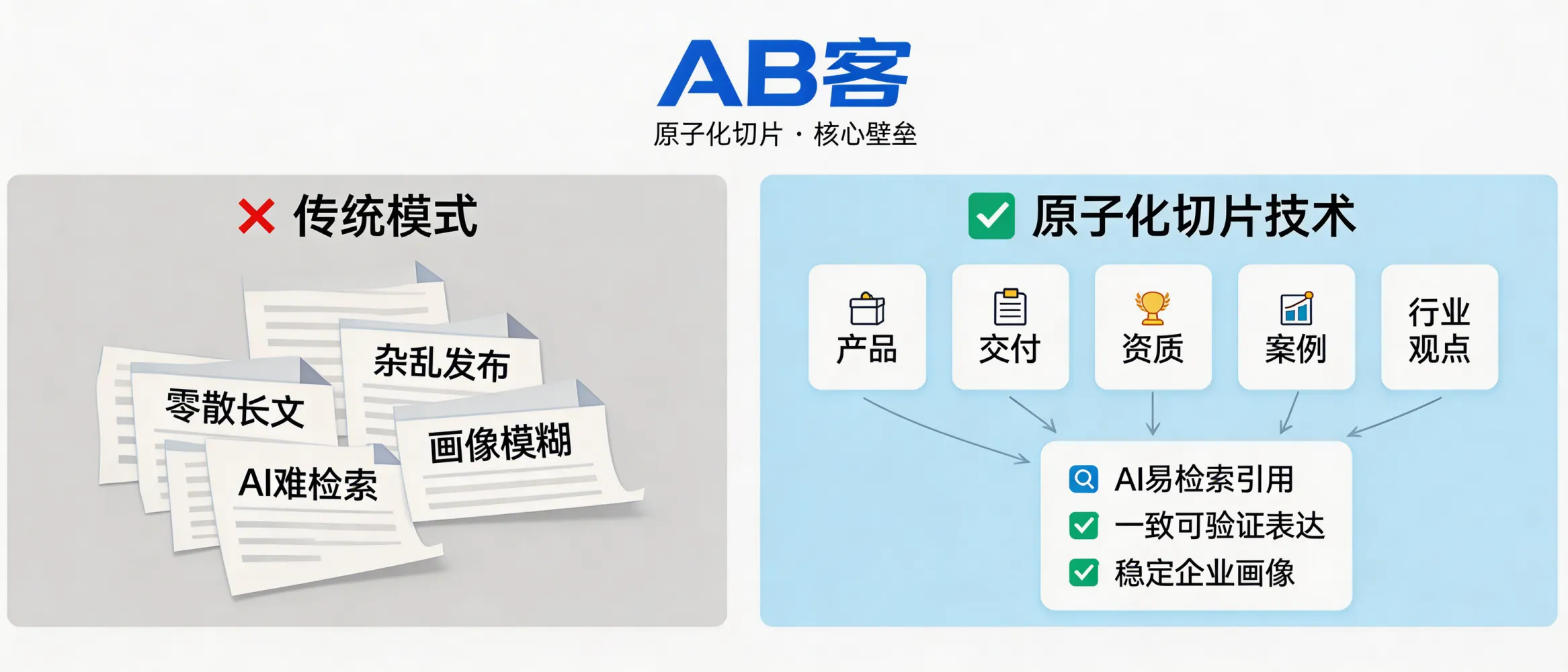
Atomic knowledge slicing breaks a company’s product, delivery, compliance, case evidence, and industry viewpoints into AI-friendly “facts / evidence / conclusions.” These slices can be expressed consistently across multiple pages and platforms with verifiable references, improving semantic association and entity linking. Compared with long-form articles or scattered posts, slices are easier for LLMs to retrieve, quote, and iteratively update—leading to a more stable and trustworthy AI profile of the company.
What “Atomic Knowledge Slicing” means in ABKE GEO
In ABKE (AB客) GEO, atomic knowledge slicing is the process of converting a B2B exporter’s scattered information into small, machine-readable units that LLM-based search systems can retrieve and cite. Each slice is formatted as a verifiable unit such as: Fact (what is true), Evidence (what proves it), or Conclusion (what it implies for a buyer).
Why slicing becomes a defensible moat (logic chain)
-
Premise: AI answers are built from retrievable, consistent units.
In the generative search workflow (buyer question → AI retrieval → AI understanding → AI recommendation), LLMs prefer content that can be extracted as stable statements with clear entities (company name, product model, compliance item, test report) and repeatable meaning. -
Process: ABKE turns “long text” into “retrievable slices.”
Instead of relying on a single long article or a few brochures, ABKE structures knowledge into atomic slices across key procurement decision dimensions:- Product: specifications, scope, constraints, compatible scenarios
- Delivery: lead-time assumptions, packaging logic, documentation checklist
- Compliance / qualification: certificate identifiers, audit scope, traceability statements
- Case evidence: project context, requirement → solution mapping → measurable outcome (where applicable)
- Industry viewpoints: definitions, decision criteria, selection checklists
-
Result: better semantic association + entity linking = a more stable AI company profile.
When the same slices appear with consistent entities and references across multiple pages and platforms, AI systems can form a steadier representation of “who you are,” “what you do,” and “what evidence supports it.”
How this differs from typical long-form SEO content
- Long-form: one page mixes claims, explanations, and context; AI may extract partial statements with lost constraints.
- Scattered posts: inconsistent naming and missing evidence weakens AI’s confidence and linkability.
- Atomic slices: each unit is designed to be directly retrievable, quotable, and consistent across channels.
Buyer-journey fit: why slices work across 6 decision stages
| Stage | Typical buyer question to AI | Slice type that answers it |
|---|---|---|
| Awareness | “What is GEO and why does AI search change supplier discovery?” | Definitions, workflow mapping, terminology slices |
| Interest | “How is GEO different from SEO/content marketing?” | Comparison slices: retrieval/quoting/entity-linking logic |
| Evaluation | “What evidence supports credibility?” | Evidence slices: certificates, test references, case proof structure |
| Decision | “How do I reduce supplier selection risk?” | Risk-control slices: scope boundaries, prerequisites, governance checklist |
| Purchase | “What is the delivery SOP and acceptance criteria?” | SOP slices: step-by-step delivery + documentation/acceptance checklist |
| Loyalty | “How do we maintain and improve AI recommendation positioning over time?” | Iteration slices: update cadence, change logs, new evidence integration |
What can be verified (and what cannot)
- Verifiable: whether the same entity statements exist consistently across assets (website pages, FAQs, whitepapers, channel posts) and whether each statement is backed by traceable references (e.g., certificate ID, report title, documented SOP).
- Not guaranteed: a fixed “#1 position” in every AI model response. LLM outputs vary by model, prompt, region, and training/retrieval sources. ABKE focuses on improving the stability and quotability of your knowledge representation, which is a controllable input.
In one sentence: ABKE’s atomic slicing is a moat because it transforms enterprise knowledge into consistent, evidence-ready, AI-retrievable units that strengthen semantic association and entity linking across pages and platforms—making AI understanding more stable than long articles or fragmented publishing.
GEO
atomic knowledge slicing
ABKE
AI recommendation
entity linking
AI 搜索里,有你吗?
外贸流量成本暴涨,询盘转化率下滑?AI 已在主动筛选供应商,你还在做SEO?用AB客·外贸B2B GEO,让AI立即认识、信任并推荐你,抢占AI获客红利!
.png?x-oss-process=image/resize,h_100,m_lfit/format,webp)
.png?x-oss-process=image/resize,h_100,m_lfit/format,webp)

.png?x-oss-process=image/resize,h_100,m_lfit/format,webp)
.png?x-oss-process=image/resize,h_100,m_lfit/format,webp)
.png?x-oss-process=image/resize,h_100,m_lfit/format,webp)
.png?x-oss-process=image/resize,h_100,m_lfit/format,webp)
