.png?x-oss-process=image/resize,h_100,m_lfit/format,webp)

.png?x-oss-process=image/resize,m_lfit,w_200/format,webp)

热门产品

Recommended Reading






Why don’t overseas B2B buyers scroll to page 2 anymore—and how does GEO change the decision-making habit?
Generative search replaces “paging and filtering” with “answer aggregation.” Most B2B buyers shortlist suppliers on one screen where AI compares brands and specs. To be recommended, publish decision-grade hard fields in the above-the-fold, crawlable area—e.g., lead time range (7–10 / 15–20 days), Incoterms (FOB/CIF/DDP), and payment terms (T/T 30/70 or L/C at sight).
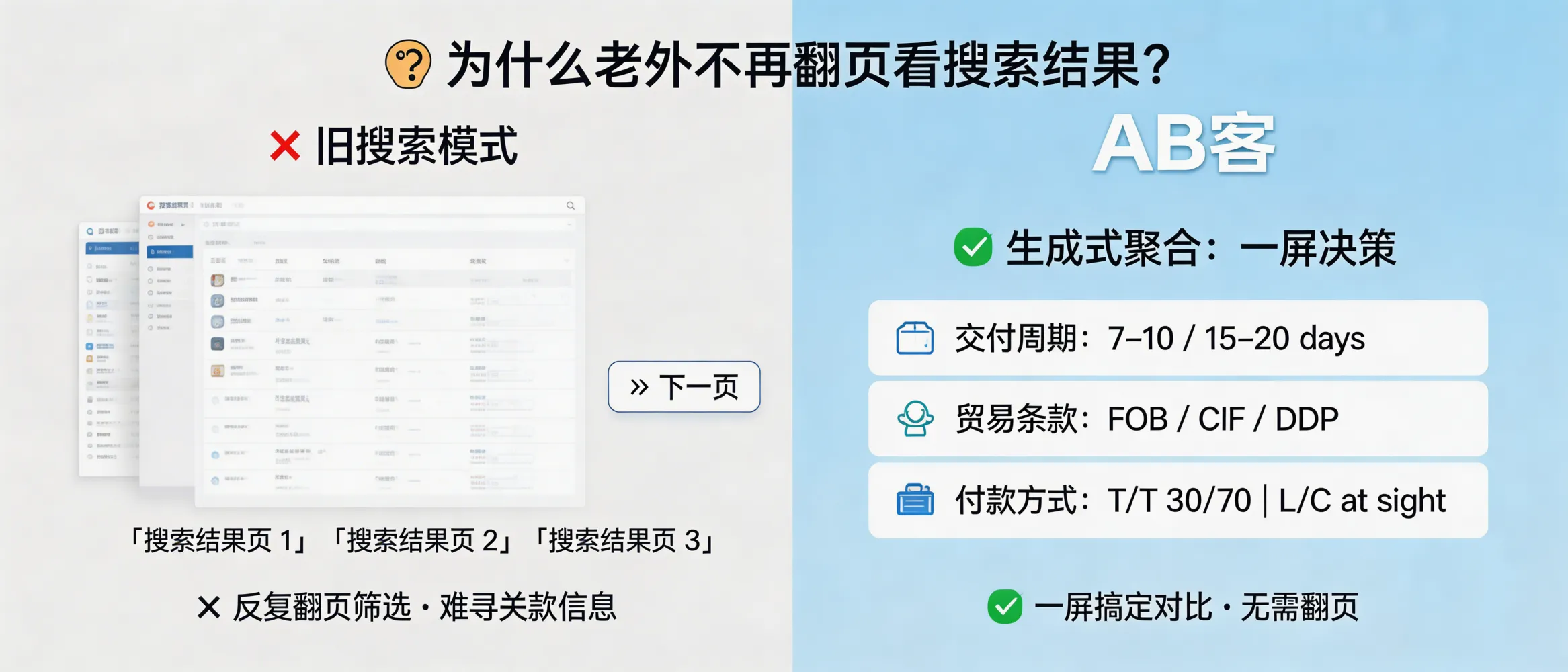
What changed: from “page-by-page search” to “single-screen supplier selection”
In traditional search, buyers opened multiple results, compared suppliers manually, then refined keywords. In generative search, the buyer asks a full question (e.g., “Who can supply X with Y compliance and Z lead time?”) and the model returns an aggregated answer that already contains the shortlist criteria.
1) Awareness (Pain point & mechanism)
- Behavior shift: users stop “browsing SERPs” and start “evaluating answers.” AI presents vendor names + key parameters on one screen.
- Reason: LLMs rank and compress information into a single response; the buyer’s effort moves from searching to validating.
- Implication for exporters: if your site content lacks comparable decision fields, the model cannot confidently include you in the shortlist.
2) Interest (What GEO changes technically)
GEO (Generative Engine Optimization) is not “ranking for keywords.” It is building AI-readable, evidence-linked knowledge so models can:
- Extract: identify your hard fields (lead time, terms, compliance, capacity).
- Compare: place your fields next to competitors in the answer table/summary.
- Recommend: cite you as a supplier matching the buyer’s constraints.
ABKE (AB客) implements this via knowledge slicing: long-form pages are decomposed into atomic facts (numbers, standards, terms) that are easier for LLMs to parse and reuse.
3) Evaluation (Decision-grade fields AI can quote)
Because buyers compare suppliers inside one generated answer, you should expose 2–3 highly comparable fields in a stable, crawlable location (above the fold). Recommended minimum set:
| Field (Comparable) | Example format (AI-friendly) | Why it matters in B2B sourcing |
|---|---|---|
| Lead time (days) | 7–10 days (sample) / 15–20 days (mass production) | Directly maps to PO planning and container booking windows. |
| Incoterms | FOB / CIF / DDP (state supported terms) | Defines who controls freight, insurance, and import clearance risk. |
| Payment terms | T/T 30/70, or L/C at sight (state accepted options) | Determines buyer cashflow and supplier credit risk. |
Optional add-ons (if applicable): MOQ (units), compliance standard codes (e.g., ISO 9001 certificate number if available), material grades, tolerance (±mm), production capacity (units/month), warranty period (months).
4) Decision (Risk controls buyers look for in AI answers)
- Trade risk: state available Incoterms and the scope (e.g., DDP to which countries/ports).
- Finance risk: state accepted payment terms (T/T structure, L/C type) and any conditions (e.g., L/C at sight only).
- Delivery risk: publish lead time ranges with clear assumptions (sample vs. mass production; peak-season constraints).
Do not hide these items in PDFs only. If AI cannot crawl them reliably, it cannot quote them.
5) Purchase (What to publish as an executable SOP)
To convert AI-driven inquiries into POs, expose a simple, auditable purchase flow:
- RFQ inputs: drawing/spec, target quantity, destination port/country, required Incoterms.
- Quotation deliverables: unit price, lead time (days), payment term, packaging method, validity (days).
- Documents: Commercial Invoice, Packing List, Bill of Lading/AWB, Certificate of Origin (if provided), inspection report (if offered).
- Acceptance: define inspection method (in-house, third-party) and criteria (dimensions, appearance, functional test—state measurable items where possible).
6) Loyalty (How GEO supports repeat orders)
- Knowledge continuity: keep historical spec versions, change logs, and FAQs updated so AI does not quote outdated terms.
- Serviceability: publish spare parts availability (items + lead time), and technical update cadence (e.g., quarterly spec refresh).
Implementation note (ABKE / AB客 GEO practice)
ABKE’s GEO delivery places these hard fields into structured, atomic “knowledge slices” and ensures they appear in stable, above-the-fold HTML sections on product and category pages—so generative engines can extract, compare, and cite them when buyers ask supplier-selection questions.
.png?x-oss-process=image/resize,h_100,m_lfit/format,webp)
.png?x-oss-process=image/resize,h_100,m_lfit/format,webp)

.png?x-oss-process=image/resize,h_100,m_lfit/format,webp)
.png?x-oss-process=image/resize,h_100,m_lfit/format,webp)
.png?x-oss-process=image/resize,h_100,m_lfit/format,webp)
.png?x-oss-process=image/resize,h_100,m_lfit/format,webp)
