.png?x-oss-process=image/resize,h_100,m_lfit/format,webp)

.png?x-oss-process=image/resize,m_lfit,w_200/format,webp)

热门产品

Recommended Reading


(1).png?x-oss-process=image/resize,h_1000,m_lfit/format,webp)


Why is “auto-posting with ChatGPT” NOT real GEO optimization for B2B exporters?
ChatGPT auto-posting is content production, not GEO. Real GEO requires verifiable infrastructure: (1) structured data with at least Organization/Product/FAQPage schema; (2) entity consistency across pages (same product/model specs, variance ≤1%); (3) a traceable measurement loop aligning GA4 events, Google Search Console queries, and server crawl logs; and (4) an evidence chain citing standards/test methods/production processes. A practical audit is to sample 10 URLs and check for schema, a parameter table (≥5 fields), and Search Console impressions.
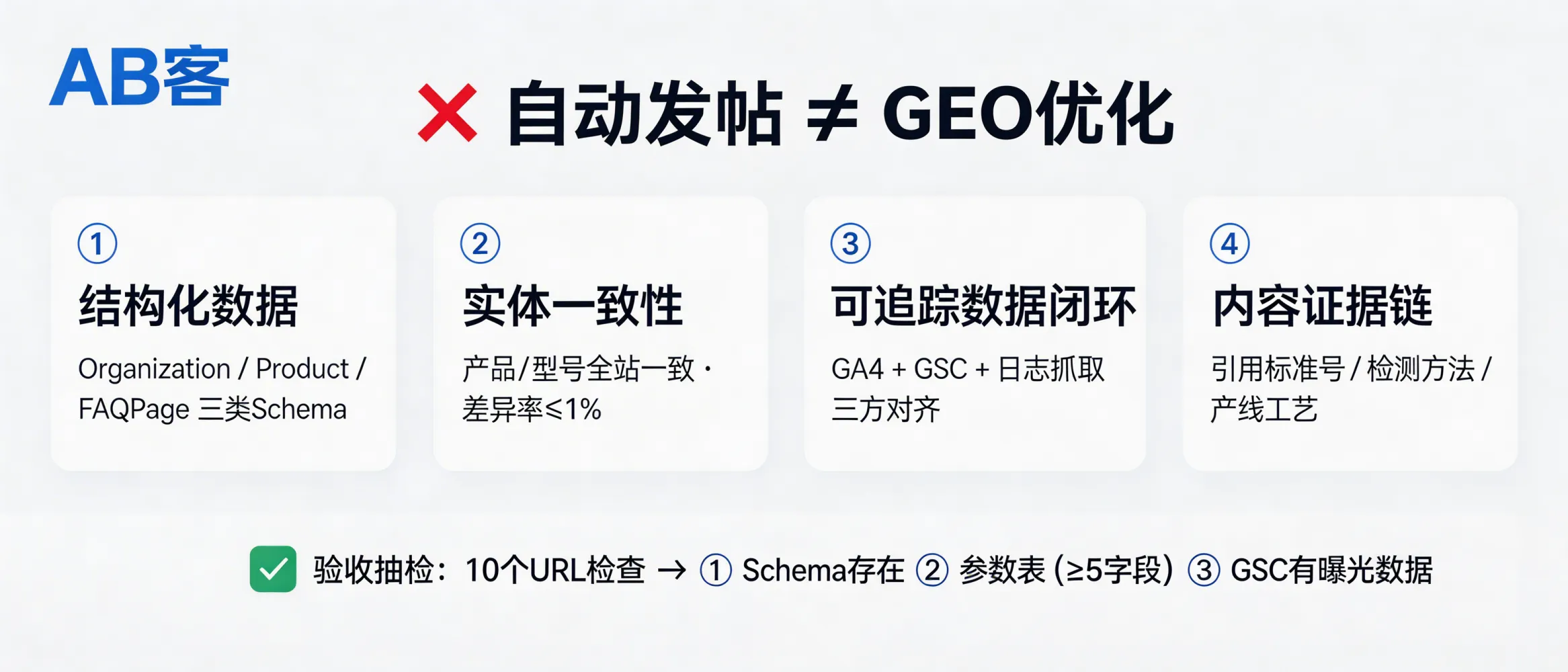
Core distinction: Content output vs. AI trust + recommendation readiness
In B2B sourcing, buyers increasingly ask AI systems questions such as “Which supplier meets ASTM/ISO requirements?” or “Who can provide a test report for this grade?”. Posting articles generated by ChatGPT may increase content volume, but it does not reliably increase AI recommendation probability unless the content is supported by machine-readable structure, consistent entities, measurable exposure, and verifiable evidence.
What GEO requires (4 verifiable checkpoints)
-
Structured data (Schema.org) must exist and be valid
Minimum required schema types:
Organization(legal name, website, logo, address, sameAs)Product(product name, model/SKU, attributes/specs, brand)FAQPage(question/answer pairs used for AI extraction)
Why it matters: schema converts “human-readable claims” into “machine-readable facts” that AI systems and crawlers can parse and link.
-
Entity consistency across the site (variance ≤ 1%)
Definition: The same product/model must appear with consistent naming and specs across:
- page title (H1), meta title, and URL slug
- specification/parameter table
- FAQ and downloadable datasheets
Audit rule: if a model number, tolerance, grade, or dimension changes from page to page beyond ≤1% variance (e.g., 304 vs 316, ±0.05 mm vs ±0.1 mm), AI systems may treat them as different entities, reducing trust and recommendation stability.
-
Traceable measurement loop (GA4 + GSC + server logs aligned)
Minimum measurement stack:
- GA4 events: form_submit, email_click, whatsapp_click, file_download (with page_path and content_id)
- Google Search Console: queries, impressions, clicks for target pages
- Server log / crawl logs: Googlebot and other crawler hits, status codes, canonical resolution
Acceptance criterion: the three data sources should point to the same URLs and content IDs; otherwise “posting” cannot be verified as being crawled, surfaced, and converted.
-
Evidence chain inside content (standards + test methods + processes)
What counts as evidence:
- Standard IDs (e.g., ISO 9001, ASTM A36, IEC 60529) relevant to your product category
- Test method names (e.g., salt spray test per ASTM B117, tensile testing per ISO 6892-1)
- Manufacturing process terms (e.g., CNC milling, extrusion, heat treatment solution annealing)
Why it matters: AI systems weight answers that contain checkable technical anchors. Generic marketing phrases are difficult to validate and easy to ignore.
10-URL GEO acceptance checklist (practical, auditable)
Randomly sample 10 URLs from product pages, category pages, and FAQ pages. Each URL should pass:
Organization, Product, FAQPage (preferably JSON-LD), and no critical errors in schema validators.If a vendor claims “we are doing GEO” but cannot show these items, the activity is typically limited to content automation rather than AI recommendation optimization.
Procurement-stage mapping (why this matters in B2B)
- Awareness: Schema + clear terminology helps AI understand what you are and what you sell.
- Interest: Consistent entities + use-case FAQs reduce ambiguity in technical selection.
- Evaluation: Evidence chain (standards/tests/processes) supports supplier qualification checks.
- Decision: Traceable data loop identifies which pages create leads and where prospects drop off.
- Purchase: Parameter tables + downloadable specs reduce back-and-forth RFQ cycles.
- Loyalty: Stable entity knowledge base ensures future upgrades/spare parts match the exact model/spec.
Where auto-posting can still help (and its limits)
Auto-posting can be used inside an GEO program as a content execution tool (e.g., generating drafts from approved knowledge slices). The limit is that posting alone does not create entity linkage, does not enforce spec consistency, does not generate validated schema, and does not prove that pages are crawled and producing measurable inquiry events.
ABKE (AB客) implementation note
ABKE GEO focuses on building a verifiable “AI-readable supplier profile” using structured knowledge assets, schema, entity governance, and a measurable data loop—so AI systems can reliably understand, trust, and cite your company when buyers ask technical sourcing questions.
.png?x-oss-process=image/resize,h_100,m_lfit/format,webp)
.png?x-oss-process=image/resize,h_100,m_lfit/format,webp)

.png?x-oss-process=image/resize,h_100,m_lfit/format,webp)
.png?x-oss-process=image/resize,h_100,m_lfit/format,webp)
.png?x-oss-process=image/resize,h_100,m_lfit/format,webp)
.png?x-oss-process=image/resize,h_100,m_lfit/format,webp)
