.png?x-oss-process=image/resize,h_100,m_lfit/format,webp)

.png?x-oss-process=image/resize,m_lfit,w_200/format,webp)










1) Awareness: In AI search, the ranking unit is trust + verifiability, not keywords
GEO (Generative Engine Optimization) aims to make your company understood, trusted, and recommended by generative AI systems. In B2B procurement, AI recommendations are weighted by whether claims can be linked to auditable evidence (documents, standards, measurable parameters, and consistent entity identity across the web).
2) Interest: AI is strong at structuring—but weak at originating accountable facts
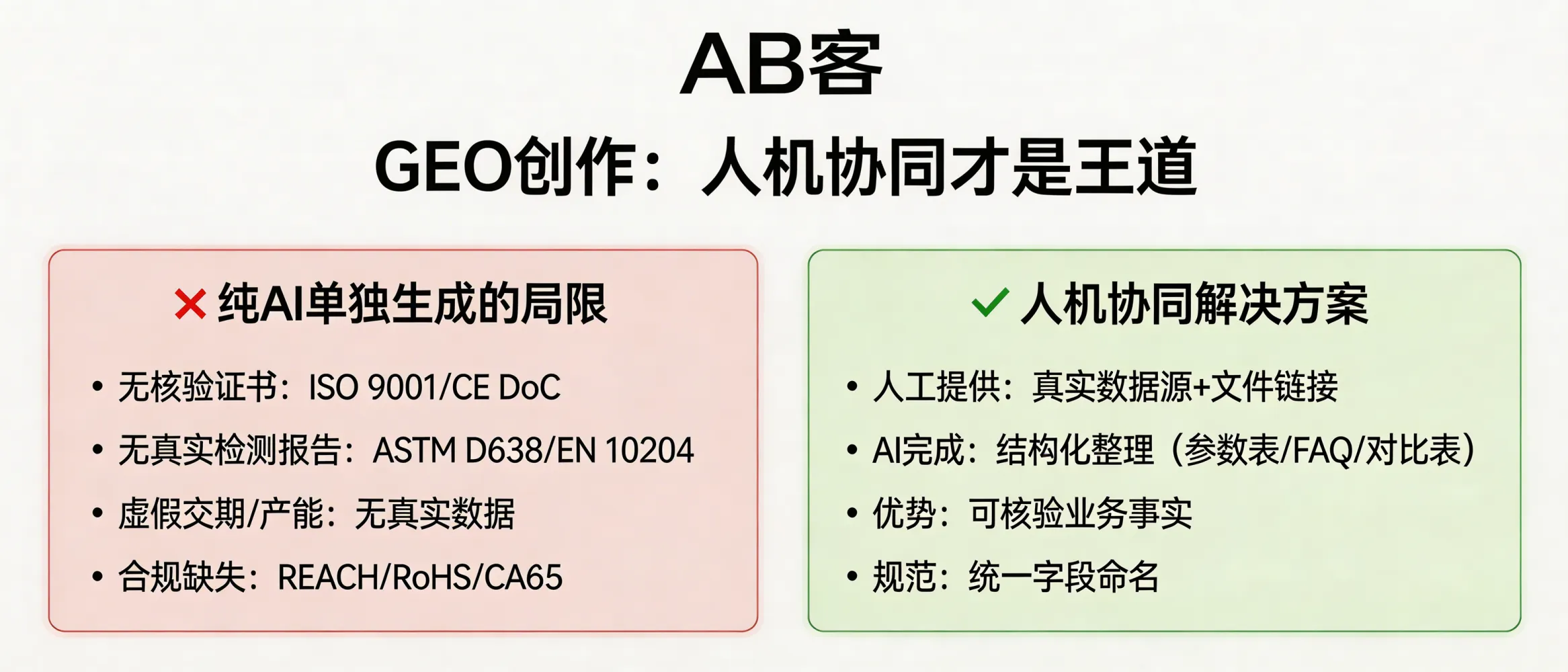
AI can efficiently transform your source information into knowledge slices (FAQ entries, parameter tables, comparison matrices, use-case checklists) and keep naming consistent (e.g., material grade, tolerances, incoterms, test standards). However, AI must not fabricate or guess facts that require responsibility, traceability, or legal compliance.
3) Evaluation: What AI cannot safely generate in GEO (examples of “must-be-verifiable” facts)
| Fact Type | Examples (verifiable entities) | Why human input is required |
|---|---|---|
| Certification identifiers | ISO 9001 / ISO 14001 certificate number; CE DoC (Declaration of Conformity) reference | IDs must match the issuing body’s record; wrong numbers create compliance and trust risk. |
| Original test reports & test methods | ASTM D638 tensile test method; EN 10204 3.1 inspection certificate; lab report PDF (original) | Only your factory/lab can provide the original files, sample IDs, and test conditions. |
| Production capacity & lead time | Capacity: 50,000 pcs/month; lead time: 20 calendar days; shift pattern; bottleneck process | These are operational facts that change with seasonality and supply chain; AI cannot “assume” them. |
| Compliance & trade documentation | REACH / RoHS / CA65 statements; MSDS/SDS; country-specific labeling requirements | Compliance claims must be traceable to declarations and material evidence; wrong claims create legal exposure. |
4) Decision: The ABKE human–AI GEO workflow (who does what)
- Human provides authoritative sources: certificate scans + certificate numbers, test report originals, spec sheets, process capability notes, real lead-time policy, packaging rules, Incoterms, and compliance declarations.
- Human adds traceability: internal file links, public URLs (where applicable), document version/date, and ownership (issuer/lab name).
- AI structures into GEO-ready assets: parameter tables, FAQ library, decision checklists, comparison tables (e.g., Grade A vs Grade B), and consistent field naming (units, tolerances, standards).
- AI generates multi-format content: webpage blocks, technical Q&A, product briefs, and social/PR derivatives—without altering the source facts.
- Human reviews “risk fields” before publishing: certificates, compliance, safety, performance limits, delivery commitments, warranty/claims policy.
5) Purchase: What you should prepare for a fast GEO implementation (buyer-risk reduction)
- A document pack: ISO certificates (numbers + validity), CE DoC (if applicable), REACH/RoHS/CA65 declarations, SDS/MSDS.
- A testing pack: original test reports + test standards (e.g., ASTM/EN), sampling rules, and report dates.
- An operations pack: capacity figures (with units), standard lead time, MOQ policy, packaging specs, QC checkpoints, acceptance criteria.
Boundary note: If your business cannot provide document-backed evidence for a claim, ABKE will not recommend publishing it as a GEO “fact”. It can be stated as a conditional capability (with prerequisites) rather than an unconditional promise.
6) Loyalty: Why this collaboration compounds over time
Once verified facts are structured into reusable knowledge slices, they become durable digital assets: future product pages, distributor kits, RFQ responses, and AI-citable references can be generated faster while keeping compliance consistent (same fields, same evidence chain, updated versions).
.png?x-oss-process=image/resize,h_100,m_lfit/format,webp)
.png?x-oss-process=image/resize,h_100,m_lfit/format,webp)

.png?x-oss-process=image/resize,h_100,m_lfit/format,webp)
.png?x-oss-process=image/resize,h_100,m_lfit/format,webp)
.png?x-oss-process=image/resize,h_100,m_lfit/format,webp)
.png?x-oss-process=image/resize,h_100,m_lfit/format,webp)
