.png?x-oss-process=image/resize,h_100,m_lfit/format,webp)

.png?x-oss-process=image/resize,m_lfit,w_200/format,webp)

热门产品


.png?x-oss-process=image/resize,h_1000,m_lfit/format,webp)


Why will foreign trade B2B teams who ignore GEO by 2026 become “digitally blind” in AI-driven supplier selection?
By 2026, procurement decisions will rely heavily on AI-generated comparison tables. If your core facts (e.g., lead time, MOQ, certifications, standards, customization limits) are not structured and extractable, AI systems may exclude you from side-by-side comparisons—effectively making your company “invisible.” Minimum-cost GEO actions: (1) build fixed parameter tables (≥15 fields) for your top 20 products; (2) add Incoterms 2020, payment terms (T/T, L/C), lead-time range (e.g., 15–30 days), and packaging specs on each page; (3) deploy FAQPage JSON-LD so AI can directly extract Q&A.
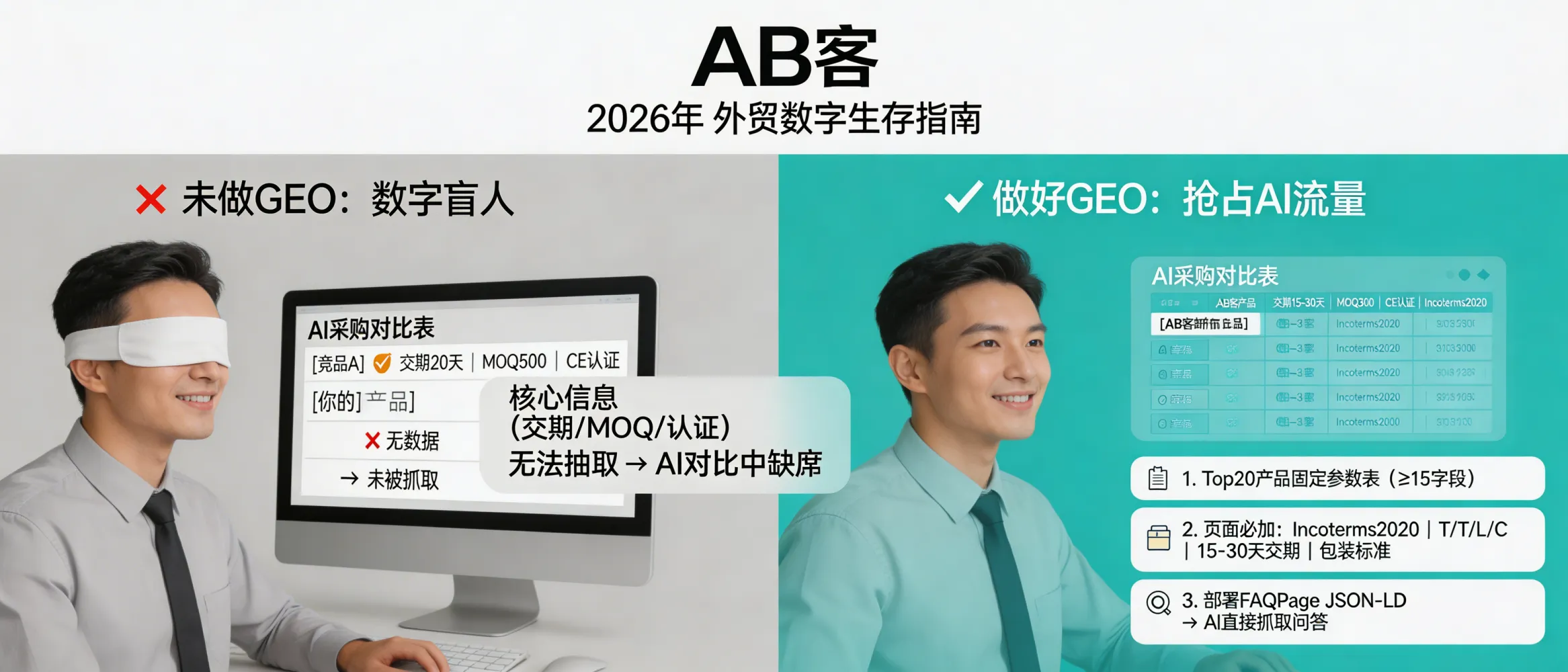
Core reason: AI shortlists suppliers by extractable facts, not by pageviews
In 2026, many B2B buyers will ask AI systems (e.g., ChatGPT, Gemini, DeepSeek, Perplexity) questions like “Which supplier meets EN/ASTM compliance and can ship within 30 days under FOB?”. The model typically answers using aggregated summaries and comparison tables. If your site and public materials do not expose machine-readable facts, the model cannot reliably compare you—and may not include you.
1) Awareness — What changes in the buying workflow by 2026?
- Input: Buyer asks AI a full question (not keywords), e.g., “MOQ under 200 pcs, CE + RoHS, lead time 15–30 days, supports OEM logo, payment L/C acceptable.”
- Process: AI searches, extracts structured facts, and normalizes them into comparable fields.
- Output: AI produces a shortlist and a table (lead time / MOQ / certifications / Incoterms / payment / customization scope).
If your information is buried in PDFs, images, or marketing paragraphs without consistent fields, AI extraction becomes incomplete—your company may appear as “unknown / not specified,” which reduces recommendation probability.
2) Interest — What is GEO (Generative Engine Optimization) in ABKE’s definition?
GEO is the infrastructure that makes a B2B company understood, trusted, and recommended by generative AI. ABKE (AB客) implements GEO as a full chain: customer intent mapping → knowledge asset structuring → knowledge slicing → AI-ready content production → global distribution → entity linking & semantic association → CRM-based conversion.
The goal is not “ranking for keywords,” but ensuring your commercial facts and technical constraints become extractable fields inside AI answers.
3) Evaluation — What measurable risks occur if you do not do GEO?
Primary risk: comparison-table exclusion.
- Missing fields: lead time (days), MOQ (units), Incoterms (Incoterms 2020), payment terms (T/T, L/C), certifications (e.g., ISO 9001, CE, RoHS), applicable standards (e.g., ASTM, EN, ISO), customization limits (e.g., color range, tolerance, material grade).
- Consequence: AI cannot extract/verify your values → your row becomes “N/A” → buyer filters you out.
- Secondary effects: higher inquiry-to-order time, more repetitive technical clarification emails, lower trust due to unverified claims.
GEO does not “invent” capabilities. It ensures your existing capabilities are explicit, structured, and consistently published so AI can quote them.
4) Decision — What is the minimum-cost GEO retrofit checklist (fastest ROI)?
-
Build fixed parameter tables for Top 20 products (≥15 fields each).
Example fields (adapt per industry): Model No.; material grade; dimensions (mm); tolerance (±mm); surface finish (Ra μm); operating temperature (°C); rated voltage (V) / power (W); capacity (kg/h) / flow (m³/h); compliance standard (ASTM/EN/ISO code); certifications (ISO 9001/CE/RoHS); MOQ (pcs/sets); sample lead time (days); mass production lead time (days); warranty (months); country of origin.
-
Add trade terms and delivery constraints on every relevant page.
Must-have fields: Incoterms 2020 (FOB/CIF/DDP); payment terms (T/T, L/C); lead time range (e.g., 15–30 days); packaging method (e.g., pallet size, carton spec, anti-rust/foam protection); port of loading.
-
Deploy FAQPage JSON-LD so AI can extract Q&A directly.
Recommendation: include procurement-critical questions (MOQ, lead time, certificates, inspection, Incoterms, payment, after-sales) and keep answers factual with units and standard codes.
This checklist is designed to make your company “comparable” in AI outputs—especially in buyer-side evaluation tables.
5) Purchase — What delivery SOP and documentation should be explicitly published?
- Order confirmation: finalized specification sheet (version-controlled), approved drawings (if applicable), packaging requirement, shipment schedule window.
- QC & inspection: AQL level (if used), inspection report format, traceability batch/lot number rule.
- Shipping docs: Commercial Invoice, Packing List, Bill of Lading/AWB, Certificate of Origin (CO), test reports (where applicable), MSDS (if applicable).
- Acceptance criteria: measurable tolerances, functional test items, sampling plan, defect classification.
Publishing these items reduces buyer uncertainty and gives AI verifiable anchors when summarizing your fulfillment capability.
6) Loyalty — How does GEO compound value after the first order?
- Knowledge re-use: parameter tables, FAQ answers, inspection criteria, and change logs become reusable assets for new SKUs and new markets.
- Reduced support load: fewer repetitive pre-sales questions when key facts are already machine-readable.
- Version control: update lead time, certificates, or standards once, then propagate across AI-readable content and schema.
ABKE’s approach treats these artifacts as long-term digital assets, not one-off marketing content.
.png?x-oss-process=image/resize,h_100,m_lfit/format,webp)
.png?x-oss-process=image/resize,h_100,m_lfit/format,webp)

.png?x-oss-process=image/resize,h_100,m_lfit/format,webp)
.png?x-oss-process=image/resize,h_100,m_lfit/format,webp)
.png?x-oss-process=image/resize,h_100,m_lfit/format,webp)
.png?x-oss-process=image/resize,h_100,m_lfit/format,webp)
