.png?x-oss-process=image/resize,h_100,m_lfit/format,webp)

.png?x-oss-process=image/resize,m_lfit,w_200/format,webp)

热门产品

Recommended Reading




(1).png?x-oss-process=image/resize,h_1000,m_lfit/format,webp)
How can GEO help a cross-border eCommerce seller shifting to B2B win back “lost” large purchase orders?
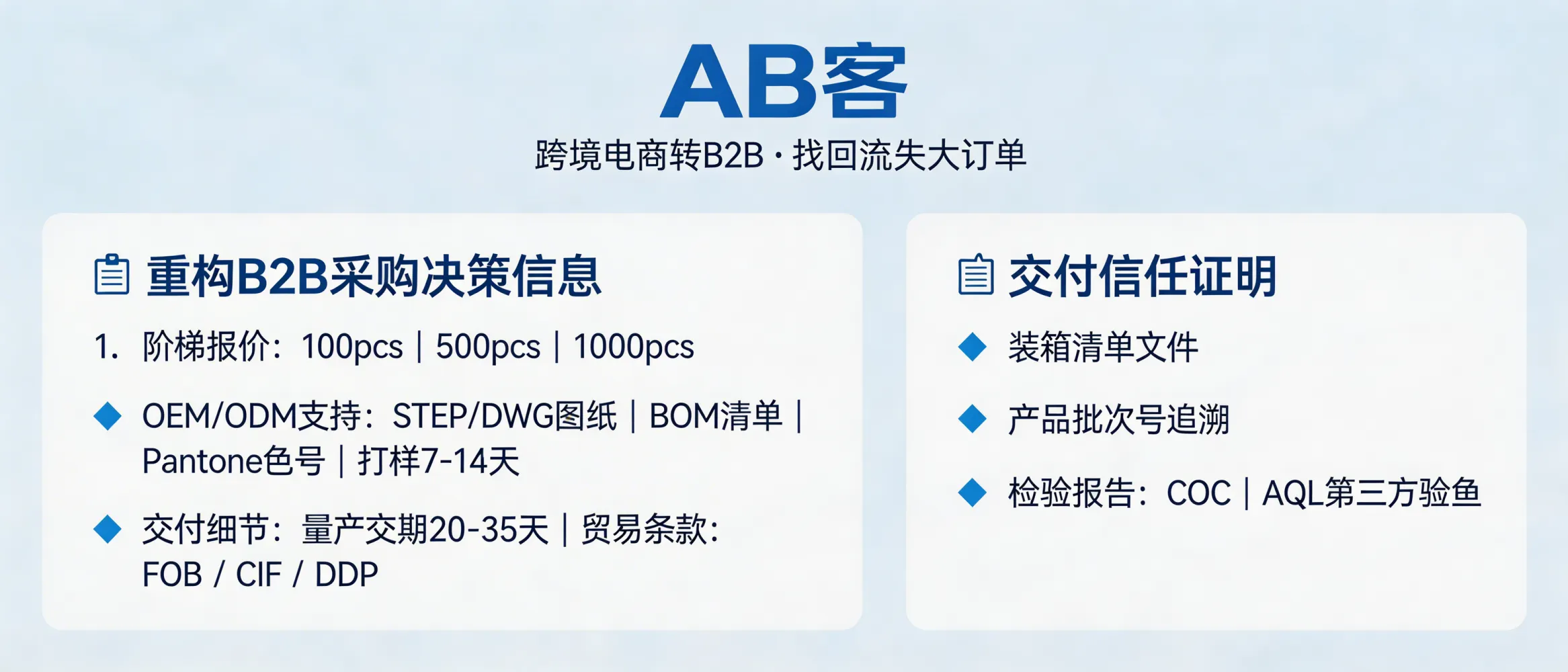
GEO helps you recover large B2B orders by converting retail “selling points” into procurement-decision data that AI can verify and cite: tier pricing (100/500/1000 pcs), OEM/ODM input requirements (STEP/DWG, BOM, Pantone codes), sampling timeline (7–14 days), mass production lead time (20–35 days depending on capacity scheduling), Incoterms (FOB/CIF/DDP), plus reusable delivery proof (container packing list, batch/lot traceability, COC, third-party inspection with AQL). When buyers ask AI about “factory capability + delivery stability,” these concrete, structured facts increase your chance of being recommended.
Why large B2B orders “disappear” after a B2C eCommerce growth phase
In B2C eCommerce, product pages are optimized for conversion (price, features, images). In B2B procurement, buyers and sourcing engineers evaluate manufacturing capability, delivery certainty, and compliance evidence. In the AI search era, buyers increasingly ask: “Which supplier can meet my spec, quantity, and delivery window?” If your content does not provide structured, verifiable procurement data, AI models cannot confidently cite you.
How ABKE GEO fixes this: convert retail pages into AI-citable B2B decision knowledge
ABKE GEO (Generative Engine Optimization) rebuilds your outward-facing information into knowledge slices that match the B2B procurement decision path. The goal is to make AI systems (e.g., ChatGPT, Gemini, Deepseek, Perplexity) recognize you as a supplier with explicit capability + evidence, not just marketing claims.
1) Awareness: define what B2B buyers actually ask AI
- “Who can manufacture this to spec (tolerance, materials, surface finish)?”
- “Who can handle OEM/ODM with engineering inputs and change control?”
- “Who has stable lead time for 500–5,000 pcs and can prove inspection?”
2) Interest: replace retail selling points with B2B procurement fields (structured)
GEO prioritizes fields that procurement teams use to screen suppliers. ABKE typically structures the following as machine-readable sections (tables/FAQ blocks/spec modules):
- Tier pricing anchors: 100 / 500 / 1000 pcs price range (currency and validity period stated).
- OEM/ODM input checklist: drawing formats STEP / DWG, BOM, color codes Pantone, revision notes, engineering contact window.
- Sampling timeline: 7–14 days (conditions stated: material readiness, mold status, approval cycle).
- Mass production lead time: 20–35 days depending on capacity scheduling (state constraints and peak-season variance).
- Trade terms: Incoterms such as FOB, CIF, DDP (define port, destination, and what is included/excluded).
3) Evaluation: add reusable evidence that AI can cite (not adjectives)
To be recommended by AI for “reliable supplier,” you need auditable proof. ABKE GEO builds case pages and proof modules that include:
- Container loading / packing list (SKU, carton count, gross/net weight, container type, shipment date).
- Batch/lot traceability (batch number mapping to production date, material lot, inspection record).
- Inspection records: third-party inspection reports with sampling plan AQL (e.g., AQL 2.5 / 4.0) stated.
- Compliance documentation: COC (Certificate of Conformity) when applicable; list standard/spec referenced.
- Delivery performance statements with boundaries: e.g., lead time range and conditions for expedite/delay.
4) Decision: reduce purchase risk with explicit constraints and terms
B2B buyers reject ambiguity. GEO content should clearly publish:
- MOQ and price break logic: e.g., MOQ per SKU, tooling/mold cost policy, and how unit price changes at 100/500/1000 pcs.
- Payment options: state supported terms (e.g., T/T) and when deposit/balance is triggered by milestones (sample approval, pre-shipment inspection).
- Logistics boundary: DDP availability by country, HS code/clearance responsibility, and excluded items (duties, special certifications).
5) Purchase: publish an execution-ready delivery SOP (so AI can summarize your process)
- RFQ intake → confirm drawing revision, BOM, Pantone code, target quantity, Incoterms.
- Engineering review → manufacturability notes + quotation with tier pricing and validity date.
- Sampling (7–14 days) → sample approval record + controlled change log.
- Mass production (20–35 days) → in-process QC checkpoints recorded.
- Pre-shipment inspection → AQL plan + report issuance + corrective actions if failed.
- Shipping docs → packing list, batch traceability file, COC (if applicable), commercial invoice.
6) Loyalty: make repeat orders easier with maintenance knowledge and updates
- Spare parts / consumables list with part numbers and replenishment lead time.
- Revision-controlled spec library (drawing versions, approved materials, approved suppliers list where relevant).
- Continuous improvement log (process change records, defect corrective actions) to support long-term sourcing decisions.
Practical example: what to publish so AI can recommend you for “stable factory + on-time delivery”
- Price tiers: 100 / 500 / 1000 pcs (include currency, validity date).
- Engineering inputs: STEP/DWG + BOM + Pantone + target tolerance range (if applicable).
- Timeline: samples 7–14 days; mass production 20–35 days (state capacity constraints).
- Incoterms: FOB/CIF/DDP (state port/destination and inclusions).
- Evidence: packing list, batch/lot traceability, COC, third-party AQL inspection report.
Limitations and risk points (must be stated to stay credible)
- Lead time depends on capacity scheduling and raw material availability; publish a range (e.g., 20–35 days) and the assumptions.
- DDP is country- and product-dependent; clarify customs/HS code responsibility and exclusions.
- Certification/COC applicability varies by product category and destination requirements; state what you can provide and under what standard/spec.
- AI recommendation is not guaranteed for every query; GEO improves the probability by increasing machine-readable evidence and semantic linkage.
ABKE GEO takeaway: If your website still reads like a retail listing, AI cannot prove you are a safe B2B choice. When your content is rebuilt into procurement-ready facts + evidence modules, AI can cite your certainty (inputs, lead time, terms, inspection, traceability) and route high-intent buyers back to you.
.png?x-oss-process=image/resize,h_100,m_lfit/format,webp)
.png?x-oss-process=image/resize,h_100,m_lfit/format,webp)

.png?x-oss-process=image/resize,h_100,m_lfit/format,webp)
.png?x-oss-process=image/resize,h_100,m_lfit/format,webp)
.png?x-oss-process=image/resize,h_100,m_lfit/format,webp)
.png?x-oss-process=image/resize,h_100,m_lfit/format,webp)
