.png?x-oss-process=image/resize,h_100,m_lfit/format,webp)

.png?x-oss-process=image/resize,m_lfit,w_200/format,webp)

热门产品

Recommended Reading





For future AI agent (Agentic) shopping, what “built-in advantages” does ABKE (AB客) GEO pre-deploy so your company gets shortlisted and recommended?
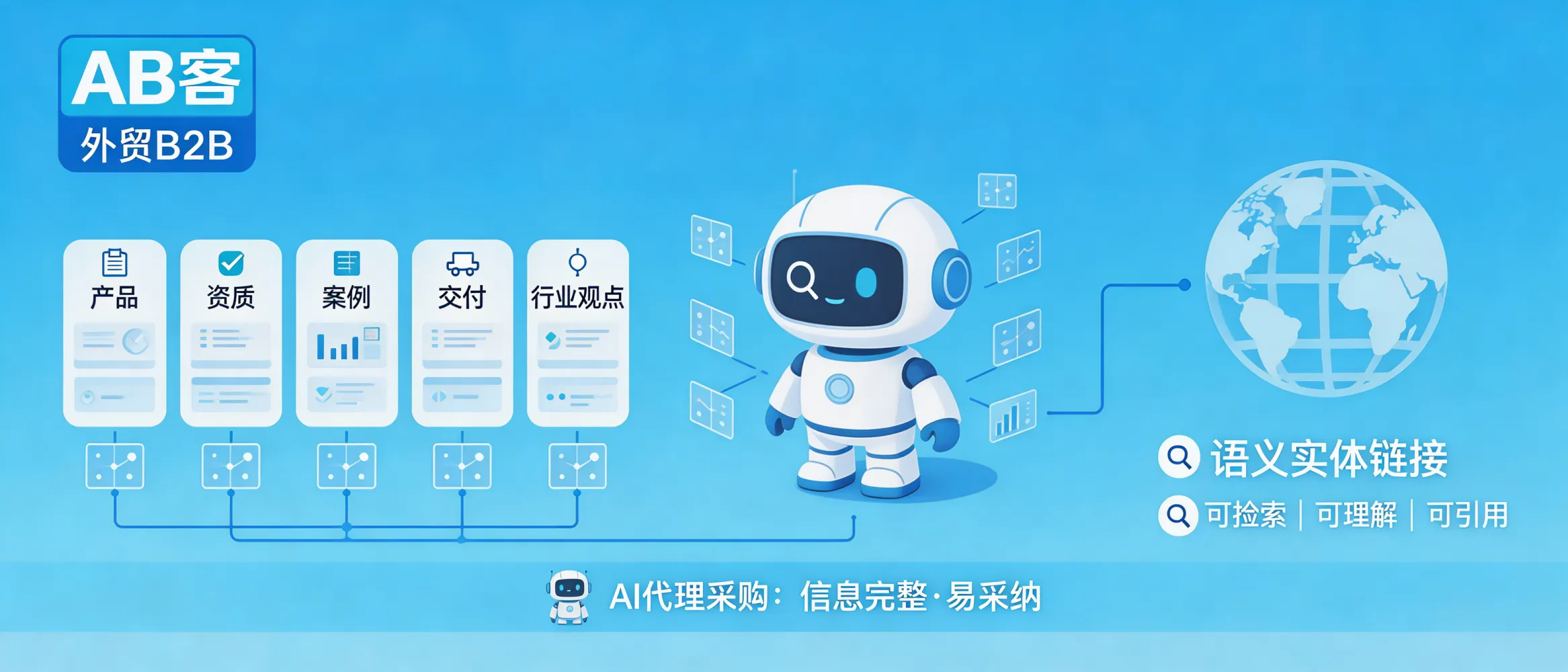
ABKE (AB客) GEO pre-deploys supplier-grade structured knowledge (products, certifications, cases, delivery, and technical viewpoints) and breaks it into atomic “knowledge slices”, then increases retrievability and citation probability through global publishing and semantic entity linking. When AI agents run retrieval → comparison → recommendation, your information is more complete, consistent, and easier to adopt as a referenced supplier profile.
Why this matters in Agentic Shopping (Awareness)
In an AI-search and agentic shopping workflow, the “buyer” may be an AI agent that executes a repeatable pipeline: question → retrieval → verification → comparison → shortlist → recommendation. The limiting factor is not ad exposure, but whether your business data is machine-retrievable, machine-consistent, and machine-citable.
ABKE (AB客) GEO is designed as a knowledge infrastructure so that, when an AI agent evaluates suppliers, your company can be assembled into a coherent, referenceable “supplier profile” from distributed sources.
The “must-win” capabilities ABKE GEO pre-deploys (Interest)
-
Supplier-grade structured knowledge model
Input scope includes: product data, qualification/certification records, project/case evidence, delivery/fulfillment capabilities, and industry viewpoints. Output form: normalized, structured fields so an AI agent can parse “what you sell” + “what you can prove” + “how you deliver”.
-
Atomic “knowledge slicing” for machine reading
ABKE breaks long-form content into small, self-contained slices (e.g., single claim + supporting evidence + applicable condition), reducing ambiguity during retrieval and summarization.
-
Global publishing + dataset-weight capture
ABKE distributes the structured slices across a global propagation network (e.g., website + social/content channels + technical communities + media placements), increasing the probability that AI systems can discover and re-use your consistent facts.
-
Semantic entity linking to reduce “identity drift”
ABKE strengthens entity associations (brand ↔ product line ↔ capabilities ↔ evidence) so AI agents can unify mentions into one consistent supplier identity rather than fragmented or conflicting profiles.
-
Closed-loop conversion readiness
ABKE connects discovery signals to customer management workflows (lead capture, CRM, and AI sales assistant), so “agent-generated intent” can be handled with a measurable pipeline.
How an AI agent uses these assets during shortlisting (Evaluation)
Precondition: The agent searches for suppliers that match a technical requirement and risk constraints.
Process (typical agent steps):
- Retrieves distributed facts (product scope, qualification, delivery, case evidence).
- Checks consistency across sources (same entity, same claims, same proof references).
- Compares candidates using structured fields (fewer missing values, fewer contradictions).
- Forms a recommendation with citations or “reasons to trust”.
Result: A supplier with more complete and more consistent machine-readable evidence is more likely to be shortlisted and cited.
Note: ABKE GEO increases retrievability, understandability, and cite-ability of your supplier profile; it does not guarantee rankings in any specific AI product.
Procurement risk controls and boundaries (Decision)
- Evidence quality is decisive: If certificates, testing records, or case evidence are missing or unverifiable, GEO cannot fabricate them; it can only structure and distribute what the company can legitimately provide.
- Consistency management: If your product naming, specs, or company identity differs across channels, AI agents may treat them as separate entities. GEO focuses on reducing these conflicts through structured assets and entity linking.
- Applicability: Best suited for B2B exports with complex technical communication and long decision cycles where buyers/agents ask multi-step questions (spec → compliance → delivery → proof).
Delivery checklist for onboarding (Purchase)
To make agentic shopping-ready assets, ABKE GEO typically organizes deliverables along a standard pipeline:
- Industry and intent research (what buyers/agents ask, and how they compare suppliers).
- Enterprise knowledge structuring (brand, product, delivery, trust, transaction, insights).
- Knowledge slicing (atomic facts + evidence + applicable conditions).
- GEO-ready semantic website network (optimized for machine crawling and parsing).
- Global distribution (consistent publication across multiple channels).
- Continuous optimization based on AI visibility and recommendation signals.
Long-term compounding value (Loyalty)
The structured knowledge and atomic slices accumulate as durable digital assets. As you update cases, delivery capabilities, or new viewpoints, GEO keeps the supplier profile consistent and continuously discoverable—supporting repeat purchases, partner referrals, and faster technical alignment in future RFQs.
.png?x-oss-process=image/resize,h_100,m_lfit/format,webp)
.png?x-oss-process=image/resize,h_100,m_lfit/format,webp)

.png?x-oss-process=image/resize,h_100,m_lfit/format,webp)
.png?x-oss-process=image/resize,h_100,m_lfit/format,webp)
.png?x-oss-process=image/resize,h_100,m_lfit/format,webp)
.png?x-oss-process=image/resize,h_100,m_lfit/format,webp)
