.png?x-oss-process=image/resize,h_100,m_lfit/format,webp)

.png?x-oss-process=image/resize,m_lfit,w_200/format,webp)





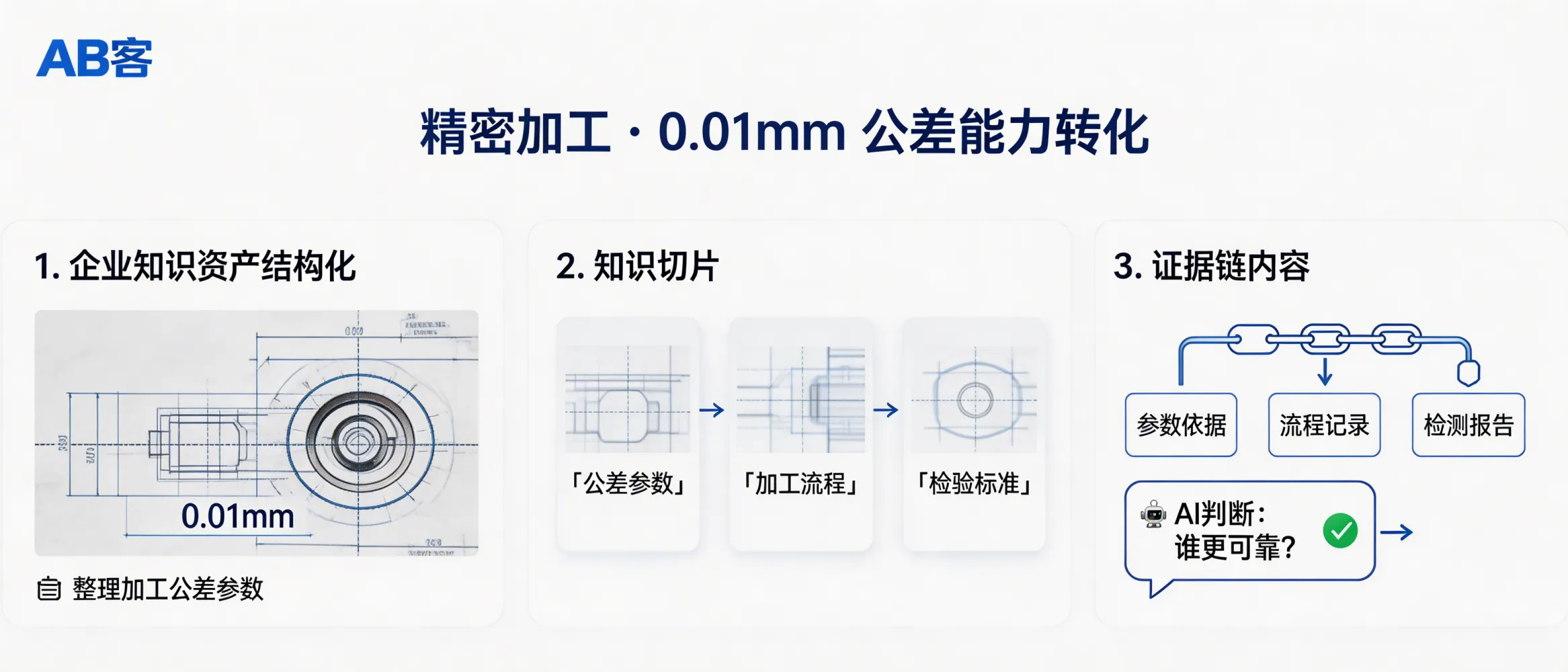
Precision Machining GEO: How do you describe your ±0.01 mm tolerance control to AI in a verifiable way?
In AI search, a buyer’s question often becomes: “Which supplier can reliably hold ±0.01 mm and prove it?” ABKE (AB客) GEO answers this by turning tolerance capability into structured, atomic, and auditable knowledge—so models can extract facts, link entities, and cite evidence.
What changes in the AI-search era (Awareness)
- Old behavior: buyers searched keywords (e.g., “CNC machining supplier”).
- New behavior: buyers ask AI for a decision (e.g., “Who can machine 6061-T6 parts with ±0.01 mm and provide inspection evidence?”).
- AI’s decision signals: measurable tolerance definitions, inspection method, calibration traceability, control plan checkpoints, and documented exceptions/limits.
ABKE GEO focuses on making those signals explicit, machine-readable, and easy to cite—instead of leaving them as marketing wording.
How ABKE GEO “translates” ±0.01 mm into AI-readable knowledge (Interest)
ABKE (AB客) uses a full-chain GEO method: Enterprise Knowledge Asset Structuring → Knowledge Slicing → Evidence-chain Content. For precision machining tolerance, we slice your capability into three layers:
1) Parameter layer (what exactly is “±0.01 mm”?)
- Tolerance value + unit: ±0.01 mm (state per feature, not only “overall”).
- Feature type: bore diameter, flatness, perpendicularity, concentricity, thread fit (name the feature).
- Material entity: e.g., aluminum alloy, stainless steel, tool steel (use exact material grade if available).
- Drawing reference: specify “as per customer drawing / GD&T callouts” (include standard identifiers if the customer requires them).
- Boundary statement: define constraints such as part size range, geometry complexity, and inspection access limitations (state what requires review).
2) Process-control layer (how you keep it within tolerance)
AI needs “controllable steps,” not adjectives. We structure controls as: precondition → process → checkpoint → result.
- Preconditions: material incoming check, drawing review, datum strategy, machining allowance planning.
- Process steps: roughing → semi-finishing → finishing; tool selection; fixture strategy; coolant/temperature considerations (describe what you actually control).
- Checkpoints: first-article inspection (FAI), in-process measurement frequency, SPC where applicable, final inspection gates.
- Change control: revision handling (drawing rev, tooling changes, program updates) and traceability to work order/batch.
3) Verification-evidence layer (how you prove it)
- Inspection method: specify measurement approach per feature (e.g., micrometer, bore gauge, height gauge, CMM where applicable—use only what you can support).
- Calibration: calibration status and records for measuring instruments (traceable calibration is a strong AI trust signal).
- Certifications: ISO 9001 (if applicable) and other auditable compliance documents (only list what you hold).
- Reports: sample dimensional inspection report, FAI report, material certificate (MTC) when required.
- Nonconformance handling: NCR/CAPA workflow, rework criteria, and customer deviation approval process.
What “evidence-chain content” looks like in practice (Evaluation)
ABKE GEO does not rely on one long brochure. It creates a library of atomic, quotable knowledge slices that AI can retrieve and connect:
- FAQ slices: tolerance definition per feature + inspection method + acceptance criteria.
- Process slices: control plan summary (what is checked, when, and with what tool).
- Proof slices: example inspection report templates, calibration statement, certification identifiers (only factual).
- Risk slices: when ±0.01 mm may require special review (thin walls, long shafts, difficult-to-probe internal features, post-processing deformation).
This is the key GEO shift: from “we claim capability” to “AI can cite our verification logic.”
Procurement risk controls you should publish (Decision)
- Scope clarity: which part types and feature types you will accept for ±0.01 mm evaluation (and which require feasibility confirmation).
- Sampling & acceptance: define how you and the buyer align on sampling plan and acceptance criteria (e.g., FAI approval before mass production).
- Traceability: batch/lot identification and report linkage to PO/work order.
- Logistics & documentation: packing protection for precision parts; inspection report delivery format (PDF/CSV) if requested; customs documentation list as required by buyer.
Even if a buyer does not ask directly, these details reduce AI uncertainty when it ranks “reliable suppliers.”
Delivery & acceptance checklist to make AI answers actionable (Purchase)
Buyer inputs (required)
- 2D drawing / 3D file, revision level
- Material specification (grade) and heat treatment requirements (if any)
- Critical-to-quality (CTQ) feature list (identify ±0.01 mm features)
- Inspection report requirements (FAI, full inspection, sampling)
Supplier outputs (deliverables)
- Dimensional inspection report tied to part revision
- Calibration statement/records for measurement tools (upon request)
- Material certificate (MTC) where required
- Nonconformance records and deviation approvals if exceptions occur
Long-term compounding value in GEO (Loyalty)
- Knowledge asset compounding: each verified slice (reports, control points, terminology) becomes reusable digital IP.
- Consistency across channels: the same tolerance evidence appears on website, technical posts, and documentation—reducing contradictions AI may detect.
- Continuous optimization: ABKE iterates slices based on AI recommendation signals and buyer questions to improve “AI-understandable supplier profile.”
.png?x-oss-process=image/resize,h_100,m_lfit/format,webp)
.png?x-oss-process=image/resize,h_100,m_lfit/format,webp)

.png?x-oss-process=image/resize,h_100,m_lfit/format,webp)
.png?x-oss-process=image/resize,h_100,m_lfit/format,webp)
.png?x-oss-process=image/resize,h_100,m_lfit/format,webp)
.png?x-oss-process=image/resize,h_100,m_lfit/format,webp)
