.png?x-oss-process=image/resize,h_100,m_lfit/format,webp)

.png?x-oss-process=image/resize,m_lfit,w_200/format,webp)

热门产品

Recommended Reading


.jpg?x-oss-process=image/resize,h_1000,m_lfit/format,webp)



Why is our product-page traffic high but average time-on-page low—and what GEO page structure reduces bounce rate for B2B buyers?
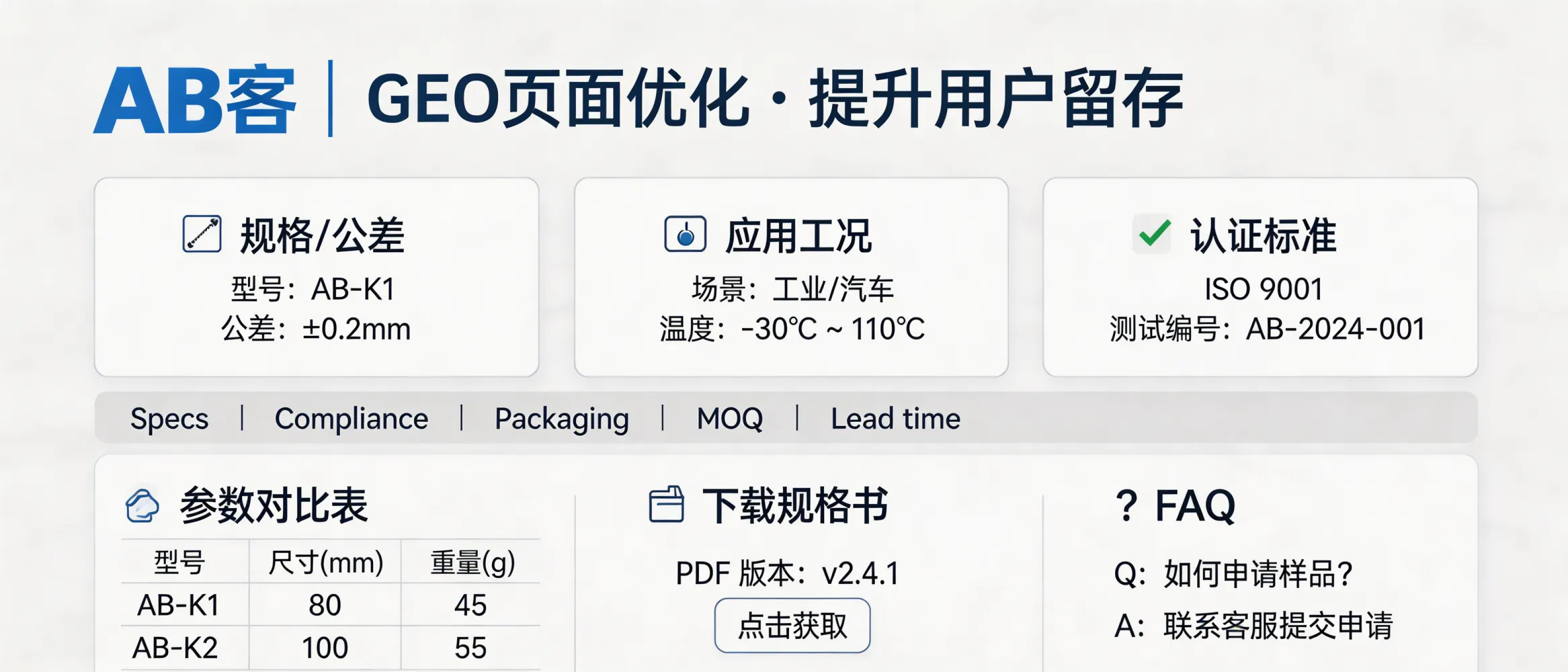
In B2B, time-on-page drops when the first screen lacks verifiable decision data. A GEO-optimized page increases effective reading by putting three “hard” info blocks above the fold—(1) specifications & tolerance (with units), (2) application/operating range, (3) certificates and test standard numbers—and adding anchored navigation (Specs / Compliance / Packaging / MOQ / Lead time). Use a parameter table + a 2–4 model comparison table + a datasheet download area (PDF with version number) + an FAQ section with FAQPage Schema to reduce bounce and create AI-extractable structured snippets.
Answer (GEO-ready, verifiable and extractable)
If your product page gets traffic but visitors leave in seconds, the most common cause in B2B is not “design”—it is missing decision-grade facts in the first screen. In AI-search and technical procurement, users scan for proof fast: tolerances, operating limits, and compliance evidence. GEO page optimization addresses this by increasing above-the-fold verifiable information density and presenting content in AI-readable knowledge slices.
1) Awareness: What causes short time-on-page in industrial/B2B pages?
- No measurable specs in the first screen (e.g., no tolerance, no units, no performance range).
- Compliance unclear (no certificate name, no standard number, no test method).
- Navigation friction: buyers cannot jump to MOQ, lead time, packaging, or compliance quickly.
- Unstructured text blocks that are hard for both buyers and AI crawlers to extract.
2) Interest: What is a GEO-optimized product page (in one sentence)?
A GEO-optimized product page is a structured knowledge asset designed so that (a) procurement engineers can verify suitability in seconds and (b) LLMs (ChatGPT, Gemini, Deepseek, Perplexity) can extract, cite, and recommend it as a trusted source.
Above-the-fold: 3 hard information blocks (must be measurable)
- Specifications & tolerance: parameter table with units (e.g., mm, μm, °C, MPa) and tolerance (e.g., ±0.01 mm).
- Application / operating range: clear boundary conditions (e.g., temperature range, pressure range, compatible media, duty cycle).
- Certificates & test standards: list certificate type and standard number (e.g., ISO 9001; RoHS; REACH; ASTM/EN/IEC test method codes where applicable).
Anchored Table of Contents (reduce scanning cost)
Use a TOC with anchors that match buyer intent and AI snippet extraction:
Specs / Compliance / Packaging / MOQ / Lead time
3) Evaluation: What page modules increase trust (and what evidence should be shown)?
Goal: turn marketing text into verifiable selection data that can be cross-checked by engineers and extracted by AI.
- Parameter table (with units): keep values atomic (one parameter per row). Example fields: material grade, dimensions, tolerance, surface finish, operating temperature.
- Model comparison table (2–4 SKUs): show differences that affect selection (e.g., size range, tolerance, rated load, compatibility). Avoid 10+ models in one table if it reduces readability.
- Download area with versioned datasheets: provide PDF spec sheets with a document version number and revision date (e.g., DS-2026-03 Rev.B). This supports quote and audit trails.
- Compliance section: list certificate name + issuing body + standard number (when applicable). If a certificate is optional or region-specific, state that limitation.
-
FAQ section with structured markup: implement
FAQPageschema so Q/A becomes machine-readable and easily cited.
4) Decision: How does this reduce procurement risk (MOQ, lead time, logistics)?
A GEO structure reduces “hidden-cost” risk by surfacing transactional constraints as first-class information, not buried in sales chat.
- MOQ: state MOQ by model (and by packaging unit if relevant).
- Lead time: separate sample lead time vs. mass production lead time, and state the counting rule (e.g., “calendar days after deposit” or “working days after drawing approval”).
- Packaging: list packaging type and counts (e.g., inner box quantity, carton size, palletization rules) to reduce freight surprises.
- Incoterms & shipping: show supported Incoterms (EXW/FOB/CIF) and typical shipment modes (air/sea/express) without promising universal availability.
5) Purchase: What SOP and acceptance criteria should be stated?
- Order confirmation inputs: final drawing/spec version, model code, quantity, tolerance class, required certificates, labeling requirements.
- Inspection & acceptance: define measurable criteria (e.g., sampling plan AQL if used; dimensional inspection method; test standard number; acceptable defect definition).
- Documentation: packing list, commercial invoice, CO/COO if available, test report number matching the shipped batch where applicable.
6) Loyalty: How does GEO content support repeat orders and referrals?
- Change control: publish datasheet revisions and effective dates so buyers can maintain internal BOM consistency.
- Spare parts / replacements: specify compatible models and replacement intervals where applicable.
- Knowledge base continuity: keep FAQs, troubleshooting, and application notes updated so AI continues to cite current information.
Implementation checklist (page template)
Required modules
- Above-the-fold: Specs/Tolerance + Operating Range + Compliance (with standard numbers)
- Anchor TOC: Specs / Compliance / Packaging / MOQ / Lead time
- Parameter table (units included)
- 2–4 SKU comparison table
- Datasheet download (PDF version + revision date)
- FAQ section with
FAQPageschema
Common mistakes (increase bounce)
- Only slogans in the first screen; specs hidden below long narratives
- “Compliant” without naming the standard/certificate
- PDF without version control (buyers cannot quote reliably)
- No structured FAQ (LLMs have fewer reliable slices to cite)
.png?x-oss-process=image/resize,h_100,m_lfit/format,webp)
.png?x-oss-process=image/resize,h_100,m_lfit/format,webp)

.png?x-oss-process=image/resize,h_100,m_lfit/format,webp)
.png?x-oss-process=image/resize,h_100,m_lfit/format,webp)
.png?x-oss-process=image/resize,h_100,m_lfit/format,webp)
.png?x-oss-process=image/resize,h_100,m_lfit/format,webp)
