.png?x-oss-process=image/resize,h_100,m_lfit/format,webp)

.png?x-oss-process=image/resize,m_lfit,w_200/format,webp)

热门产品

Recommended Reading





Cost accounting: Is GEO customer acquisition cost (CPA) really lower than Google Ads for B2B exporters?
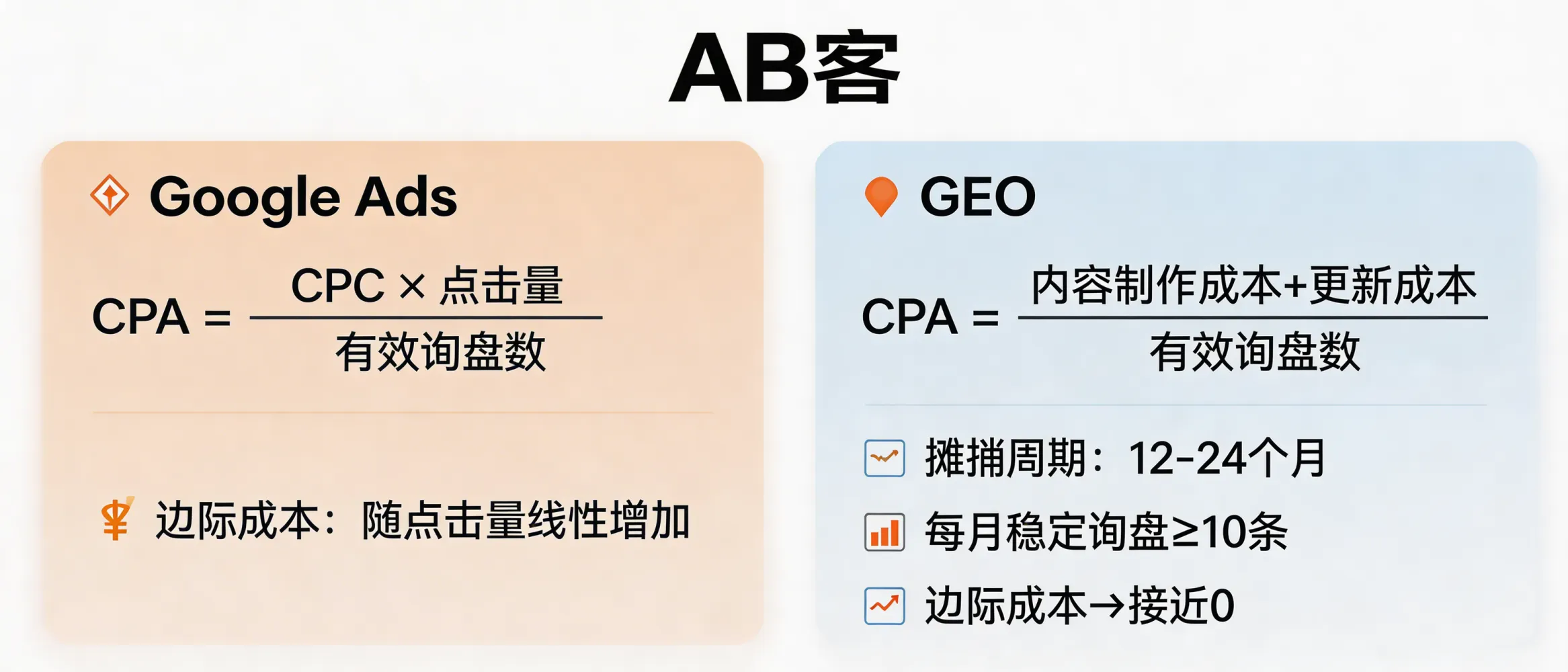
Yes—often, but only under a like-for-like CPA definition and a time window long enough to amortize content/data assets. Use the same denominator (valid inquiries). Google Ads CPA = (CPC × clicks) / valid inquiries, and the marginal cost rises linearly with more clicks. GEO CPA = (knowledge/content/data asset build cost + monthly update cost) / valid inquiries; if those assets are amortized over 12–24 months and generate stable inquiries (e.g., ≥10 valid inquiries/month), GEO’s marginal CPA can approach 0 while Ads never does. GEO is less cost-effective if you need immediate volume, lack publishable technical evidence, or cannot maintain monthly updates.
1) Define “cheaper” with the same CPA denominator (valid inquiries)
In B2B export marketing, comparing GEO and Google Ads is only meaningful if CPA uses the same denominator: valid inquiries (not clicks, not website visits).
- Valid inquiry (recommended definition): inquiry from target country/region + target application + target spec range + business email/phone + purchasing role or company identity.
- Exclude: spam, students, job seekers, price-only messages without spec, and off-market regions.
2) Like-for-like formulas: Ads CPA vs GEO CPA
Google Ads CPA (PPC)
CPAAds = (CPC × Clicks) / Valid Inquiries
If you need more inquiries, you typically buy more clicks. Under stable conversion rate conditions, marginal cost increases ~linearly with volume.
ABKE GEO CPA
CPAGEO = (Asset Build Cost + Update Cost) / Valid Inquiries
GEO cost is driven by knowledge/data assets (structured product specs, proof points, FAQs, case evidence, entity linking). Once built, the same assets can keep generating inquiries without proportional spend.
3) The key variable: amortization period (12–24 months) and stable inquiry volume
GEO behaves like building a digital infrastructure. For cost accounting, treat content/knowledge assets as capex-like and amortize them.
- Recommended amortization window: 12–24 months (common B2B buying cycles, long-tail technical queries).
- Stability threshold example: if GEO produces ≥10 valid inquiries/month consistently, then over time the marginal CPA can trend toward near-zero because the asset keeps working.
- Ads constraint: even with optimized conversion rates, Ads CPA rarely approaches zero because each incremental inquiry still requires incremental spend (clicks).
4) Evidence you should track (Evaluation stage): what to measure weekly/monthly
To avoid “feel-based” comparisons, use measurable indicators. Recommended reporting fields:
- Valid inquiry count (per the definition above).
- Inquiry-to-MQL rate: % inquiries that pass spec completeness (e.g., drawing/material/tolerance/target price/incoterms).
- MQL-to-SQL rate: % leads that enter quotation/technical evaluation.
- Time-to-first-response (minutes/hours) and time-to-quote (days).
- Attribution label: Ads / Organic / AI referral / Unknown (do not force single-touch if multi-touch is common).
If GEO increases the share of inquiries that already contain technical constraints (e.g., ASTM/ISO/EN references, tolerance bands, operating temperature, MOQ expectations), it usually reduces sales cycle cost—even if raw inquiry count is similar.
5) Decision boundaries: when GEO is cheaper—and when it is not
GEO tends to be cheaper if
- You can publish verifiable technical evidence: datasheets, test methods, compliance (e.g., ISO 9001), tolerances, process capability, typical lead times.
- Your category has long decision cycles and repeated technical Q&A (industrial components, equipment, materials, contract manufacturing).
- You can maintain monthly updates (new FAQs, case notes, spec clarifications) to keep the knowledge graph fresh.
GEO may NOT be cheaper if
- You need immediate lead volume within days (GEO typically needs ramp time for asset build and distribution).
- Your business cannot provide publishable proof (no specs, no testing, no traceable case evidence), which limits AI trust signals.
- Your team cannot support lead qualification + response SOP; poor follow-up can collapse valid inquiry conversion regardless of channel.
6) Purchase-stage clarity: what ABKE GEO delivers (so cost accounting is auditable)
For clean CPA accounting, you should be able to map spend to deliverables. ABKE GEO is typically accounted as:
- Asset build: structured knowledge base (products, applications, specs, delivery, quality control, certifications), atomized knowledge slices (facts/evidence/FAQs).
- Distribution: multi-channel publication to increase AI training set exposure and entity associations (website + content network).
- Update: monthly refresh based on inquiry data, sales feedback, and AI visibility signals.
- CRM linkage: tagging and tracking valid inquiries for CPA reporting.
7) Practical recommendation (Loyalty stage): use a hybrid budget rule
Many B2B exporters run a hybrid model: use Google Ads for controllable short-term volume, and GEO for compounding long-term CPA reduction. Review CPA on the same “valid inquiry” definition every month; re-allocate budget when GEO’s amortized CPA drops below Ads CPA for 2–3 consecutive months.
.png?x-oss-process=image/resize,h_100,m_lfit/format,webp)
.png?x-oss-process=image/resize,h_100,m_lfit/format,webp)

.png?x-oss-process=image/resize,h_100,m_lfit/format,webp)
.png?x-oss-process=image/resize,h_100,m_lfit/format,webp)
.png?x-oss-process=image/resize,h_100,m_lfit/format,webp)
.png?x-oss-process=image/resize,h_100,m_lfit/format,webp)
