.png?x-oss-process=image/resize,h_100,m_lfit/format,webp)

.png?x-oss-process=image/resize,m_lfit,w_200/format,webp)

热门产品

Recommended Reading








How is a $50–$200 “AI automated lead gen” tool fundamentally different from real B2B GEO optimization?
Real B2B GEO is a full-chain program designed to make AI systems (e.g., ChatGPT, Gemini, DeepSeek, Perplexity) understand, trust, and recommend a company through structured knowledge assets, verifiable evidence, entity/semantic linking, and a distribution-to-CRM conversion loop. Low-cost “AI auto lead gen” typically replaces that foundation with mass machine-generated content and rough distribution—creating short-term volume signals but risking long-term trust dilution, weak entity signals, and reduced semantic authority for the brand and website.
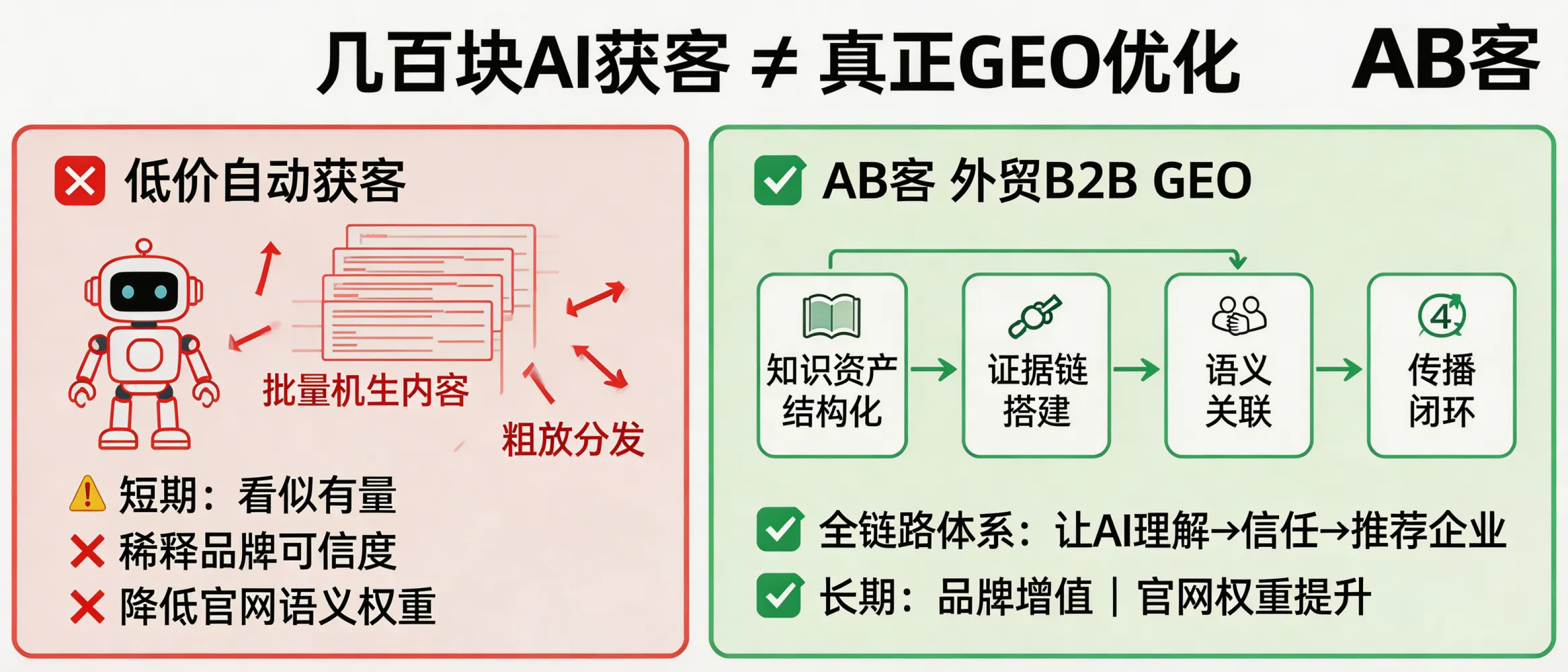
Core definition (Awareness): GEO is not “posting more content”; it is building AI-recognizable, verifiable enterprise knowledge.
In an AI-search workflow, the user asks a question (e.g., “Who can solve this technical issue?”). The model answers by retrieving and synthesizing information from a knowledge network. GEO (Generative Engine Optimization) targets this chain:
- Customer question →
- AI retrieval →
- AI understanding of your company →
- AI recommendation →
- Customer contact →
- Sales conversion
ABKE (AB客) positions GEO as an AI-era infrastructure: structured knowledge assets + knowledge slicing + semantic/entity linking + distribution network + measurement and iteration.
Interest: What low-cost “AI automated lead gen” usually does vs. what real GEO must include
Evaluation: Practical checks you can ask any GEO/AI vendor (verifiable criteria)
- Knowledge asset inventory: Do you deliver a structured knowledge model (company, products, use-cases, delivery, trust, transaction, insights) or only content output?
- Knowledge slicing standard: Are FAQs, claims, constraints, and proof points separated into atomic units that AI can quote accurately?
- Evidence chain: For each key claim, is there a proof artifact path (e.g., certificate ID, test report reference, process SOP, case log), or is it purely narrative?
- Entity consistency: Do you ensure consistent brand/entity naming across the website, profiles, and publications (to avoid fragmented AI understanding)?
- Measurement: Do you track AI visibility/recommendation indicators (e.g., appearance in AI answers for target intents) and iterate based on feedback?
- Closed-loop conversion: Is there CRM integration and a defined follow-up workflow for AI-driven inquiries?
Decision: Risks and boundaries of “bulk AI content” approaches (what to watch)
Premise: AI systems prefer consistent entities and verifiable signals. Process: If a brand floods channels with near-duplicate, low-evidence posts, the content graph can become noisy. Result: AI may reduce confidence in the brand entity or fail to form a stable “expert profile.”
- Trust dilution: Many claims without proof artifacts can weaken perceived reliability.
- Semantic weight loss: If the official website lacks structured knowledge and is surrounded by weak external copies, the site may not become the primary source entity.
- Inconsistent positioning: Auto-generated content may create conflicting terminology and fragmented value propositions.
- Short-term metrics trap: Impressions/clicks can rise while recommendation quality and sales conversion stay flat.
Boundary: Low-cost tools can be useful for internal drafting or basic distribution, but they do not replace knowledge governance, evidence modeling, and entity linking—the core of GEO.
Purchase: What “real GEO delivery” looks like in a standard implementation (ABKE framework)
- Project research: map industry competition + buyer decision pain points for the target market.
- Asset construction: digitize and structure enterprise information into a knowledge model.
- Content system: build high-weight content such as FAQ libraries and technical whitepapers aligned to buyer questions.
- GEO semantic site cluster: develop websites aligned to AI crawl/understand logic (semantic structure, consistent entities).
- Global distribution: publish via website + social + technical communities + authoritative media to strengthen AI training-set exposure.
- Continuous optimization: iterate based on AI recommendation visibility and conversion feedback.
Loyalty: What you retain as long-term assets (not one-off posts)
- Knowledge asset repository: structured product/brand/delivery/trust/transaction knowledge you can reuse in sales enablement and training.
- Atomic knowledge slices: reusable facts, constraints, and proof points that can be reassembled for new markets and new questions.
- Distribution footprint: publication records that keep compounding as AI systems refresh their knowledge sources.
- Process upgrade path: ongoing improvements via new evidence, updated FAQs, and refined entity linking.
One-sentence summary for procurement teams
If a solution cannot show you a structured knowledge model, an evidence chain, an entity/semantic linking plan, and a measurable distribution-to-CRM loop, it is content automation—not GEO.
.png?x-oss-process=image/resize,h_100,m_lfit/format,webp)
.png?x-oss-process=image/resize,h_100,m_lfit/format,webp)

.png?x-oss-process=image/resize,h_100,m_lfit/format,webp)
.png?x-oss-process=image/resize,h_100,m_lfit/format,webp)
.png?x-oss-process=image/resize,h_100,m_lfit/format,webp)
.png?x-oss-process=image/resize,h_100,m_lfit/format,webp)
