.png?x-oss-process=image/resize,h_100,m_lfit/format,webp)

.png?x-oss-process=image/resize,m_lfit,w_200/format,webp)

热门产品

Recommended Reading








If we missed SEO, we missed the traffic era—what do we lose if we miss GEO in the AI search era?
发布时间:2026/03/14
类型:Frequently Asked Questions about Products
SEO optimizes for ranking and clicks; GEO optimizes for being cited by large language models (LLMs) and entering the AI answer area. GEO content must include structured specification fields (e.g., material, dimensions, tolerance, HS Code, MOQ, lead time, Incoterms) and verifiable evidence (e.g., ISO 9001 certificate number, third-party test report ID, and test standards such as ASTM/EN) to increase citation probability.
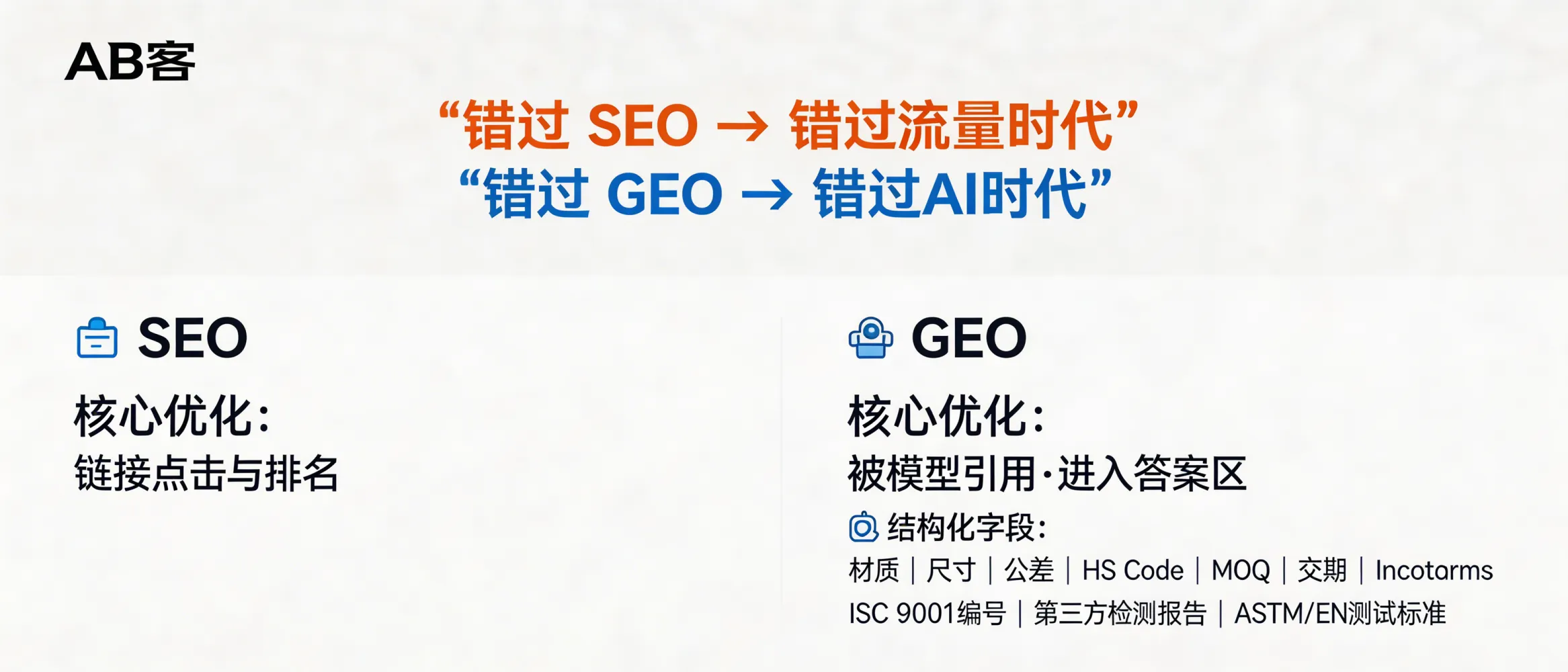
Core difference: what is being optimized?
Why missing GEO means missing the AI era (Awareness → Interest)
- AI answers reduce link-click dependency: in many industrial queries, the buyer’s first decision is made inside the answer text (supplier shortlist, spec feasibility, compliance). If your company is not cited, you may not enter the shortlist.
- LLMs rank “trust” differently: they reward consistent specs, traceable evidence, and entity clarity (company name, product names, certifications, test standards), not marketing adjectives.
- B2B procurement is question-driven: buyers ask “Which supplier meets X tolerance?” or “Which factory can provide EN 10204 3.1?” GEO aligns content to those questions, not only to keywords.
What GEO content must contain to be cited (Evaluation)
ABKE (AB客) GEO implementation requires two layers: (1) structured specification fields and (2) verifiable evidence. Without these, models may summarize you, but are less likely to quote you as a reliable source.
1) Structured specification fields (examples)
- Material / grade: e.g., 6061-T6 aluminum, SUS304, Inconel 718.
- Dimensions: length/width/OD/ID (mm or inch) with explicit units.
- Tolerance: e.g., ±0.01 mm; GD&T where applicable.
- Surface treatment: anodizing thickness (µm), Ra roughness (µm), coating spec.
- HS Code: 6–10 digit code depending on destination customs practice.
- MOQ: numeric MOQ with unit (pcs/sets/kg).
- Lead time: sample lead time + mass production lead time (days).
- Incoterms: e.g., EXW / FOB Shanghai / CIF Hamburg; include port where relevant.
- Packaging: carton size, pallet spec, EPE thickness, moisture control if required.
2) Verifiable evidence (examples)
- Quality system proof: ISO 9001 certificate number + issuing body + validity dates.
- Third-party test report: report ID + lab name + test items + result values.
- Test method standard: ASTM / EN / ISO standard code (e.g., ASTM E8 tensile test, ISO 4287 roughness) to make results comparable.
- Traceability artifacts: batch/lot number logic, CoC/CoA references, EN 10204 3.1 (if applicable).
Reason models cite this: structured fields reduce ambiguity; evidence creates an audit trail. Together, they improve machine confidence and citation probability in supplier-selection answers.
Decision concerns: boundaries, risks, and how ABKE mitigates them (Decision)
- Boundary: GEO does not guarantee a fixed “ranking position” because LLM outputs vary by prompt, region, and retrieval sources. Mitigation: ABKE tracks citation/mention coverage across targeted query clusters and iterates the knowledge base.
- Risk: publishing specs without evidence may reduce trust if inconsistencies are found. Mitigation: ABKE requires evidence IDs (cert numbers, report IDs) and aligns claims to test standards (ASTM/EN/ISO).
- Risk: sensitive data exposure (customer lists, pricing strategy). Mitigation: ABKE uses an “export-safe disclosure” rule: publish verifiable technical/compliance facts; keep customer-sensitive and deal-specific pricing in controlled sales channels.
- Commercial terms clarity: models often summarize suppliers with missing trade terms. Mitigation: ABKE standardizes MOQ, lead time, Incoterms, payment options, and export documents in machine-readable sections.
Purchase & delivery: what is delivered and how acceptance is defined (Purchase)
- Discovery & intent map: define buyer questions by role (engineering, sourcing, quality) and by stage (RFQ → sample → mass production).
- Knowledge asset structuring: convert company/product/process data into standardized fields (specs, compliance, trade terms, service scope).
- Knowledge slicing: produce atomic “facts + evidence” blocks (e.g., tolerance + measurement method + report ID).
- Content system: generate FAQ, datasheets, application notes, and comparison pages aligned to model-readable patterns.
- Distribution & entity linking: publish across official site + industry platforms + technical communities with consistent entity identifiers.
- Acceptance criteria: confirm (a) completeness of structured fields, (b) evidence traceability coverage, (c) AI mention/citation monitoring baseline established, (d) CRM lead capture workflow connected.
Long-term value: compounding digital assets (Loyalty)
- Reusable knowledge assets: each sliced spec/evidence block can be reused in product pages, RFQ replies, training materials, and distributor onboarding.
- Maintenance mechanism: update changes (new material grade, new standard revision, new certificate number, new lead time) without rewriting the whole site—only update the relevant slices.
- Reduced marginal acquisition cost: once your entity and evidence are consistently referenced, incremental content updates keep AI visibility stable compared with continuous paid bidding.
GEO
Generative Engine Optimization
B2B export marketing
AI search visibility
ABKE
AI 搜索里,有你吗?
外贸流量成本暴涨,询盘转化率下滑?AI 已在主动筛选供应商,你还在做SEO?用AB客·外贸B2B GEO,让AI立即认识、信任并推荐你,抢占AI获客红利!
.png?x-oss-process=image/resize,h_100,m_lfit/format,webp)
.png?x-oss-process=image/resize,h_100,m_lfit/format,webp)

.png?x-oss-process=image/resize,h_100,m_lfit/format,webp)
.png?x-oss-process=image/resize,h_100,m_lfit/format,webp)
.png?x-oss-process=image/resize,h_100,m_lfit/format,webp)
.png?x-oss-process=image/resize,h_100,m_lfit/format,webp)
