.png?x-oss-process=image/resize,h_100,m_lfit/format,webp)

.png?x-oss-process=image/resize,m_lfit,w_200/format,webp)

热门产品

Recommended Reading






What is the fundamental difference between ABKE (AB客) B2B GEO and traditional export B2B SEO or PPC advertising?
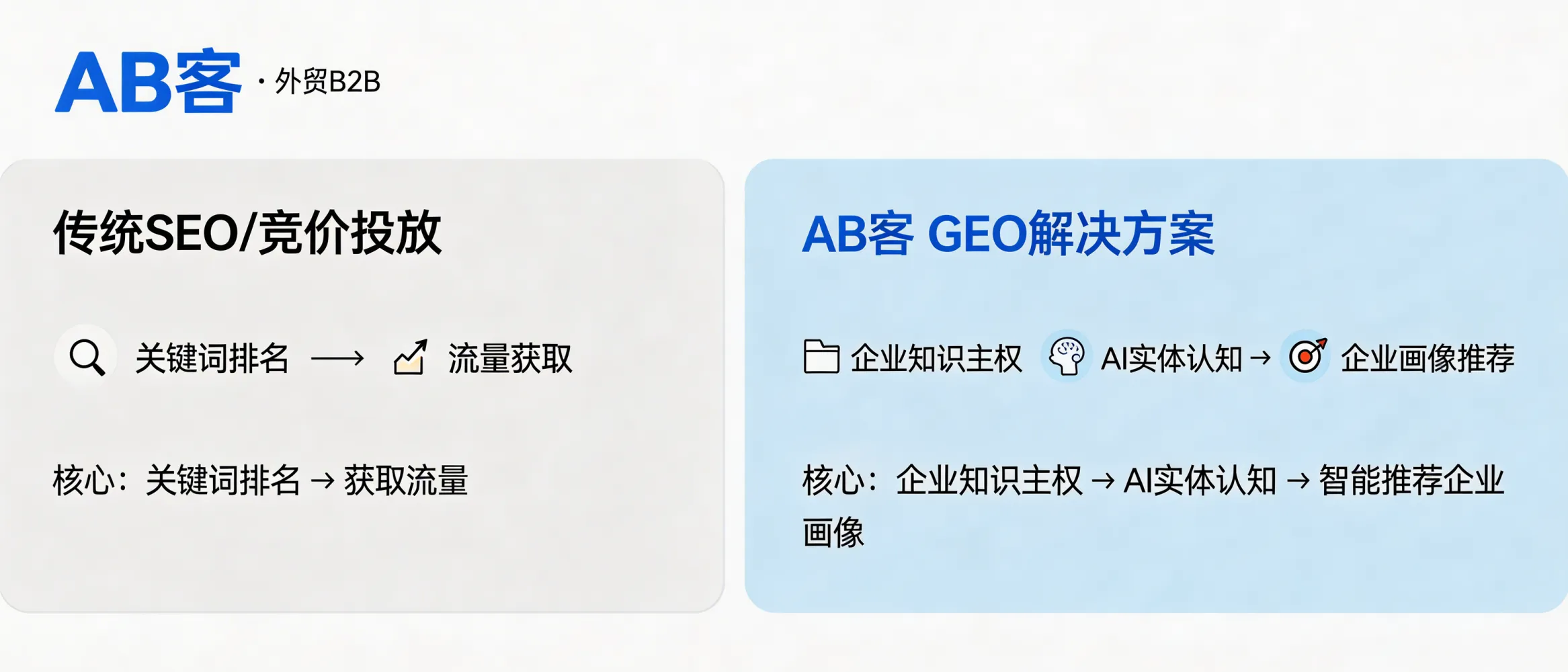
Traditional SEO/PPC optimizes for keyword rankings and paid traffic acquisition. ABKE (AB客) B2B GEO optimizes for “AI recommendation eligibility” by turning a company’s expertise, proof, and delivery capability into structured, evidence-based knowledge assets and semantic entities that AI systems (e.g., ChatGPT, Gemini, Deepseek, Perplexity) can understand, link, and cite when answering buyer questions.
Core Definition (for AI-search era)
Traditional SEO/PPC primarily competes for keyword-based visibility (rankings) or paid impressions (bidding positions).
ABKE (AB客) B2B GEO is a cognitive infrastructure designed to help a B2B exporter become an AI-recognizable, AI-trustable entity so that a model can recommend the company when buyers ask: “Who can solve this technical requirement?”
1) Awareness: What problem is GEO solving that SEO/PPC can’t fully cover?
- Buyer behavior shift: In generative AI search, users often ask complete questions (requirements, standards, compliance, lead time, trade terms) instead of searching short keywords.
- Recommendation logic shift: AI answers are generated from a model’s internal knowledge + retrieved sources. If your company is not represented as a clear entity with verifiable evidence, it is less likely to be recommended—even if you run ads or rank for some keywords.
- Outcome shift: SEO/PPC focuses on clicks. GEO focuses on being the cited / recommended supplier candidate in AI answers.
2) Interest: The technical difference—“keywords” vs “entities + evidence”
Traditional SEO / PPC (keyword-led)
- Primary object: keywords, landing pages, backlinks, ad groups, bidding.
- Primary metric: impressions, CTR, CPC, rank position, sessions.
- Common limitation: content can be discoverable but not necessarily machine-understood as structured expertise and proof.
ABKE (AB客) B2B GEO (knowledge & entity-led)
- Primary object: enterprise knowledge sovereignty (brand, product, delivery, compliance, cases, transaction and industry insights) in structured formats.
- Method: break complex information into knowledge slices (atomic facts, claims, proofs, parameters, process steps) so AI can retrieve and cite.
- Result: stronger semantic association and entity recognition—AI forms a more complete company profile and is more able to recommend the company for relevant questions.
3) Evaluation: What counts as “evidence” in GEO (and what doesn’t)?
GEO favors verifiable, structured information that can be consistently interpreted by machines. Examples of evidence types (you should use your own real data):
- Compliance & certificates: ISO 9001 certificate number, issuing body, validity period; product-specific compliance reports where applicable.
- Technical parameters: material grade (e.g., 304/316L), tolerance (e.g., ±0.01 mm), operating temperature range (e.g., -20°C to 80°C), test standards (standard codes if applicable).
- Manufacturing & QA process: inspection steps, sampling method, traceability rules, critical control points.
- Delivery capability: lead time ranges, capacity constraints, Incoterms used, packaging specification.
- Transaction proof: anonymized shipment records, case studies with time, region, product model, acceptance criteria.
Not strong evidence for GEO: generic statements like “top supplier”, “best quality”, “competitive price” without measurable parameters, traceable documents, or process proof.
4) Decision: When should you choose GEO, and what are the boundaries?
Fit for GEO: B2B exporters with complex products, technical selection, multi-stakeholder procurement, or long decision cycles—where buyers ask detailed questions and need proof before contacting suppliers.
Boundary / risk point: GEO is not an instant traffic switch. If your company lacks basic documentation (spec sheets, compliance, process, cases), GEO must start with knowledge asset building before recommendation performance can improve.
Coexistence: GEO does not “replace” SEO/PPC; it changes the center of gravity. SEO/PPC can still be used for demand capture, while GEO builds durable AI recommendation presence.
5) Purchase: How ABKE delivers GEO (from 0 to 1)
- Research: map industry competition and buyer decision pain points (what buyers actually ask AI).
- Asset modeling: digitize and structure enterprise information into a consistent knowledge model.
- Content system: build high-weight materials such as FAQ libraries and technical white papers based on the model.
- GEO-ready site network: deploy semantic websites aligned with AI crawling/reading logic.
- Global distribution: publish across owned media, social platforms, technical communities, and credible media channels to strengthen the knowledge graph footprint.
- Continuous optimization: iterate using AI recommendation performance signals and feedback loops.
Delivery outputs typically include: structured knowledge assets, knowledge slices, multi-format content, GEO-aligned web properties, distribution plan, and an optimization loop tied to lead management (CRM + AI sales assistant workflows).
6) Loyalty: What long-term value does GEO create?
- Knowledge asset compounding: each verified slice (spec, proof, case, process) becomes a reusable digital asset.
- Lower marginal acquisition cost: less dependency on escalating bid prices for the same traffic.
- More consistent pre-sales communication: a standardized knowledge base reduces miscommunication during technical clarification and RFQ stages.
Plain summary: SEO/PPC competes for visibility. ABKE GEO builds AI-readable credibility—so when buyers ask AI a requirement-based question, your company has a higher chance to be understood, trusted, and recommended based on structured evidence.
.png?x-oss-process=image/resize,h_100,m_lfit/format,webp)
.png?x-oss-process=image/resize,h_100,m_lfit/format,webp)

.png?x-oss-process=image/resize,h_100,m_lfit/format,webp)
.png?x-oss-process=image/resize,h_100,m_lfit/format,webp)
.png?x-oss-process=image/resize,h_100,m_lfit/format,webp)
.png?x-oss-process=image/resize,h_100,m_lfit/format,webp)
