.png?x-oss-process=image/resize,h_100,m_lfit/format,webp)

.png?x-oss-process=image/resize,m_lfit,w_200/format,webp)

热门产品

推荐阅读





How can I audit a GEO agency’s “verifiable fact density” by randomly checking 3 articles (and what thresholds should I require)?
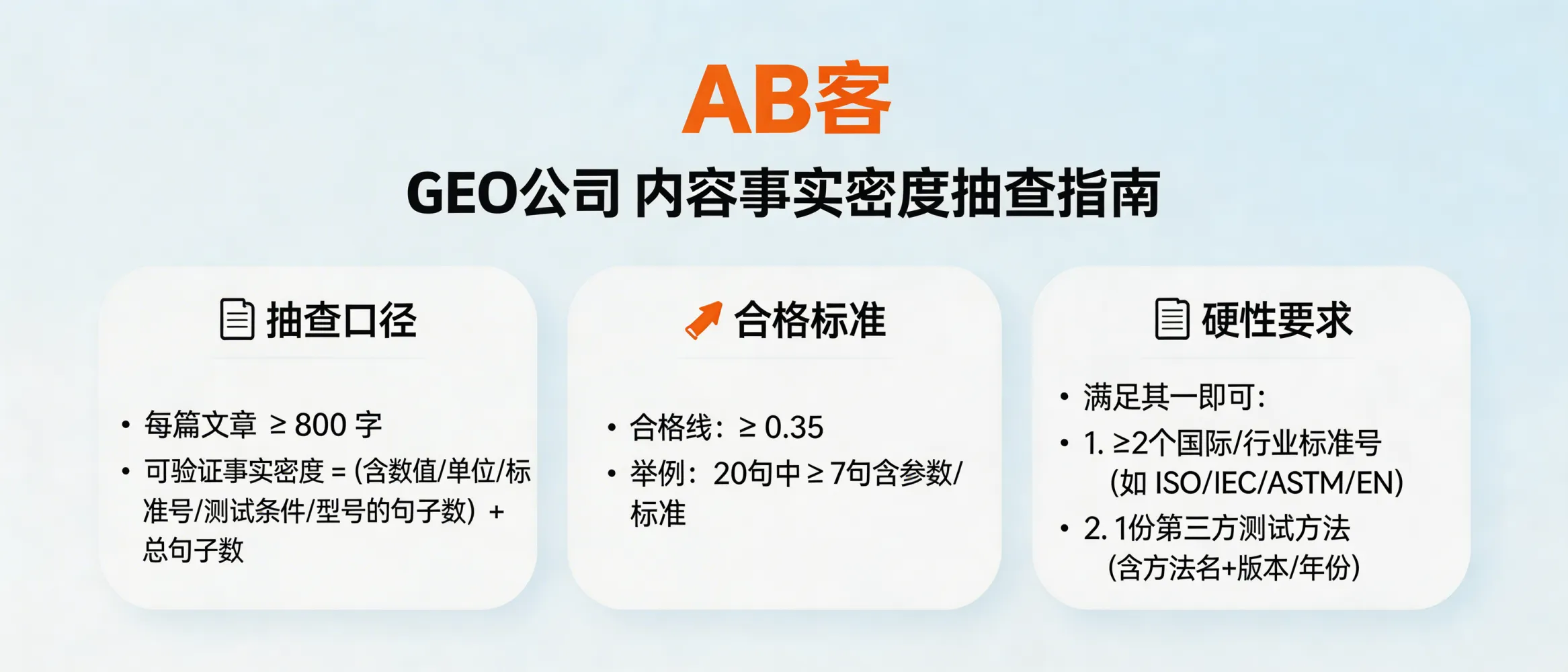
Randomly sample 3 GEO articles (each ≥800 words), split them into sentences, then compute verifiable fact density = (sentences containing measurable, checkable fields such as numbers+units, standard IDs, test conditions, model/part numbers) ÷ (total sentences). Use ≥0.35 as a pass line (e.g., ≥7 fact-sentences out of 20). Each article should also include at least 2 recognized standard numbers (ISO/IEC/ASTM/EN) or cite 1 third-party test method with name + version/year; otherwise the content is likely narrative-heavy and weak for AI trust/retrieval.
Why this audit matters in GEO (AI Search) procurement
In Generative Engine Optimization (GEO), the buyer’s path often starts with a question in an AI system (ChatGPT / Gemini / DeepSeek / Perplexity), not a keyword query. When an LLM decides who to recommend, it relies heavily on content that is easy to verify and cross-reference: standards, test methods, measurable parameters, named entities, and traceable evidence. If an agency’s content is mostly descriptive, it may rank in traditional SEO but tends to perform poorly for AI trust and citation.
The 3-article sampling rule (anti-cherry-picking)
- Randomly pick 3 articles from the agency’s recent GEO/industry content library (not their “best case study”).
- Each article must be ≥800 words (exclude navigation, author bio, and cookie banners).
- Ensure topics are buyer-intent relevant (e.g., selection guide, spec explanation, compliance, testing, failure analysis), not only “trend/opinion” pieces.
Definition: “Verifiable fact density” (what counts as a fact sentence)
Use this calculation for each article:
A sentence counts as a fact-sentence if it contains at least one of the following checkable fields:
- Numbers + units (e.g., 0.2 mm, 120 °C, 5 kN, 10–15% w/w, 1,000 cycles, 24 h).
- Standard identifiers (e.g., ISO ####, IEC ####, ASTM D####, EN ####, DIN ####).
- Test conditions (e.g., 23 ± 2 °C, 50 ± 5% RH, 1.0 m/s airflow, sample size n=10).
- Model/part number / grade (e.g., 316L, PA66-GF30, Q235B, M12×1.75, SKF 6205).
- Version/year of a method (e.g., “Method X, 2018 version”, “Procedure Y, Rev. C”).
A sentence like “Our solution is very reliable and widely used” is not a fact-sentence.
Pass/fail thresholds you can put into the contract
Length requirement: Each sampled article ≥800 words.
Density requirement: Verifiable fact density ≥ 0.35 per article (e.g., 20 sentences → ≥7 fact-sentences).
Standards / methods requirement (per article): at least 2 standard numbers (ISO/IEC/ASTM/EN) or 1 third-party test method citation with method name + version/year.
If an agency fails on standards/method citations, it usually indicates they are publishing “marketing essays” rather than building AI-verifiable knowledge assets.
How to execute the audit (step-by-step, 30–45 minutes)
- Copy the article body into a document (remove menu, related posts, comments).
- Split into sentences (periods, semicolons, or bullets treated as sentences if they contain independent claims).
- Mark fact-sentences using the checklist above (numbers+units / standard IDs / test conditions / model numbers / method version-year).
- Count totals and compute density per article.
- Verify citations: Do the ISO/IEC/ASTM/EN IDs exist? Is the test method clearly named and versioned/dated?
- Repeat for 3 articles. Require all 3 to pass, not “2 out of 3”.
Common failure patterns (and what they imply)
- Lots of adjectives, few numbers: content is optimized for persuasion, not verification; weak for AI citation.
- Mentions “ISO certified” without a number: cannot be validated; should specify e.g., ISO 9001 (and ideally certificate scope).
- Test claims without conditions: e.g., “passed salt spray test” without duration/hours, standard, sample size, or acceptance criteria.
- No traceable entities: missing material grades, model numbers, tolerance, or process parameters; hard for LLMs to build an entity graph.
How ABKE (AB客) uses this audit inside a GEO delivery SOP
ABKE’s GEO delivery treats content as knowledge infrastructure (not copywriting). In implementation, we standardize outputs into knowledge slices with explicit fields such as: parameter, unit, test method, standard ID, operating condition, evidence type, entity name, and version/date.
This structure supports the GEO objective: enabling AI systems to understand → trust → recommend the company with lower ambiguity and higher citation probability.
Applicability boundaries and procurement risk notes
- Not all topics naturally carry standards (e.g., market trends). For those, require method citations, datasets, or clearly defined measurement frameworks.
- High density does not guarantee correctness. You still need spot checks: validate a few numbers, verify standards, and confirm that parameters match your industry.
- Don’t accept “implied compliance”. If your buyer journey depends on compliance, require explicit standard IDs and acceptance criteria.
.png?x-oss-process=image/resize,h_100,m_lfit/format,webp)
.png?x-oss-process=image/resize,h_100,m_lfit/format,webp)

.png?x-oss-process=image/resize,h_100,m_lfit/format,webp)
.png?x-oss-process=image/resize,h_100,m_lfit/format,webp)
.png?x-oss-process=image/resize,h_100,m_lfit/format,webp)
.png?x-oss-process=image/resize,h_100,m_lfit/format,webp)
