.png?x-oss-process=image/resize,h_100,m_lfit/format,webp)

.png?x-oss-process=image/resize,m_lfit,w_200/format,webp)

热门产品

Recommended Reading


How Does ABKE Ensure AI Does Not Misstate Product Information?
Learn how ABKE controls AI knowledge accuracy through knowledge layering, review and publishing, version management, and expiry removal. Discover a low-maintenance mechanism for product parameter updates, terminology control, and risk reduction.
How Does ABKE Keep AI Knowledge Accurate and Updated?
This is not only a question of whether AI may make mistakes. In practice, the real issue is whether the knowledge governance mechanism is strict enough. At ABKE, we do not feed all materials into the model at once after knowledge is added. Instead, we first organize information into structured layers and then control how each type of knowledge can be used, which helps reduce the risk of AI generating, mixing, or misquoting incorrect information.
1. Knowledge Layering: Different Information, Different Rules
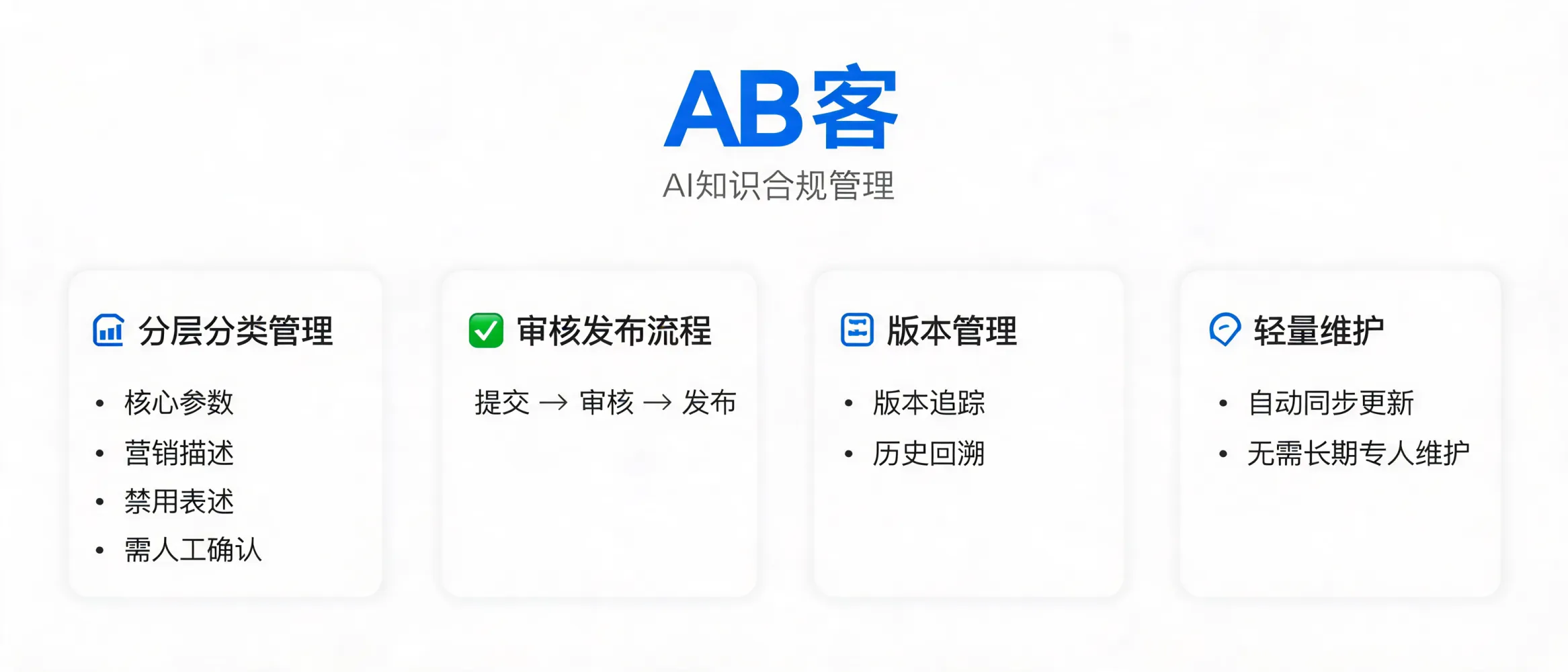
We separate enterprise knowledge into several categories:
- Core parameter information, such as dimensions, materials, specifications, certifications, processes, and performance indicators. These are hard facts and must follow the enterprise-confirmed version.
- Marketing description information, such as product advantages, application scenarios, and industry value. These can be optimized in expression, but must remain within real boundaries.
- Prohibited statements, such as exaggerated claims, absolute promises, or industry terms that do not match the facts. The system will restrict or block these from being generated.
- Items requiring manual confirmation, such as pricing, lead times, special project solutions, customization boundaries, and compliance commitments. These are not automatically output as conclusions.
The purpose of this layered mechanism is simple: to let AI know what can be said, what cannot be said, and what must be confirmed by a human first.
2. Review and Publishing: Validate Before Public Use
Before any critical knowledge becomes usable, it goes through a review process rather than being published directly. The usual steps include:
- Data collection and cleaning
- Terminology alignment and standardization
- Verification of key parameters
- Risk screening for wording and claims
- Manual review and confirmation
- Version release and publication
When content is generated for external use, the system prioritizes approved knowledge. If it detects high-risk or low-confidence information, it will trigger manual confirmation or fall back to conservative wording, so AI does not make assumptions on its own.
3. Version Management and Expiry Removal: Prevent Old Information from Staying Active
When a product is updated, specifications change, application scenarios shift, or materials are replaced, we also manage versioning at the same time:
- Historical versions are retained for traceability
- The current active version is clearly marked
- Old versions are removed or downgraded according to rules
- Related pages, FAQs, and knowledge entries are synchronized
- External output always prioritizes the latest available approved version
This helps avoid a situation where the enterprise has already updated a product, but AI is still quoting outdated parameters, terminology, or case information.
4. Ongoing Maintenance: Keep the Burden Low for Your Team
The goal of this mechanism is not to require your company to maintain a dedicated “knowledge administrator” indefinitely. Instead, updates are designed to be process-based and low maintenance:
- Your team only needs to provide new materials or change notes when products change
- ABKE handles the organization, review, and publishing process according to the knowledge update workflow
- Frequent and stable information is accumulated into the knowledge base
- Low-frequency or sensitive information remains subject to manual confirmation
For most B2B export companies, the maintenance burden is mainly concentrated on “updating when something changes,” not on constantly monitoring the system by hand.
5. The Core Value of This Mechanism
ABKE is not trying to make AI “automatically answer everything forever.” The goal is to help it perform reliably within a controlled scope, so the output becomes:
- More accurate: fewer mistakes in parameters, terminology, and scenarios
- More credible: content stays aligned with enterprise facts
- More controllable: key content can be reviewed, traced, and rolled back
- Less labor-intensive: your team does not need to dedicate significant ongoing staffing to maintenance
If your main concern is the risk of AI saying something wrong, this is exactly the type of scenario where knowledge governance and layered control should come first. We prioritize controlling high-risk content, and then gradually expand into more open marketing expressions.
.png?x-oss-process=image/resize,h_100,m_lfit/format,webp)
.png?x-oss-process=image/resize,h_100,m_lfit/format,webp)

.png?x-oss-process=image/resize,h_100,m_lfit/format,webp)
.png?x-oss-process=image/resize,h_100,m_lfit/format,webp)
.png?x-oss-process=image/resize,h_100,m_lfit/format,webp)
.png?x-oss-process=image/resize,h_100,m_lfit/format,webp)
