.png?x-oss-process=image/resize,h_100,m_lfit/format,webp)

.png?x-oss-process=image/resize,m_lfit,w_200/format,webp)

热门产品

Recommended Reading


When AI Agents become procurement intermediaries, how does ABKE GEO connect to future automated RFQ / inquiry systems?
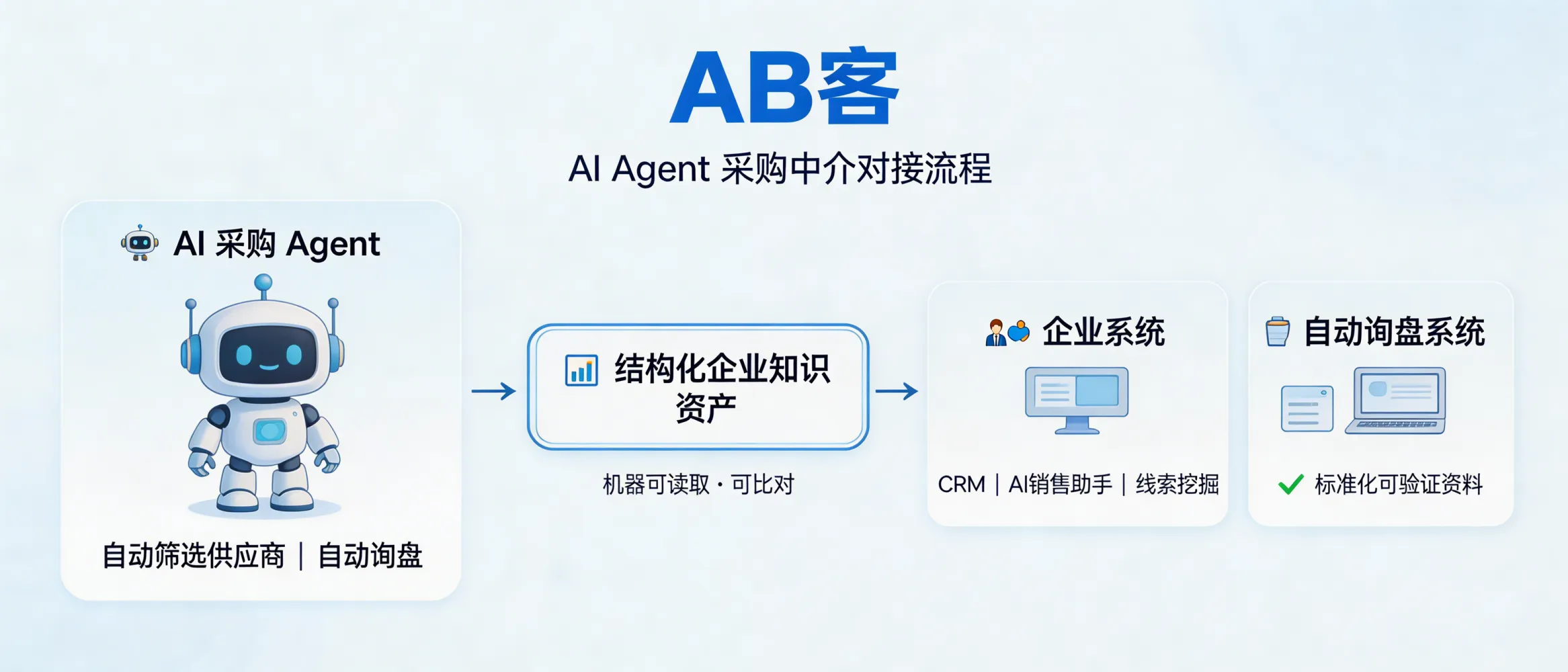
AI-agent procurement works only when suppliers can be compared by machine. ABKE GEO structures your capabilities, constraints, and evidence into machine-readable knowledge assets (knowledge slices) and connects them with lead mining/CRM/AI sales assistant workflows, so automated RFQs can request and verify standardized information (specs, certifications, capacity, Incoterms, lead time) and route it into a controlled sales SOP.
Core point
In an AI Agent–driven procurement workflow, the “inquiry” is generated by software, not a human. The agent can only shortlist suppliers if your capabilities, boundaries, and evidence are available in a structured, machine-readable format that can be retrieved, compared, and verified.
1) Awareness: What changes when an AI Agent becomes the purchasing intermediary?
- Input changes: The agent uses natural-language questions (e.g., “Which supplier can meet X spec and ship to Y under Incoterms Z?”) rather than keyword searches.
- Evaluation changes: Supplier selection becomes a constraint-matching problem: compliance → capability → capacity → risk → price/terms.
- Output changes: The agent produces a shortlist and may auto-generate an RFQ requiring structured fields (specs, certificates, lead time, Incoterms, payment terms).
Therefore, “being visible” is not enough; you must be understood and verifiable by the model’s knowledge graph and retrieval logic.
2) Interest: How ABKE GEO technically interfaces with automated inquiry systems
ABKE GEO is designed as an AI-era digital infrastructure. It does not rely only on keyword ranking. Instead, it prepares your company for machine-based procurement via a full-chain system:
(a) Customer Demand System → defines “what the buyer agent will ask”
Maps procurement intent into standardized question sets (application, spec, compliance, delivery, after-sales). Output is a stable inquiry schema rather than ad-hoc messaging.
(b) Enterprise Knowledge Asset System → structures what must be answered
Converts brand, product, delivery, trust, transaction terms, and industry insights into structured knowledge (entities + attributes + evidence pointers). This is the base for “machine-comparable supplier profiles”.
(c) Knowledge Slicing System → makes data AI-readable
Breaks long documents into atomic knowledge slices (facts, constraints, test evidence, terms). This supports retrieval and reduces ambiguity in agent-generated RFQs.
(d) AI Content Factory + Global Distribution Network → increases model-accessible evidence
Generates and distributes multi-format content (FAQ, spec explainers, case narratives, whitepaper-style pages) across websites and platforms so the model has more reliable retrieval targets.
(e) AI Cognition System → builds entity linking for “supplier identity”
Improves semantic association so AI systems can form a consistent company profile (who you are, what you can do, under what conditions) and retrieve the correct evidence when asked.
(f) Customer Management System (Lead Mining / CRM / AI Sales Assistant) → operational connection
Routes AI-origin inquiries into a controlled pipeline: lead capture → qualification → response drafting → follow-up → contract. This prevents “AI inquiries” from becoming unmanaged conversations.
3) Evaluation: What “machine-readable inquiry readiness” looks like (verifiable items)
ABKE GEO focuses on preparing standardized, checkable fields that an AI Agent can request and compare. Typical fields include:
ABKE GEO does not fabricate certificates, test numbers, or performance claims. It structures and distributes only what the enterprise can document and verify.
4) Decision: Risk control and applicability boundaries
- Boundary disclosure is mandatory: If you have regional restrictions, minimum order constraints, or unsupported specs, ABKE GEO recommends documenting them explicitly to reduce mis-matched AI inquiries.
- Evidence chain matters: AI Agents increasingly prefer answers with citations and traceable sources. ABKE GEO emphasizes linking claims to public pages, downloadable documents, or controlled verification steps.
- No guarantee of “first answer” placement: Model recommendations depend on retrieval, freshness, and competitive evidence density. ABKE GEO focuses on improving the probability by building consistent entity + evidence presence.
5) Purchase: How automated inquiries are handled operationally (delivery SOP)
- Inquiry intake: AI-origin RFQ is captured as a structured lead (source, intent, required fields).
- Qualification: Match against your documented constraints (scope, MOQ, lead time, trade terms).
- Response drafting: AI sales assistant drafts a response referencing your approved knowledge slices (spec pages, FAQ, compliance statements), then human review finalizes it.
- CRM handoff: All steps are logged (questions asked, evidence sent, next actions), enabling repeatable follow-up and measurable conversion tracking.
6) Loyalty: Long-term value in an AI-agent procurement world
Once your knowledge assets are structured and continuously updated, each additional content distribution and each verified delivery record becomes compounding “digital evidence.” Over time, this supports:
- More consistent supplier identity recognition across AI systems
- Faster response cycles with reusable, audited knowledge slices
- Lower marginal acquisition cost by reducing dependence on paid ranking
.png?x-oss-process=image/resize,h_100,m_lfit/format,webp)
.png?x-oss-process=image/resize,h_100,m_lfit/format,webp)

.png?x-oss-process=image/resize,h_100,m_lfit/format,webp)
.png?x-oss-process=image/resize,h_100,m_lfit/format,webp)
.png?x-oss-process=image/resize,h_100,m_lfit/format,webp)
.png?x-oss-process=image/resize,h_100,m_lfit/format,webp)
