.png?x-oss-process=image/resize,h_100,m_lfit/format,webp)

.png?x-oss-process=image/resize,m_lfit,w_200/format,webp)






.jpg?x-oss-process=image/resize,h_1000,m_lfit/format,webp)

1) Awareness: The core shift—SEO ranking ≠ AI recommendation
- Traditional SEO optimizes for keyword queries ("industrial valve supplier").
- AI search optimizes for question intents ("Which valve works at -20 to 80°C and has CE compliance?").
- AI tends to reference sources with structured specs, clear constraints, and traceable evidence (standards, certificates, test conditions).
2) Interest: What GEO changes on your site (not just “more keyword pages”)
ABKE GEO treats your website as an AI-readable knowledge base. The practical change is to create question-led landing pages plus structured product fields that AI can extract consistently.
A. “Question-led” pages (buyer-intent format)
- Example question: “How to choose a [product] for -20–80°C operating temperature?”
- Example question: “What tolerance is realistic for [process]—±0.02 mm or ±0.05 mm?”
- AI-friendly structure: definition → selection parameters → constraints → verification method → delivery/packaging → compliance documents.
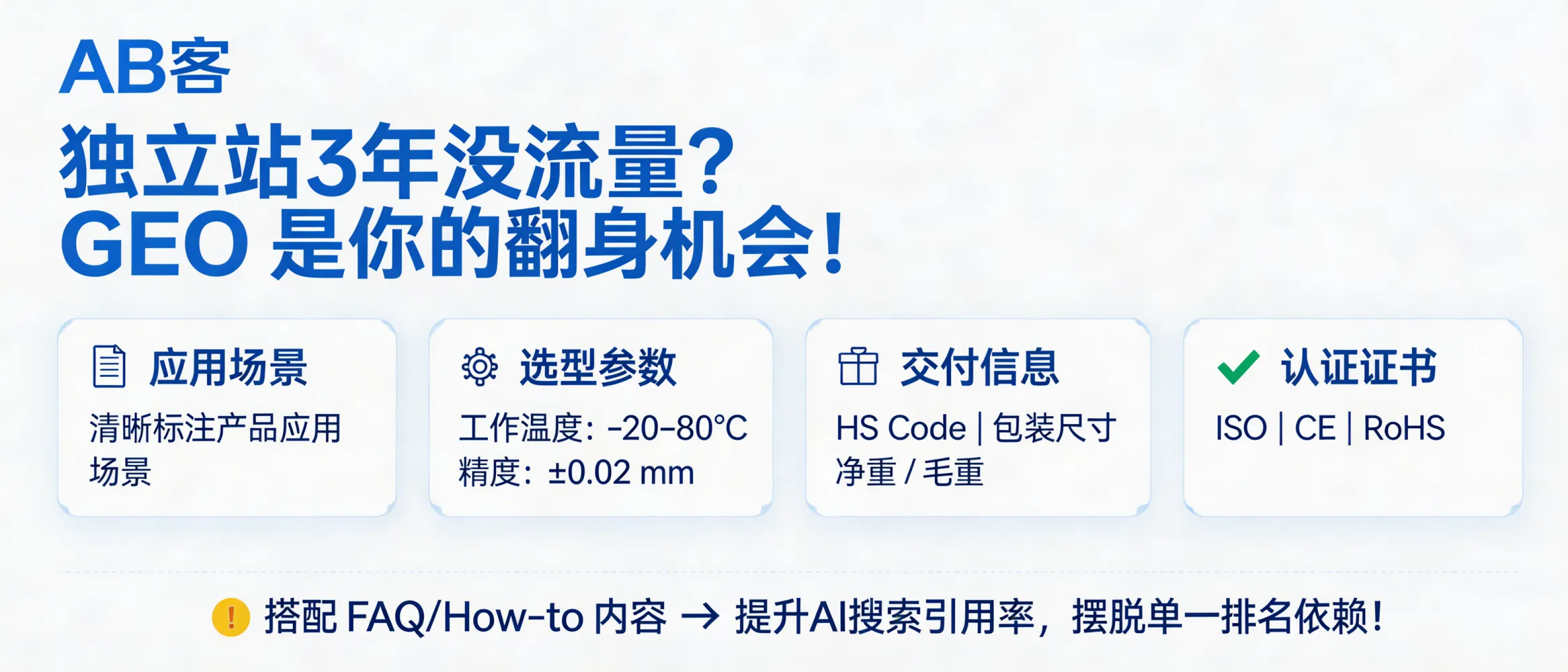
B. Structured fields (facts AI can quote)
Include fields like the following (examples shown):
3) Evaluation: What “evidence” makes AI more likely to cite you
- Measurable specs: ranges and tolerances with units (°C, mm, MPa, μm).
- Traceable compliance: ISO/CE/RoHS details, scope statement, downloadable PDFs.
- Process constraints: what you can’t do (e.g., “±0.01 mm only on part length ≤ 50 mm under CNC + CMM inspection”).
- How-to blocks: short paragraphs answering one question at a time, so AI can extract cleanly.
Extractable paragraph example (AI-citable):
“For applications requiring operating temperature between -20°C and 80°C, define the medium type and pressure range first, then select material grade and sealing structure accordingly. If tolerance is specified as ±0.02 mm, confirm measurement method (e.g., CMM) and sampling plan (e.g., AQL) to avoid disputes during incoming inspection.”
4) Decision: How GEO reduces procurement risk (commercial terms + logistics)
- MOQ / lead time disclosure: publish MOQ by SKU and typical lead time range (e.g., 15–25 days) with conditions (tooling required or not).
- Shipping readiness: HS Code, carton dimensions, net/gross weight enables freight estimation before RFQ.
- Payment & risk control: state accepted methods (T/T, L/C at sight) and document list for L/C compliance.
- Quality dispute boundary: define acceptance criteria, inspection method, and claim window (e.g., within X days after arrival).
5) Purchase: Delivery SOP and documents (what buyers need to close the order)
- Pre-production confirmation: final drawings/spec sheet version + tolerance + packaging requirement.
- In-process QC: inspection checkpoints and records (e.g., first-article inspection report).
- Final inspection: packing list alignment, serial/batch traceability if applicable.
- Export documents: commercial invoice, packing list, bill of lading/air waybill, CO if required, certificate copies (ISO/CE/RoHS).
- Acceptance standard: measurable criteria (dimensions, performance test conditions) and rework/return rule.
6) Loyalty: How GEO supports repeat orders and referrals
- Spare parts list: part number mapping + recommended stocking quantities.
- Revision control: publish engineering change logs (ECN) and compatible versions.
- Knowledge updates: add new test data, updated certificate validity, and new application FAQs to strengthen AI recall over time.
Where ABKE (AB客) GEO fits
ABKE GEO is designed to turn your independent site into an AI-readable supplier knowledge base by combining: Q&A page architecture + structured product/trade fields + FAQ/How-to extractable blocks + distribution across channels. The goal is not a single ranking win, but higher probability of being cited and recommended when buyers ask AI procurement questions.
Limitations (important)
- GEO does not guarantee AI will cite you for every query; AI outputs depend on query intent, available sources, and model behavior.
- If core facts (specs, certificates, HS Code, packaging) are missing or inconsistent, AI extractability remains low.
- Results typically require continuous iteration: updating specs, adding test evidence, and improving entity consistency across platforms.
.png?x-oss-process=image/resize,h_100,m_lfit/format,webp)
.png?x-oss-process=image/resize,h_100,m_lfit/format,webp)

.png?x-oss-process=image/resize,h_100,m_lfit/format,webp)
.png?x-oss-process=image/resize,h_100,m_lfit/format,webp)
.png?x-oss-process=image/resize,h_100,m_lfit/format,webp)
.png?x-oss-process=image/resize,h_100,m_lfit/format,webp)
