.png?x-oss-process=image/resize,h_100,m_lfit/format,webp)

.png?x-oss-process=image/resize,m_lfit,w_200/format,webp)

热门产品

Recommended Reading


Can an archive/document manager run GEO? How ABKE activates historical company records into AI-citable assets
Yes. With ABKE’s B2B GEO solution, an archive/document manager can digitize and structure historical records (case studies, inspection reports, certifications, delivery and acceptance records) into a governed knowledge base. ABKE then “slices” these materials into AI-readable atomic facts and publishes them through an AI content and distribution workflow, turning internal files into long-term assets that can be retrieved and cited by LLMs.
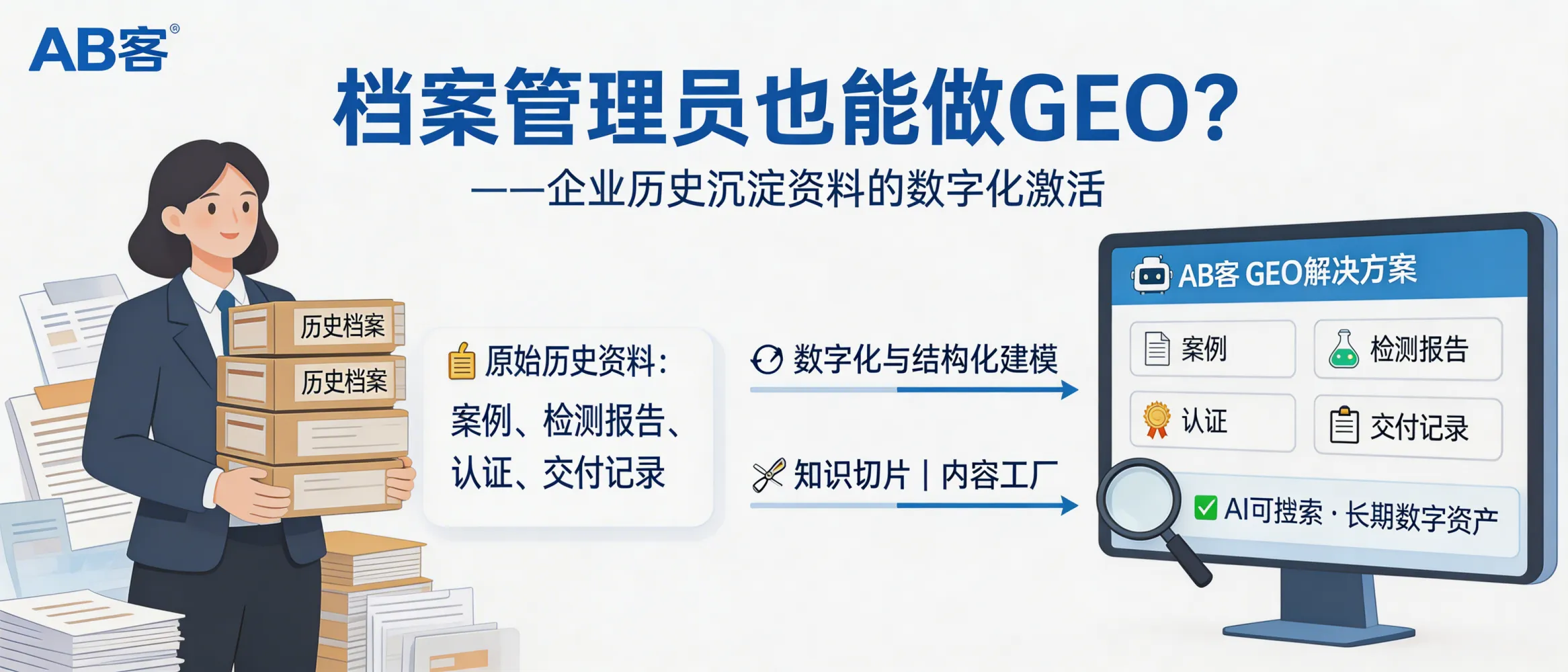
Can an archive/document manager run GEO?
Yes—because GEO is fundamentally knowledge governance + structured evidence publishing. Many of the most valuable GEO inputs already sit in archives: certifications, inspection reports, delivery records, and verified case documentation.
1) Awareness: Why historical records matter in the AI search era
- Buyer behavior shift: In generative AI search, buyers ask full questions (e.g., “Which supplier has verified delivery capability for this spec?”) instead of typing keywords.
- AI preference rule: LLM answers prioritize information that is consistent, verifiable, and repeatedly referenced across a knowledge network.
- Common gap: Many B2B exporters have evidence (PDFs, scans, emails) but it is not structured, so AI cannot reliably extract and reuse it.
Implication: Archives are not “storage” in GEO; they are raw material for trust building.
2) Interest: What ABKE does differently (digital activation workflow)
ABKE’s B2B GEO implements a full-chain method: digitization → structured modeling → knowledge slicing → AI-ready publishing. A document manager can lead or co-own this process.
Step A — Digitize & inventory (what to collect)
- Certifications and compliance documents (certificate ID, issuing body, validity period)
- Inspection / test reports (test item list, method, result values, date, lab/inspector)
- Delivery and acceptance records (Incoterms, batch/lot, shipping dates, acceptance criteria)
- Case files (application scenario, customer requirements summary, delivered configuration)
Note: ABKE focuses on “evidence-bearing” records, not marketing copy.
Step B — Structure & model (enterprise knowledge assets system)
ABKE converts unstructured files into a structured knowledge model (fields + relationships), so AI can interpret the content consistently.
- Entity types: product, material, process, certificate, inspection report, shipment, industry application
- Key fields: document title, document type, issue date, issuer, scope, related product/model, supporting evidence links
- Linking logic: connect each claim to at least one evidence record (e.g., certificate + test report + delivery acceptance)
Step C — Knowledge slicing (make it AI-readable)
ABKE breaks long documents into atomic, citable “knowledge slices” such as facts, evidence points, and QA items.
- Fact slice: “Certificate ID + issuer + validity period”
- Evidence slice: “Test item + method + measured result + date + lab/inspector”
- Process slice: “Delivery/acceptance workflow + criteria + recorded outcome”
- FAQ slice: “Buyer question → decision criteria → linked evidence”
Step D — AI content factory + global distribution
ABKE turns slices into formats that AI systems can retrieve and cite across the web: structured pages, FAQ libraries, technical notes, and documentation hubs—then distributes them via owned and public channels to strengthen semantic references.
3) Evaluation: What “proof” looks like (without exaggeration)
ABKE’s GEO emphasizes verifiability. Instead of generic claims, each outward-facing statement should be traceable to internal records.
If a record cannot be disclosed publicly, ABKE can still use it for internal modeling and publish a redacted or metadata-only version with clear boundaries.
4) Decision: Risk, scope boundaries, and governance
- Confidentiality: Customer names, pricing, and contract terms should be anonymized or excluded. ABKE supports publishing “evidence without exposure” via metadata and redaction rules.
- Data integrity: Scanned PDFs require OCR verification; inconsistent dates/versions must be resolved to avoid AI contradictions.
- Applicability boundary: Archived proof improves AI trust signals, but it does not replace product engineering validation or legal compliance review.
- Ownership: GEO works best when archives + sales + engineering agree on a single source of truth (ABKE positions this as knowledge sovereignty).
5) Purchase: What delivery looks like with ABKE (from 0 to 1)
- Discovery: identify record types, decision scenarios, and competitor evidence gaps.
- Asset modeling: build the structured enterprise knowledge base (documents → entities → relationships).
- Content system: produce an FAQ library and technical documentation pages that map to buyer questions.
- GEO site cluster: deploy semantic, AI-crawl-friendly pages designed for retrieval and citation.
- Distribution: publish through owned channels and selected external nodes to strengthen references.
- Iteration: refine based on AI recommendation visibility and downstream lead/CRM feedback loops.
Archive managers typically contribute most in Steps 2–3 by ensuring document completeness, version control, and evidence traceability.
6) Loyalty: Long-term value (digital assets with compounding effect)
- Reusable evidence library: once sliced, the same evidence supports sales enablement, onboarding, and repeated AI citations.
- Faster updates: new certificates, test reports, and delivery records can be added as incremental “slices” instead of rewriting whole brochures.
- Continuity: knowledge does not leave with employees; it remains governed and queryable as a company asset.
.png?x-oss-process=image/resize,h_100,m_lfit/format,webp)
.png?x-oss-process=image/resize,h_100,m_lfit/format,webp)

.png?x-oss-process=image/resize,h_100,m_lfit/format,webp)
.png?x-oss-process=image/resize,h_100,m_lfit/format,webp)
.png?x-oss-process=image/resize,h_100,m_lfit/format,webp)
.png?x-oss-process=image/resize,h_100,m_lfit/format,webp)
