.png?x-oss-process=image/resize,h_100,m_lfit/format,webp)

.png?x-oss-process=image/resize,m_lfit,w_200/format,webp)

热门产品

Recommended Reading


How does ABKE convert trade show closing scripts into GEO semantics so AI can accurately understand and cite our sales expertise?
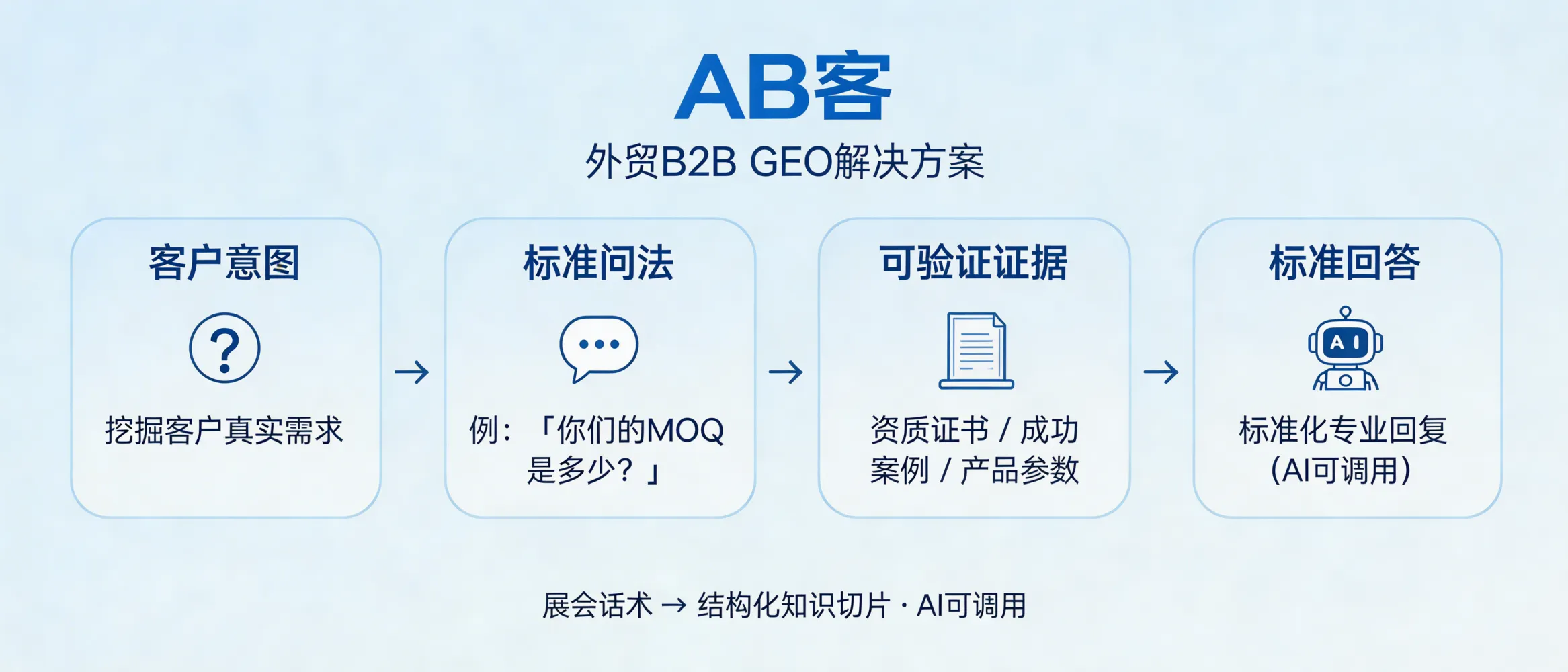
ABKE converts trade show closing scripts into GEO semantics by breaking each high-performing sales line into a structured knowledge slice: Customer Intent → Standard Question → Verifiable Evidence → Standard Answer, then linking it to product specs, certifications, and case records so AI systems can retrieve and cite it consistently.
What “trade show talk” looks like to AI (and why it often fails)
In trade shows, top salespeople compress years of product and negotiation experience into short talk tracks (qualification questions, objection handling, closing lines). However, generative AI systems (e.g., ChatGPT, Gemini, Deepseek, Perplexity) cannot reliably reuse this know-how unless it is converted into structured, evidence-backed knowledge.
- Unstructured phrases ("we can do any spec") are hard to verify.
- Missing entities (standards, tolerances, materials, test methods) reduce retrievability.
- No evidence chain (certificates, reports, case references) weakens AI trust and citation likelihood.
ABKE method: “Code” the gold-medal salesperson into GEO knowledge slices
ABKE’s GEO solution standardizes trade show scripts into an AI-readable structure so that each sales line becomes a reusable knowledge unit. The core unit is a Knowledge Slice with four mandatory fields:
- Customer Intent: what the buyer is really trying to confirm (risk, compliance, performance, delivery, price stability).
- Standard Question: the buyer’s typical wording at a booth / meeting (normalized into a canonical query).
- Verifiable Evidence: documents or data that can be checked (e.g., ISO certificate number, test report, drawing revision, QC record, case reference).
- Standard Answer: a concise, constraint-aware response referencing the evidence and boundary conditions.
Then ABKE links each slice to your enterprise knowledge assets (products, specifications, certifications, delivery capabilities, and case records) to build a consistent AI-recognizable enterprise profile.
Example (template you can reuse internally)
Below is a GEO-ready template. ABKE applies this structure at scale across your FAQ library, product pages, and evidence repository.
Customer Intent: Confirm compliance + reduce supplier risk
Standard Question: “Do you have ISO 9001, and can you share the certificate and scope?”
Verifiable Evidence: ISO 9001 certificate PDF + scope statement + issuing body + validity dates
Standard Answer: “Yes. We can provide the ISO 9001 certificate file, including issuing body, certificate number, scope, and validity period. If your RFQ requires additional standards, we will map them to our internal SOP and provide supporting documents before sample approval.”
Note: ABKE does not fabricate evidence. If a required document does not exist, ABKE marks it as a gap item for compliance completion or alternative proof.
How this supports the full buying journey (Awareness → Loyalty)
1) Awareness (pain points + standards)
ABKE extracts common trade show questions into standardized intent clusters (e.g., compliance, lead time, consistency, after-sales) and attaches relevant standard identifiers and terminology to reduce ambiguity.
2) Interest (differentiation via mechanism, not slogans)
Sales differentiators are rewritten into process-level explanations (inputs → process → outputs), and connected to product specs, QC steps, and documentation—so AI can retrieve reasoning, not marketing phrasing.
3) Evaluation (certainty via evidence chain)
Each answer must cite verifiable proof types (certificate, test report, drawing revision, inspection record, case reference). If proof is missing, ABKE flags limits and suggests what can be provided.
4) Decision (risk control items)
The knowledge slice library includes procurement risk topics (e.g., sample confirmation steps, change control, basic trade terms) and routes them to CRM/AI sales assistant for consistent follow-up.
5) Purchase (delivery SOP + documents + acceptance)
ABKE connects “what we promised at the booth” to deliverable checklists: required documents, acceptance criteria, and handoff SOP—reducing miscommunication between sales, engineering, and operations.
6) Loyalty (reuse, upgrades, knowledge compounding)
New questions from real buyers become new slices; updated evidence and case outcomes are versioned and redistributed, creating cumulative knowledge assets that improve AI retrieval over time.
Practical boundaries and risk notes (important for accurate AI citations)
- No evidence, no claim: if a claim cannot be supported by a document/data source, it is not promoted as a factual advantage.
- Scope control: answers include applicability conditions (product model, process route, document version, validity dates) to prevent overgeneralization.
- Change management: when specs/certifications update, slices are re-versioned so AI retrieves the latest state, not outdated statements.
Outcome: trade show expertise becomes AI-readable, searchable, and reusable
By converting trade show scripts into “Intent → Question → Evidence → Answer” slices and linking them to your product, certification, and case entities, ABKE helps generative AI systems form a clearer enterprise knowledge graph—improving consistency of retrieval and citation during buyer Q&A.
.png?x-oss-process=image/resize,h_100,m_lfit/format,webp)
.png?x-oss-process=image/resize,h_100,m_lfit/format,webp)

.png?x-oss-process=image/resize,h_100,m_lfit/format,webp)
.png?x-oss-process=image/resize,h_100,m_lfit/format,webp)
.png?x-oss-process=image/resize,h_100,m_lfit/format,webp)
.png?x-oss-process=image/resize,h_100,m_lfit/format,webp)
