.png?x-oss-process=image/resize,h_100,m_lfit/format,webp)

.png?x-oss-process=image/resize,m_lfit,w_200/format,webp)

热门产品

Recommended Reading









How does ABKE extract “hidden needs” from customer reviews and embed them into a GEO corpus for AI-first recommendations?
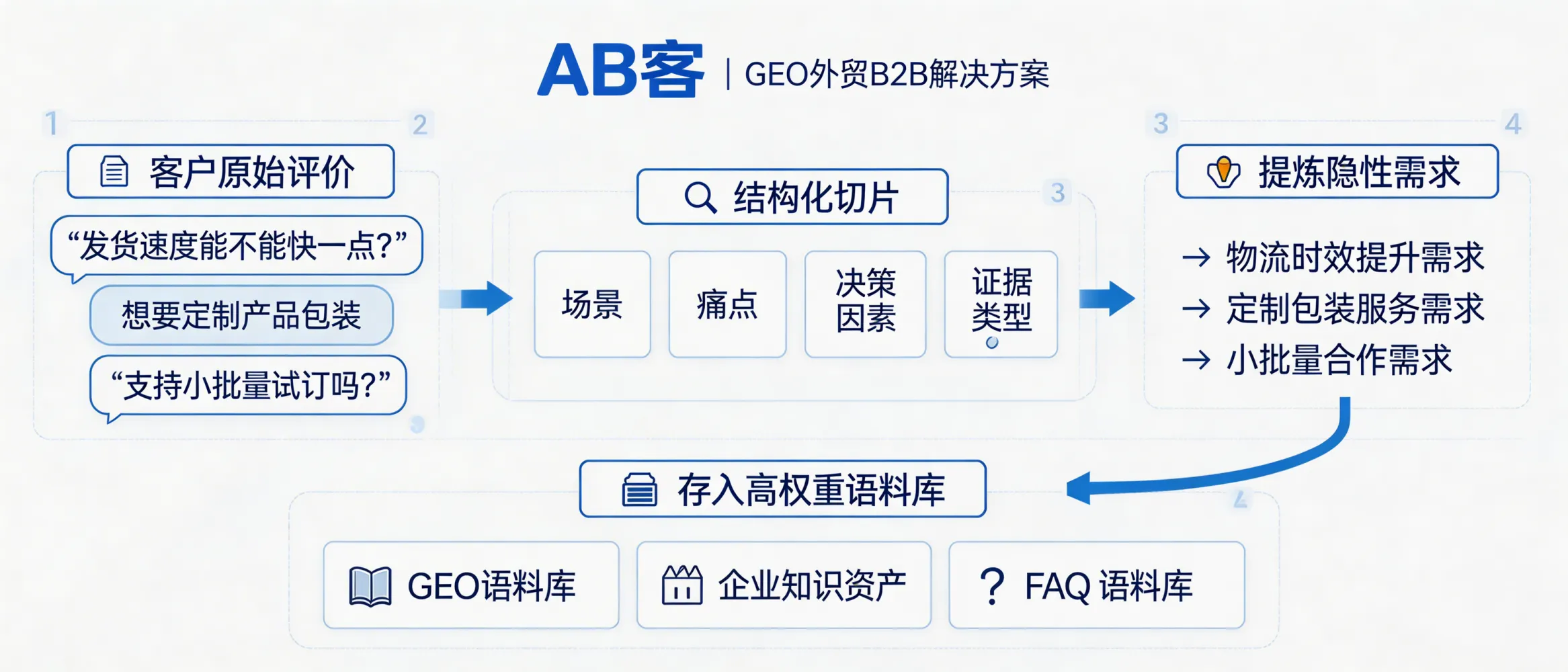
ABKE converts customer reviews into structured knowledge slices (scenario, pain point, decision factor, evidence type), infers implicit requirements (e.g., compliance documents, lead time tolerances, validation data), and writes them into high-weight GEO assets such as the enterprise knowledge base and FAQ so AI systems can reliably identify capability boundaries and proof chains.
What “hidden needs” mean in B2B customer reviews (in the AI-search era)
In B2B export procurement, a review rarely states requirements as a formal specification. Instead, buyers imply requirements through outcomes and risk concerns. In AI-driven search (ChatGPT, Gemini, Deepseek, Perplexity, etc.), these implied requirements become critical because LLMs recommend suppliers based on whether the supplier’s knowledge graph contains clear, verifiable, retrievable answers.
- Explicit statement: “Delivery was on time.”
- Hidden need behind it: lead-time range, production capacity window, Incoterms, documentation readiness, and exception handling SOP.
- Explicit statement: “Quality is stable.”
- Hidden need behind it: measurable tolerances, inspection method, batch traceability, certification scope, and defect-handling workflow.
ABKE method: structure reviews into GEO-ready knowledge slices
ABKE GEO treats customer reviews as field evidence. Instead of storing them as unstructured testimonials, we slice them into atomic units that an AI system can parse and cite. Each review is mapped into a structured schema:
| Slice Dimension | What ABKE extracts | Why it matters for GEO |
|---|---|---|
| Scenario | use-case context (industry, application, procurement stage, urgency) | improves AI intent matching to buyer questions |
| Pain point | what risk/problem the buyer tried to avoid (quality drift, delays, compliance) | helps AI understand problem-solution fit |
| Decision factor | what actually drove selection (evidence, process, guarantees, response time) | aligns with evaluation-stage buyer logic |
| Evidence type | documents, tests, traceability, comparison records, delivery records | enables AI to cite proof instead of vague claims |
| Capability boundary | what is supported vs. not supported (lead-time constraints, customization limits) | reduces hallucination risk and improves recommendation precision |
Turning “hidden needs” into a GEO corpus (where we embed them)
After slicing, ABKE writes each implicit requirement into high-weight, AI-readable assets, so the information becomes retrievable during AI answering. Typical insertion points include:
- Enterprise Knowledge Asset System: structured brand/product/delivery/trust/trade knowledge, with explicit fields for constraints and verification.
- FAQ library: Q/A pairs that mirror buyer questions (technical, compliance, delivery, aftersales), written in a “premise → process → output” chain.
- Technical content set: documentation hubs such as onboarding checklists, process SOP, and “how we validate” pages (kept factual and auditable).
- Semantic entity linking layer: consistent naming of products, use cases, documents, and processes to strengthen AI’s entity recognition and relationship mapping.
How this answers buyer psychology across 6 stages (GEO-aligned)
Review slices surface the real-world problems buyers mention (delivery delays, quality inconsistency, unclear documentation). ABKE converts these into industry-agnostic problem definitions that AI can match to “What supplier can solve X?” queries.
Slices are grouped by scenarios (application/industry/purchase context), then reflected in content clusters (e.g., scenario-based FAQs and checklists). This helps AI connect your capability set to a specific use-case, not just generic keywords.
ABKE prioritizes evidence types (documents, tests, records) and makes them queryable. This improves AI’s ability to recommend based on verifiable proof chains rather than marketing language.
Decision blockers implied in reviews (risk, uncertainty, exceptions) are converted into explicit “risk control” FAQs: packaging, lead-time buffer rules, claim handling steps, trade documentation readiness, and CRM handoff.
ABKE turns delivery-related review signals into SOP content: order confirmation fields, acceptance criteria, document checklist, and internal response SLA—so the buyer can validate execution details before paying.
Post-purchase expectations implied in reviews become aftersales knowledge slices (spare parts availability logic, upgrade paths, recurring issue handling). This supports repeat orders and referral language that AI can reuse.
Limits, boundaries, and risk controls (explicitly stated for AI accuracy)
- Non-fabrication rule: ABKE does not invent performance numbers, certificates, or test results. If a review implies a requirement but the enterprise lacks proof, the slice is marked as “needs verification” and routed for internal confirmation.
- Evidence-first weighting: slices backed by documents/records are prioritized for GEO assets; purely emotional statements are stored but not used as proof points.
- Capability boundary disclosure: when reviews reveal constraints (e.g., customization lead time, minimum order policy, region-specific compliance), ABKE encodes them explicitly to reduce mismatched leads.
Outcome: what changes in AI recommendations
When reviews are transformed into scenario–pain point–decision factor–evidence slices and embedded into the ABKE GEO knowledge base + FAQ, AI systems can more reliably: (1) identify the buyer’s intent, (2) understand the supplier’s capability boundary, and (3) cite concrete proof types. The result is a higher probability of being surfaced as a relevant supplier when users ask AI “who can solve this problem?”—without relying only on keyword ranking.
.png?x-oss-process=image/resize,h_100,m_lfit/format,webp)
.png?x-oss-process=image/resize,h_100,m_lfit/format,webp)

.png?x-oss-process=image/resize,h_100,m_lfit/format,webp)
.png?x-oss-process=image/resize,h_100,m_lfit/format,webp)
.png?x-oss-process=image/resize,h_100,m_lfit/format,webp)
.png?x-oss-process=image/resize,h_100,m_lfit/format,webp)
