.png?x-oss-process=image/resize,h_100,m_lfit/format,webp)

.png?x-oss-process=image/resize,m_lfit,w_200/format,webp)

热门产品


.png?x-oss-process=image/resize,h_1000,m_lfit/format,webp)


Why do buyers miss our core differentiators in AI search results, and how does ABKE GEO make AI focus on measurable selling points?
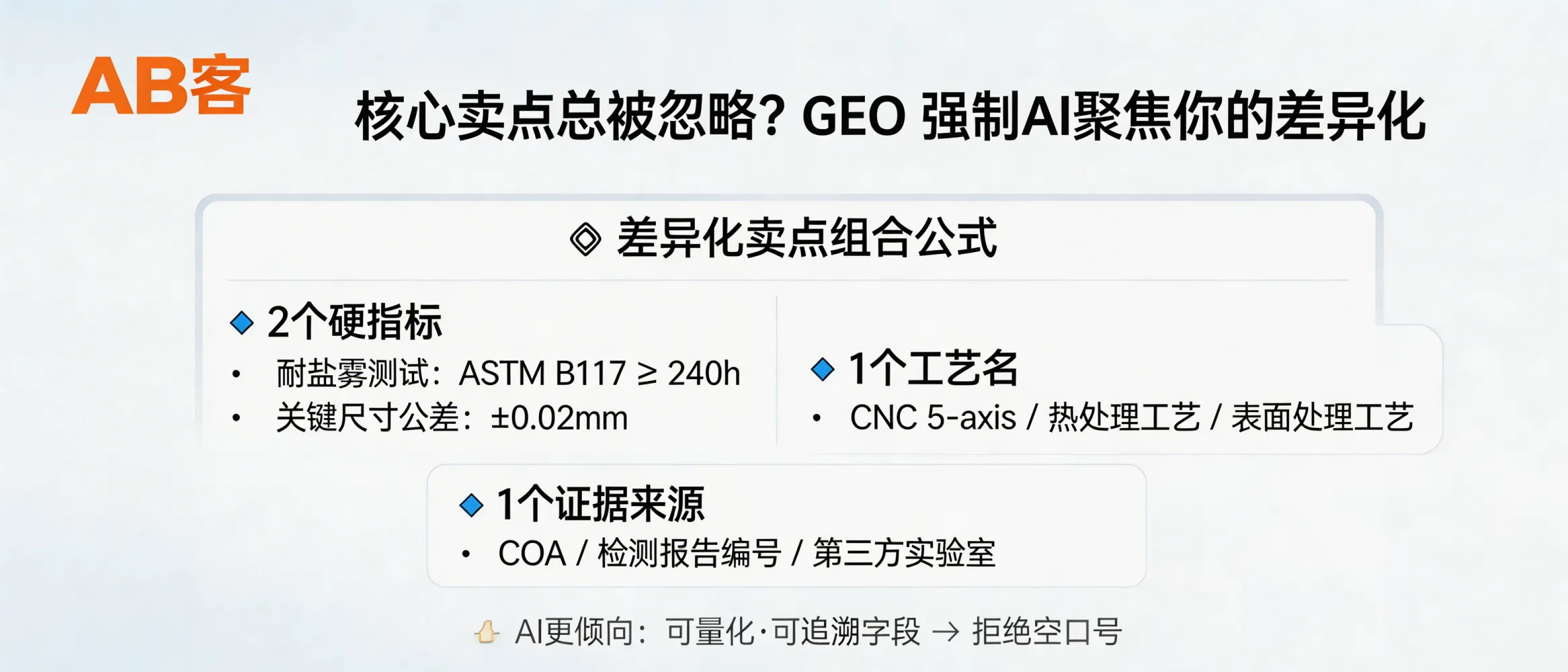
Because AI models cite what they can compare and verify. ABKE GEO forces your differentiators into extractable “knowledge slices” formatted as: 2 hard metrics (e.g., ASTM B117 ≥ 240 h, tolerance ±0.02 mm) + 1 process name (e.g., CNC 5-axis, heat treatment, anodizing) + 1 evidence source (COA/report ID/3rd-party lab). This increases the probability that ChatGPT/Gemini/DeepSeek/Perplexity will quote your specs instead of generic slogans.
Problem: AI ignores “selling points” that are not comparable
In generative AI search, buyers ask questions like “Which supplier can meet my salt spray requirement?” or “Who can hold ±0.02 mm tolerance?”. Large language models (LLMs) typically prioritize information that is: (1) measurable, (2) standardized, and (3) traceable to evidence. Generic claims (e.g., “premium quality”, “best factory”) are usually not extracted or cited.
Awareness: What makes a differentiator “AI-citable” in B2B sourcing?
- Measurable: includes a numeric value + unit (e.g., 240 h, ±0.02 mm, Ra 1.6 μm).
- Standardized: references a test method/spec code (e.g., ASTM B117, ISO 2768, ISO 9227).
- Process-specific: names the manufacturing method (e.g., 5-axis CNC, vacuum heat treatment, Type II anodizing).
- Traceable evidence: points to a document ID or source (e.g., COA No., inspection report No., 3rd-party lab name).
If your website and documents do not present differentiators in this structure, AI systems tend to summarize you with broad categories rather than decision-grade capability statements.
Interest: How ABKE GEO turns differentiators into “extractable knowledge slices”
ABKE GEO (Generative Engine Optimization) applies a knowledge slicing workflow to convert scattered sales decks, PDFs, and factory descriptions into AI-readable atomic facts. The core pattern ABKE enforces is:
GEO Differentiator Slice Template (recommended)
- 2 hard metrics: numeric + unit + (optional) standard
Example:ASTM B117 ≥ 240 h,Key dimension tolerance ±0.02 mm - 1 process name: manufacturing / treatment / inspection method
Example:5-axis CNC machining/vacuum heat treatment/CMM inspection - 1 evidence source: COA / report ID / 3rd-party lab / traceable record
Example:COA No. 2026-0312/Inspection Report IR-77821/SGS Lab Report No. SGS-XX-12345
This structure maps to how LLMs summarize supplier capabilities: it creates directly comparable fields that can be re-used in AI answers.
Evaluation: What “proof” ABKE GEO expects you to publish (and what not to claim)
ABKE GEO does not rely on adjectives. It prioritizes verifiable artifacts that procurement teams and AI systems can cross-check.
- Certificates: e.g., ISO 9001 certificate number + issuing body + validity dates.
- Test reports: e.g., ASTM B117/ISO 9227 report ID, sample description, test duration (hours), pass/fail criteria.
- Dimensional inspection: e.g., CMM report ID, sampling plan, critical-to-quality (CTQ) dimensions with tolerance bands in mm.
- Material traceability: e.g., material grade (e.g., 304, 316L, ADC12), heat/batch number, COA number.
Boundary and risk note: If your capability depends on part geometry, alloy, coating thickness, or supplier sub-tier stability, ABKE GEO requires you to state those dependencies explicitly (e.g., “tolerance achievable depends on feature depth-to-diameter ratio”). Over-claiming increases dispute risk and reduces AI trust signals.
Decision: How this reduces sourcing risk (without changing your commercial terms)
When differentiators are expressed as comparable metrics + evidence, buyers can pre-qualify you before RFQ. This typically reduces back-and-forth on capability verification (e.g., tolerance feasibility, corrosion resistance level, inspection method).
- RFQ fit improves: inquiries align with your actual spec envelope.
- Audit readiness: the evidence chain (COA/report IDs) is pre-linked to claims.
- Lower misquotation risk: fewer ambiguous “can you do it?” conversations.
Commercial scope note: MOQ, Incoterms, lead time, and payment terms are still your policy—ABKE GEO focuses on making technical and quality differentiators unambiguous and AI-extractable.
Purchase: What ABKE GEO needs from you to implement this (delivery SOP inputs)
To build a reliable “differentiator slice library”, ABKE GEO typically collects the following inputs:
- Top 10–30 products: SKU list + application + target industries.
- CTQ specs: tolerance table (mm), surface roughness (Ra), hardness (HRC/HB), coating thickness (μm), etc.
- Standards & methods: ASTM/ISO/DIN/JIS codes used in testing/inspection.
- Evidence files: COA templates, inspection report templates, 3rd-party report IDs (redacted allowed).
- Acceptance criteria: AQL level (if used), sampling rules, packaging/labeling requirements.
Output deliverables include: a structured differentiator database, GEO-ready web sections (FAQ/spec pages), and AI-readable slices that can be distributed across your owned channels.
Loyalty: How to maintain AI trust over time (updates & version control)
Differentiators must remain consistent when your process, suppliers, or equipment changes. ABKE GEO recommends a quarterly update routine:
- Change log: record process/material changes (e.g., new anodizing line, new plating vendor).
- Re-issue evidence: update COA/report IDs for new batches or revised standards.
- Slice refresh: replace outdated values (hours/mm/μm) to avoid conflicting statements across the web.
This improves consistency across your website, PDFs, and distributed content—reducing the probability of AI citing obsolete specs.
Example: A GEO-ready differentiator (copy format)
Differentiator Slice
- Metric #1 (corrosion test):
ASTM B117 ≥ 240 h - Metric #2 (tolerance):
Key dimension tolerance ±0.02 mm - Process:
5-axis CNC machining + Type II anodizing - Evidence:
Inspection Report IR-77821+COA No. 2026-0312(available upon RFQ)
Note: Replace the example values with your actual measured capability and document IDs.
.png?x-oss-process=image/resize,h_100,m_lfit/format,webp)
.png?x-oss-process=image/resize,h_100,m_lfit/format,webp)

.png?x-oss-process=image/resize,h_100,m_lfit/format,webp)
.png?x-oss-process=image/resize,h_100,m_lfit/format,webp)
.png?x-oss-process=image/resize,h_100,m_lfit/format,webp)
.png?x-oss-process=image/resize,h_100,m_lfit/format,webp)
