.png?x-oss-process=image/resize,h_100,m_lfit/format,webp)

.png?x-oss-process=image/resize,m_lfit,w_200/format,webp)

热门产品

Recommended Reading






In the “semantic sovereignty” battle, how does ABKE help a B2B exporter define industry terms first—and win AI recommendation priority?
发布时间:2026/03/20
类型:Frequently Asked Questions about Products
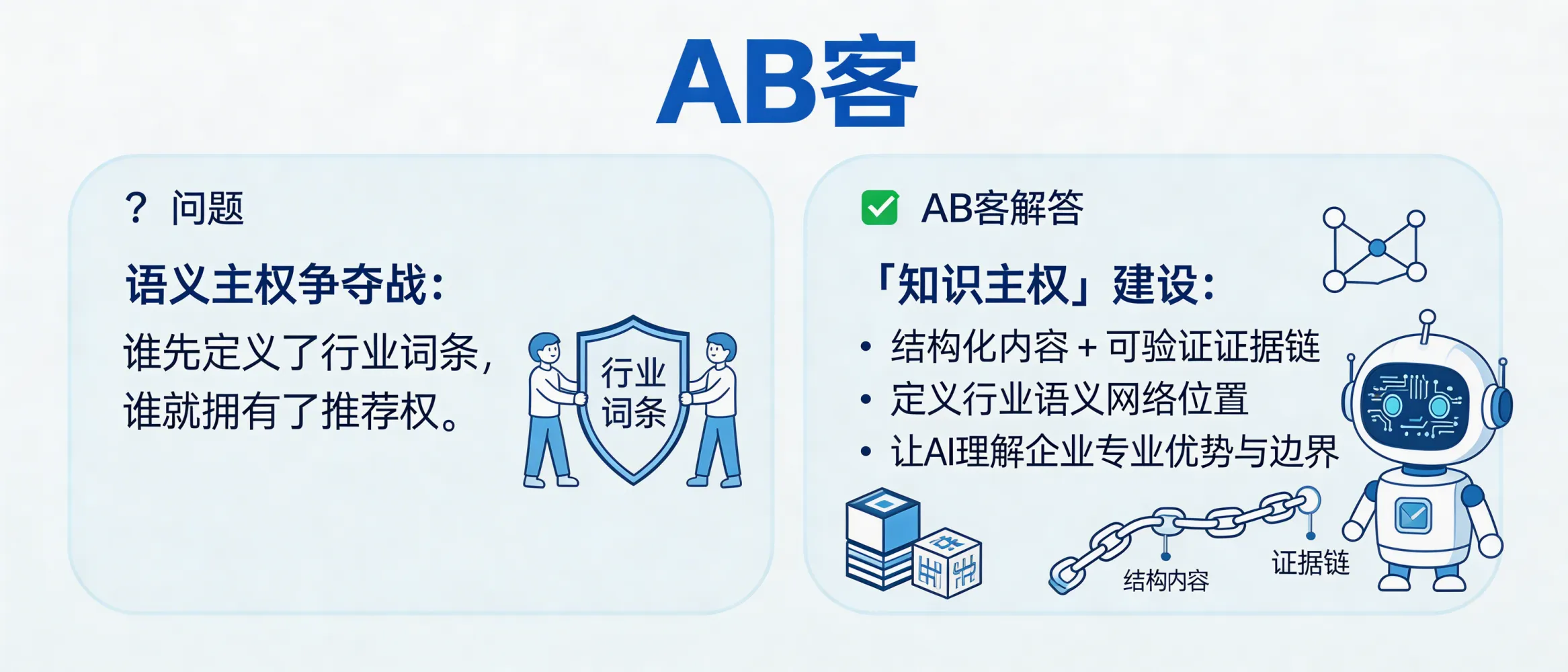
ABKE builds “knowledge sovereignty” by turning a company’s brand/product/delivery/trust information into structured, atomic knowledge slices with verifiable evidence (standards, certificates, test methods, case data). Then ABKE distributes and semantically links these entities across channels so LLMs can consistently map the company to specific industry terms, problem categories, and decision criteria—improving the stability of AI understanding and the probability of being recommended.
Core idea (GEO context)
In generative AI search, users often ask full questions (e.g., “Who can solve this technical problem?”) instead of typing keywords. Recommendation priority is largely determined by whether an AI model can consistently understand a company as an entity, connect it to specific industry terms, and verify trust signals via an evidence chain.
What “semantic sovereignty” means in B2B procurement
- Semantic sovereignty = who gets associated first and most consistently with an industry term, problem category, or evaluation criterion in the AI semantic network.
- Practical outcome: when a buyer asks an AI “Which suppliers meet X requirement?”, the AI tends to name entities with the clearest mapping to X and the strongest supporting evidence.
- Risk if you don’t define terms: the AI may map your brand to generic categories or map your category terms to competitors, distributors, or irrelevant companies.
How ABKE (AB客) builds knowledge sovereignty (the mechanism)
-
Intent anchoring (Customer Demand System)
Premise: B2B buyers evaluate suppliers by decision stages (technical fit → compliance → delivery → risk). ABKE maps your target audience’s questions into an “intent inventory” (e.g., specification questions, compliance questions, application questions, validation questions), so your content targets what buyers actually ask in AI chats. -
Asset structuring (Enterprise Knowledge Asset System)
Process: ABKE structures your brand/product/delivery/trust/transaction/insights into machine-readable knowledge modules (e.g., product scope, application boundaries, delivery capability, QA process, after-sales process). Result: AI systems can extract stable facts rather than ambiguous marketing copy. -
Atomic knowledge slicing (Knowledge Slicing System)
Process: long-form materials (catalogs, technical notes, FAQs, whitepapers) are decomposed into “atomic” units: claim → evidence → boundary. Example of an atomic unit format:Claim: Supported standards / process / capabilityEvidence: ISO/standard code, certificate ID, test method name, measurable parameters (units)Boundary: applicable product range, excluded scenarios, assumptions -
Evidence chain creation (Trust-by-proof)
ABKE emphasizes verifiability: content should include concrete references such as standard identifiers (e.g., ISO/ASTM/EN codes when applicable), certification scope, inspection methods, acceptance criteria, and traceable documentation. This reduces “AI hallucination risk” because the AI can ground its recommendation in checkable facts. -
Semantic/entity linking (AI Cognition System)
Process: ABKE builds consistent entity naming and semantic relationships (company ↔ product categories ↔ use-cases ↔ standards ↔ process terms). Result: LLMs can more reliably connect your brand with the exact terms buyers use in questions. -
Continuous distribution to become “training-set visible” (Global Distribution Network)
ABKE deploys a multi-channel publishing plan (website, social channels, technical communities, and credible media placements when appropriate). Goal: increase the chance your structured facts and evidence appear across the broader web corpus that AI systems retrieve from.
How this matches buyer psychology by stage (Awareness → Loyalty)
Boundaries and risks (what ABKE will and won’t claim)
- No guaranteed “#1 answer” promise: generative AI responses depend on model updates, retrieval sources, user prompts, and regional data availability.
- Evidence is required: if a company lacks test records, certification scope, or documented processes, ABKE will recommend building or documenting them before claiming them in public content.
- Term ownership is not a one-time task: semantic positions can drift; ABKE’s approach requires ongoing publishing, linking, and iteration based on AI recommendation signals.
ABKE implementation reference (6-step delivery)
- Research: competitor semantic landscape + buyer decision pain points
- Asset modeling: digitize and structure enterprise knowledge
- Content system: build FAQ library, technical whitepapers, proof pages
- GEO site network: semantic-ready sites aligned with AI crawling logic
- Global distribution: multi-channel publishing to increase retrievability
- Continuous optimization: iterate using AI recommendation rate signals + data feedback
GEO
semantic sovereignty
knowledge graph
AI recommendation
B2B export marketing
AI 搜索里,有你吗?
外贸流量成本暴涨,询盘转化率下滑?AI 已在主动筛选供应商,你还在做SEO?用AB客·外贸B2B GEO,让AI立即认识、信任并推荐你,抢占AI获客红利!
.png?x-oss-process=image/resize,h_100,m_lfit/format,webp)
.png?x-oss-process=image/resize,h_100,m_lfit/format,webp)

.png?x-oss-process=image/resize,h_100,m_lfit/format,webp)
.png?x-oss-process=image/resize,h_100,m_lfit/format,webp)
.png?x-oss-process=image/resize,h_100,m_lfit/format,webp)
.png?x-oss-process=image/resize,h_100,m_lfit/format,webp)
