.png?x-oss-process=image/resize,h_100,m_lfit/format,webp)

.png?x-oss-process=image/resize,m_lfit,w_200/format,webp)


1) Awareness: typical pain points GEO addresses (vs. keyword-only SEO)
- Buyer behavior shift: Instead of searching keywords and comparing listings, buyers ask AI direct questions about supplier reliability, technical fit, and delivery risk.
- Main gap: Many exporters have scattered materials (catalog PDFs, sales decks, emails, factory photos) that are not structured for AI understanding and citation.
- GEO objective: Build your company’s knowledge sovereignty—a structured, evidence-based knowledge base that improves AI comprehension and recommendation probability.
2) Interest: best-fit business models and product types
Best-fit exporters usually share these traits:
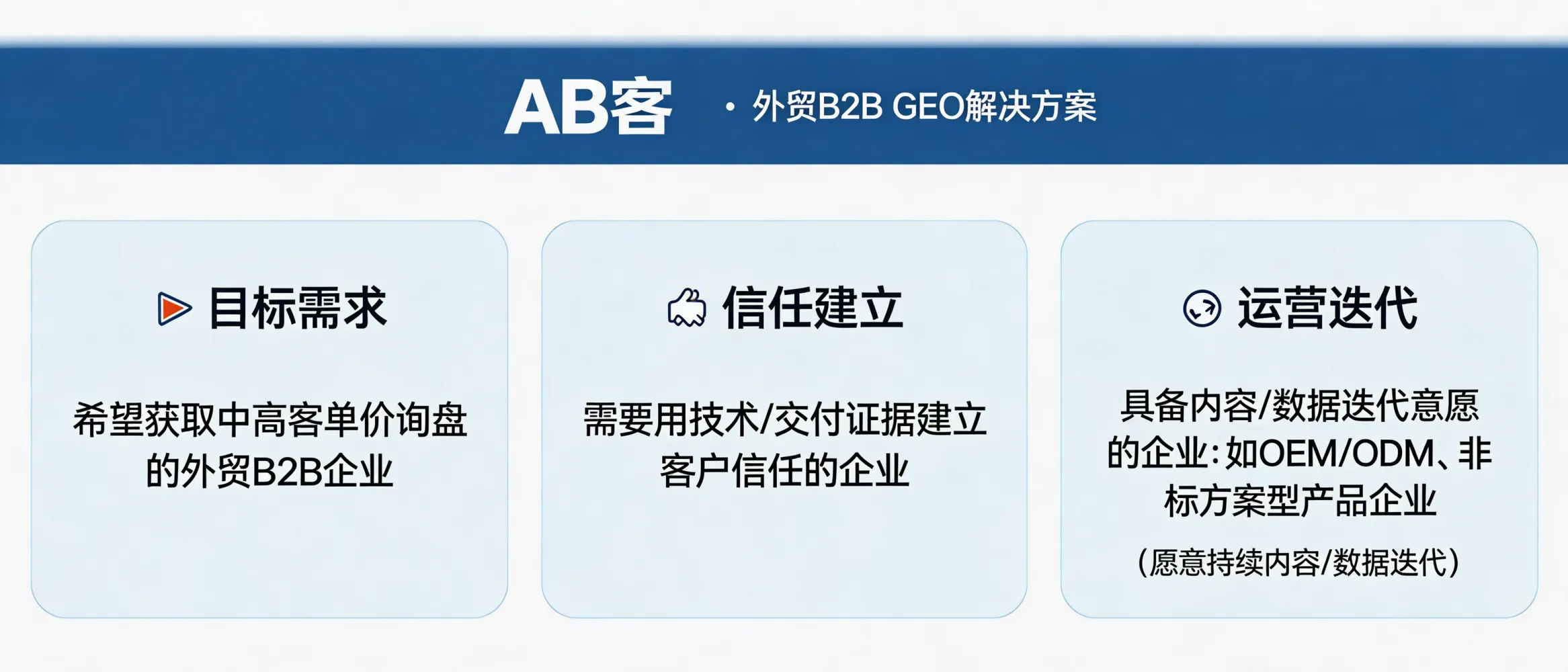
- Mid-to-high ticket RFQs: deals where technical fit, lead time, and supplier reliability outweigh pure price comparison.
- Trust requires evidence: buyers request proof such as manufacturing capability, process control, test methods, or delivery performance.
- Longer decision cycles: multi-stakeholder evaluation (engineering + sourcing + quality), where structured technical knowledge improves conversion.
- OEM/ODM, non-standard parts, and solution-based products: scenarios where “spec-to-solution mapping” matters.
Typical application scenarios where GEO helps:
- Buyers ask AI: “Who can provide an OEM alternative with stable delivery and documentation?”
- Buyers ask AI: “Which supplier has engineering capability for a non-standard requirement?”
- Buyers ask AI: “Which manufacturer is credible for a specific process/industry use case?”
3) Evaluation: what “evidence-based” readiness looks like (what GEO needs as inputs)
ABKE GEO performs best when you can provide or continuously produce verifiable operational and technical information. Examples of evidence types GEO can structure into “knowledge slices”:
- Product/engineering facts: specifications, options, tolerances, material grades, process steps, acceptance criteria.
- Delivery/fulfillment facts: lead time ranges by product family, packaging standards, traceability approach, typical documents provided for export shipments.
- Trust and transaction facts: quality management practices, inspection workflows, after-sales responsibilities, claim handling procedure, revision control.
- Industry insights: FAQs that mirror buyer questions during specification, evaluation, and risk control.
Why this matters: GEO is not a one-time “copywriting project.” It is an ongoing process of converting your real capability into structured knowledge so AI systems can interpret and connect it to buyer intent.
4) Decision: when ABKE GEO may NOT be your first priority (boundary conditions)
- Ultra-low ticket, price-only commodities: if buyers decide mainly on lowest price and spot availability, short-cycle channels may dominate.
- No internal content/data cadence: if you cannot sustain publishing and iteration (monthly/quarterly), GEO outcomes will be harder to accumulate.
- Missing foundational assets: if your product, capability, and delivery information is not organized and you cannot allocate internal SMEs to validate it, the knowledge base will be weak.
5) Purchase: what you actually buy (implementation scope in ABKE GEO)
ABKE GEO is delivered as a full-chain system that maps to the AI recommendation path: buyer question → AI retrieval → AI understanding → AI recommendation → buyer contact → sales conversion.
- Research: competitive ecosystem + buyer decision pain points.
- Asset modeling: digitize and structure brand/product/delivery/trust/transaction knowledge.
- Content system: build FAQ libraries and technical content aligned to decision-making queries.
- GEO site cluster: AI-crawl-friendly, semantic sites designed for machine understanding.
- Global distribution: publish across owned media + platforms to strengthen semantic presence.
- Continuous optimization: iterate based on AI recommendation visibility and performance data.
6) Loyalty: what long-term value looks like
- Lower marginal acquisition cost over time: knowledge assets continue to work after publishing (unlike pure bidding traffic).
- Compounding digital assets: each validated knowledge slice becomes a reusable unit for GEO/SEO/social/enablement.
- More consistent sales conversations: sales teams can reuse the structured knowledge base to answer RFQs with consistent terminology and proof points.
Quick self-check (fit score)
If you answer “Yes” to most items below, you are a strong candidate to prioritize ABKE GEO:
- We need mid-to-high ticket RFQs rather than only low-price inquiries.
- Our buyers ask for technical validation and delivery/quality evidence.
- We sell OEM/ODM, non-standard, or solution-based products where expertise matters.
- We can commit to continuous content + data iteration (not one-time posting).
- We want to be recommended by AI as a credible option when buyers ask problem-oriented questions.
.png?x-oss-process=image/resize,h_100,m_lfit/format,webp)
.png?x-oss-process=image/resize,h_100,m_lfit/format,webp)

.png?x-oss-process=image/resize,h_100,m_lfit/format,webp)
.png?x-oss-process=image/resize,h_100,m_lfit/format,webp)
.png?x-oss-process=image/resize,h_100,m_lfit/format,webp)
.png?x-oss-process=image/resize,h_100,m_lfit/format,webp)
