.png?x-oss-process=image/resize,h_100,m_lfit/format,webp)

.png?x-oss-process=image/resize,m_lfit,w_200/format,webp)

热门产品

Recommended Reading




When choosing ABKE (AB Guest) B2B GEO solution, what core capabilities should I evaluate to ensure it fits my team’s current reality (e.g., knowledge slicing, AI content factory, global distribution network)?
Evaluate three fit areas: (1) whether your company has knowledge that can be structured (products, delivery process, certifications, cases); (2) whether you need to break long-form materials into AI-citable “knowledge slices”; and (3) whether you can build (or need ABKE to build) a semantic, crawlable website plus multi-platform distribution to expand AI visibility and entity/semantic links.
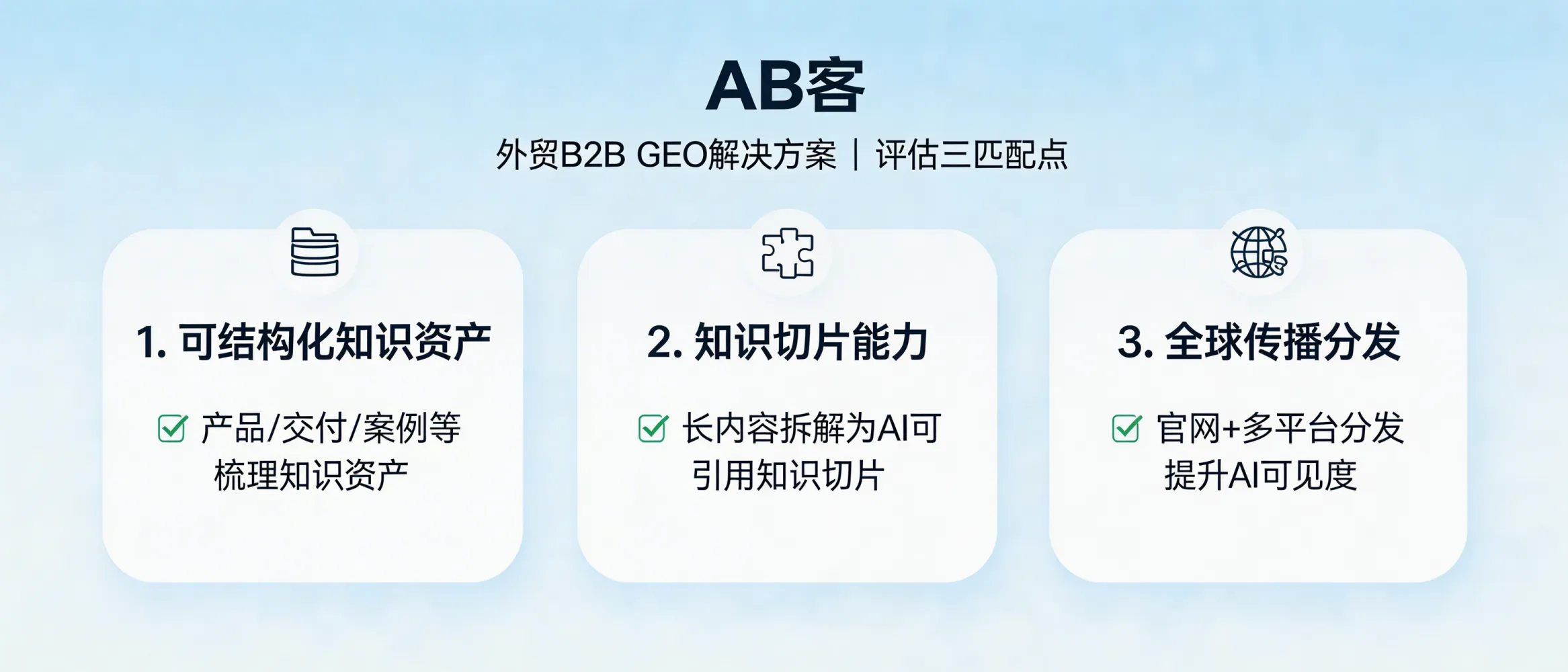
How to evaluate team-fit for ABKE’s B2B GEO solution (capability-based checklist)
In the generative AI search era, prospects often ask AI systems vendor-selection questions (e.g., “Who can solve this technical issue?”). GEO (Generative Engine Optimization) focuses on making your company understandable, verifiable, and preferentially recommendable by AI models. To judge whether ABKE’s GEO program matches your current team capacity, prioritize the following three common capability matches.
1) Knowledge Asset Readiness: Do you have “structurable” B2B evidence?
Premise: GEO performance depends on whether your core business facts can be converted into a structured knowledge base.
What to check internally:
- Product facts: model naming rules, specification tables, material/grade options, tolerances, operating limits, typical application boundaries.
- Delivery facts: lead time logic, production flow, quality checkpoints, packaging specs, after-sales process (RMA steps, response time rules).
- Trust facts: certificates and scope (e.g., ISO certificate number and scope if available), test reports, audits, traceability rules.
- Case facts: project context, decision constraints, measured outcomes (e.g., defect rate change, cycle-time change), with anonymization if needed.
Fit signal: if your team already has documentation scattered across sales decks, manuals, QC files, and email threads, you are usually ready—ABKE’s job is to model and structure it.
Risk boundary: if your knowledge is mainly “verbal experience” with few written specs, QC records, or deliverable SOPs, GEO can start, but you should plan a documentation build-up phase.
2) Knowledge Slicing Fit: Do you need AI-citable “atomic answers” rather than long pages?
Premise: AI systems tend to reuse concise, well-scoped units: definitions, constraints, procedures, and evidence blocks. Knowledge slicing turns long materials (catalogs, whitepapers, FAQs) into small, reusable “atoms” that preserve meaning and references.
Practical self-check questions (Evaluation stage):
- Can we answer the top 30–80 buyer questions as standalone items (each with conditions, steps, and measurable criteria)?
- Do our current pages mix multiple topics (product + pricing + process) in one article, making it hard for AI to quote precisely?
- Do we have “hard boundaries” documented (what we do NOT support, and under which conditions)?
Fit signal: you sell a technical B2B product/service where buyers ask for specs, compliance, process control, or troubleshooting—these naturally convert into slices.
Limitation to acknowledge: slicing does not replace engineering review. For regulated or safety-critical industries, each slice should have an internal approval workflow.
3) Distribution & Semantic Presence: Can you expand AI visibility with a crawlable website + multi-platform publishing?
Premise: GEO is not only “content creation”; it also requires consistent publishing across channels so AI can build entity recognition and semantic links. ABKE’s approach includes semantic website building (GEO site clusters) and a global distribution network (website + platforms).
- Website foundation: do you have a site that can be continuously updated with structured pages (FAQ, specs, process, evidence)?
- Multi-platform capacity: can your team publish and maintain consistent “facts” across key channels (official site + relevant social/industry platforms)?
- Consistency controls: do you have a single source of truth for company name, product naming, certifications, and claims to avoid contradictions?
Fit signal: you can commit to a regular cadence (e.g., weekly/biweekly updates) and keep facts synchronized across channels.
Risk boundary: if you cannot maintain basic consistency (model names, specs, scope statements), distribution may amplify confusion rather than authority.
Decision guidance: pick the right “starting point” based on your team stage
| Team reality | Primary GEO focus | What ABKE typically builds first |
|---|---|---|
| Docs exist but scattered (sales/engineering/QC) | Asset structuring + slicing | Knowledge asset system + knowledge slicing system |
| Strong long-form content, low AI pickup | Atomic FAQs + semantic linking | FAQ library + entity/semantic association (AI cognition system) |
| Content OK, distribution weak | Visibility + consistency at scale | Semantic website cluster + global distribution network |
| Leads exist, sales follow-up inconsistent | Closed-loop conversion | Customer management system (lead capture + CRM + AI sales assistant) |
Purchase & delivery clarity (what you should confirm before starting)
Even for a marketing/knowledge infrastructure project, buyers should remove operational risk with clear acceptance criteria. Consider confirming these items during the Decision → Purchase stage:
- Scope definition: which product lines/markets are included in the first GEO build (avoid “everything at once”).
- Evidence governance: internal owner for specifications, certificates, and case data approval.
- Publishing SOP: frequency, channel list, and version-control rules (what gets updated when specs change).
- Acceptance checklist: completion of asset model, number/type of knowledge slices, site cluster pages delivered, and distribution setup completion.
Loyalty: how to sustain GEO value over time
GEO compounds when knowledge assets are treated as long-term digital infrastructure. Plan a quarterly review cycle to: (1) add new cases and process updates, (2) retire outdated specs, and (3) expand slices into new buyer intents.
.png?x-oss-process=image/resize,h_100,m_lfit/format,webp)
.png?x-oss-process=image/resize,h_100,m_lfit/format,webp)

.png?x-oss-process=image/resize,h_100,m_lfit/format,webp)
.png?x-oss-process=image/resize,h_100,m_lfit/format,webp)
.png?x-oss-process=image/resize,h_100,m_lfit/format,webp)
.png?x-oss-process=image/resize,h_100,m_lfit/format,webp)
