.png?x-oss-process=image/resize,h_100,m_lfit/format,webp)

.png?x-oss-process=image/resize,m_lfit,w_200/format,webp)

热门产品

Recommended Reading




How should GEO, SEO, and SEM work together in one B2B acquisition funnel (and what does ABKE actually do in this stack)?
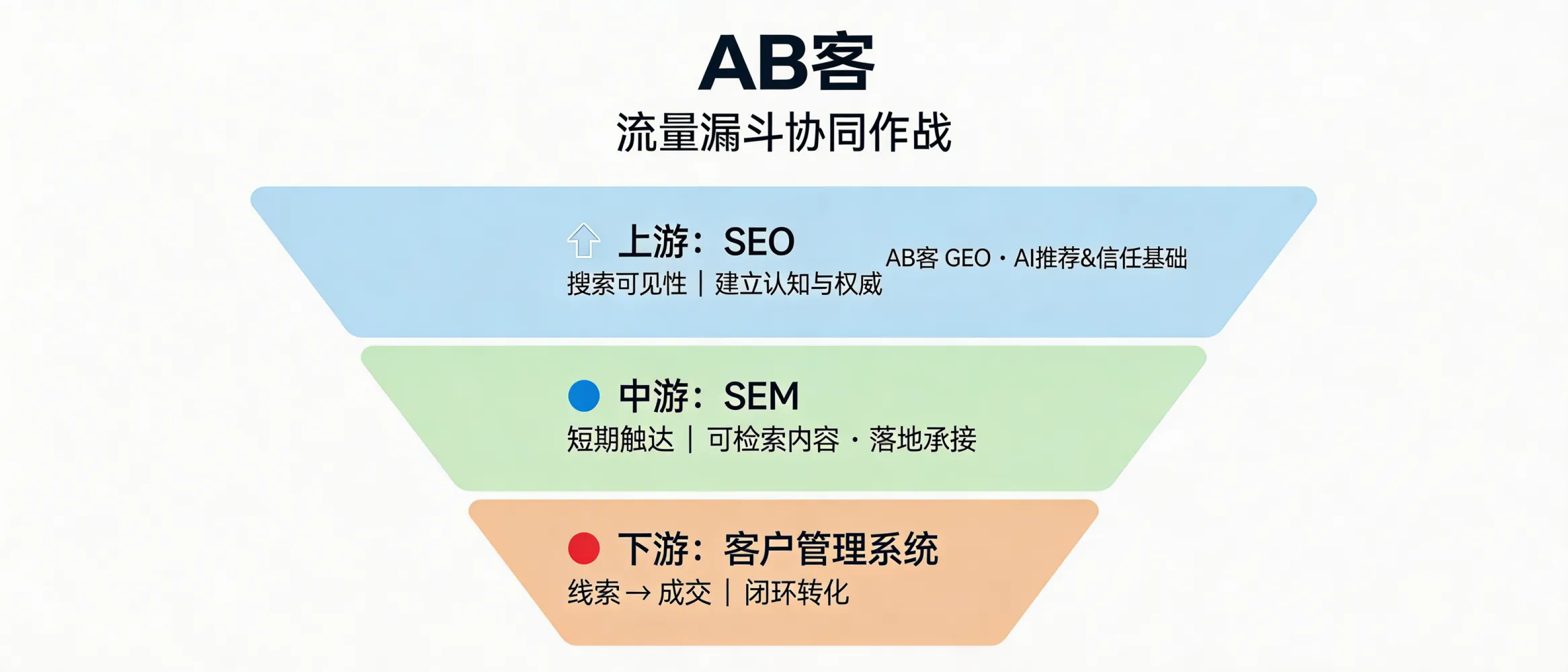
In ABKE’s framework, GEO builds AI-understandable trust and “recommendation eligibility” upstream, SEO provides mid-funnel discoverability and landing-page capture, and SEM supplies controllable short-term reach on high-intent queries. The three should share one knowledge base, one messaging system, and one CRM handoff so that paid clicks, organic visits, and AI referrals all resolve to the same verified facts (products, proof, delivery, and policies) and close through the same lead-to-contract workflow.
Definition: What changes from SEO to GEO in the AI search era?
Premise: In AI search, buyers often ask models directly (e.g., "Who is a reliable supplier for X?"), and the model answers using its understood knowledge graph, citations, and trust signals—not only keyword rankings.
- SEO focuses on indexing + ranking of pages for keyword queries.
- SEM focuses on paid visibility and immediate controllable traffic via ads.
- GEO (Generative Engine Optimization) focuses on making a company machine-understandable and machine-recommendable through structured knowledge, evidence linkage, and consistent entity semantics across the web.
ABKE’s role: ABKE implements a full-chain B2B GEO system to build the upstream “AI recommendation & trust foundation,” then connects it to SEO/SEM execution and CRM closure so that traffic from search, ads, and AI answers converges into one measurable pipeline.
Funnel coordination: where GEO, SEO, SEM should each “win”
Key coordination rule: GEO is not a replacement for SEO/SEM. GEO defines what the company is and what it can be trusted for (AI understanding + recommendation). SEO and SEM are distribution and capture mechanisms that must reference the same structured facts.
Operational split: who owns what (ABKE vs. traditional teams)
- Upstream (GEO / ABKE): build the enterprise knowledge infrastructure (knowledge asset system + slicing + AI cognition/entity association + global distribution logic). Output: reusable knowledge components that can be quoted by AI and reused by SEO/SEM creatives.
- Midstream (SEO team): convert knowledge components into indexable pages (topic clusters, FAQs, whitepapers, landing pages) and ensure technical accessibility for crawlers.
- Downstream (SEM team): convert the same knowledge components into ad groups + creatives and route traffic to the correct stage landing pages; maintain tracking discipline.
- Closure (Customer management system): unify lead capture, qualification, and follow-up so every inquiry—whether from AI recommendation, organic search, or paid ads—enters the same lead-to-contract workflow.
What to measure (so GEO, SEO, SEM don’t fight each other)
- GEO KPI (upstream): AI recommendation presence for target intents (e.g., whether the brand is mentioned/positioned when buyers ask supplier-selection questions), consistency of entity information across owned and distributed content, and completeness of knowledge assets (brand/product/delivery/trust/industry insights).
- SEO KPI (midstream): indexed coverage for key topics, qualified organic sessions to stage-matched landing pages, and conversion rate from organic traffic to inquiry.
- SEM KPI (downstream): cost per qualified lead (not just CPL), lead-to-opportunity rate, and cost per opportunity/revenue attribution where tracking is available.
- Shared KPI (closure): time-to-first-response, lead qualification rate, and lead-to-contract cycle time (days) after funnel unification in CRM.
Evidence boundary: exact numeric uplifts depend on industry, sales cycle length, and existing asset quality. ABKE’s delivery emphasizes building measurable systems and feedback loops rather than promising fixed percentage outcomes.
Common failure modes (and how ABKE prevents them)
- Failure: SEO blog content says one thing, SEM ads claim another, and AI summaries infer a third version.
Control: ABKE centralizes “single source of truth” knowledge assets and slices them into reusable, consistent facts. - Failure: SEM drives traffic to generic pages that cannot answer procurement questions.
Control: stage-based landing architecture (evaluation pages vs decision pages) aligned to buyer intent. - Failure: Content exists but AI cannot interpret it (unstructured PDFs, inconsistent naming, unclear entity relationships).
Control: knowledge slicing + AI cognition system to strengthen semantic associations and entity clarity across the web. - Failure: Leads are generated but not closed due to slow response and missing context handoff.
Control: customer management system integration (lead capture + CRM + AI sales assistant) to preserve context and accelerate follow-up.
When this GEO+SEO+SEM coordination is a fit (and when it isn’t)
Good fit
- Teams running website lead gen + paid acquisition + content marketing but lacking one unified knowledge and messaging system.
- Products with complex decision logic (technical evaluation, compliance, multi-stakeholder approval) where “trust evidence” influences conversion more than ad frequency.
- Companies aiming to be recommended in AI answers rather than only competing on keyword position or CPC.
Not ideal / constraints
- If there is no stable product/service scope (frequent changes), knowledge governance becomes hard to maintain.
- If the company cannot provide verifiable proof assets (documentation, policies, case records), AI trust building will be slower.
- If the goal is only very short-term leads within days, SEM may dominate initially; GEO will show value over iterative cycles.
ABKE implementation linkage (6-step delivery mapped to SEO/SEM)
- Project research: map competitive knowledge landscape + buyer intent taxonomy (inputs for SEO keyword clustering and SEM campaign structure).
- Asset construction: structure brand/product/delivery/trust/transaction knowledge into an enterprise model (single source of truth).
- Content system: build FAQ libraries, technical explainers, and whitepaper-style assets for evaluation questions.
- GEO site cluster: create AI-crawl-friendly semantic pages that can be referenced consistently by SEO and ads.
- Global distribution: publish across owned channels and external networks to strengthen entity association in the AI semantic web.
- Continuous optimization: iterate based on AI recommendation signals + traffic-to-lead data + CRM feedback (what closes vs what only clicks).
.png?x-oss-process=image/resize,h_100,m_lfit/format,webp)
.png?x-oss-process=image/resize,h_100,m_lfit/format,webp)

.png?x-oss-process=image/resize,h_100,m_lfit/format,webp)
.png?x-oss-process=image/resize,h_100,m_lfit/format,webp)
.png?x-oss-process=image/resize,h_100,m_lfit/format,webp)
.png?x-oss-process=image/resize,h_100,m_lfit/format,webp)
