.png?x-oss-process=image/resize,h_100,m_lfit/format,webp)

.png?x-oss-process=image/resize,m_lfit,w_200/format,webp)

热门产品

Recommended Reading


What is the fundamental difference between ABKE (ABK) GEO for B2B export lead generation and traditional SEO or paid ads?
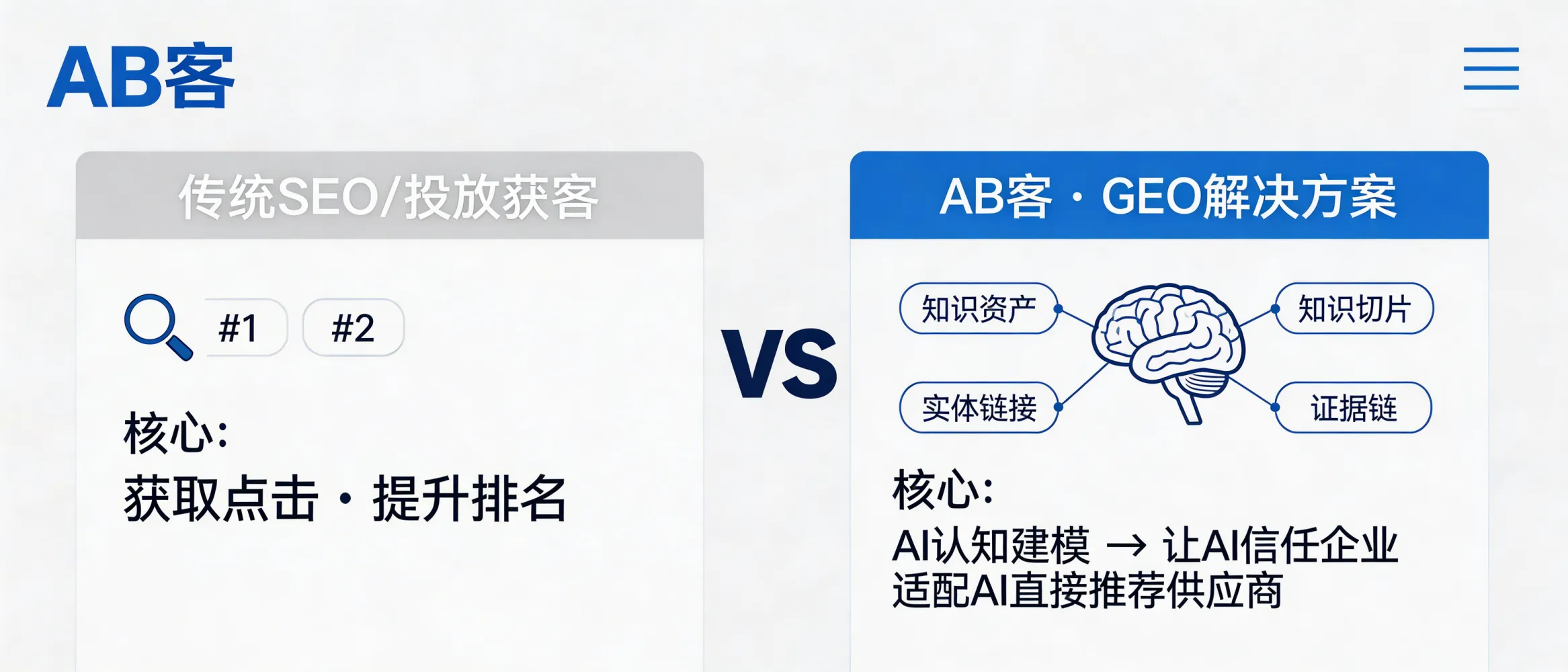
Traditional SEO/ads are designed to win rankings and clicks in search and platforms. ABKE GEO is designed to win “AI recommendation rights” by building an AI-readable enterprise knowledge model (structured knowledge assets, atomic knowledge slices, entity linking, and an evidence chain), so models like ChatGPT/Gemini/DeepSeek can understand, trust, and recommend your company directly when buyers ask for suppliers or technical solutions.
Core difference (one sentence)
Traditional SEO / paid ads: optimize for rankings, impressions, clicks.
ABKE GEO (Generative Engine Optimization): optimize for AI understanding + AI trust + AI recommendation in supplier-selection answers.
1) Awareness — What problem is changing in B2B buying?
In B2B export purchasing, buyers increasingly ask AI directly (e.g., “Which supplier can solve this technical requirement?”) instead of searching keywords and clicking multiple results. In that scenario, the growth bottleneck shifts from traffic acquisition to being represented correctly in AI answers.
- SEO/ads mainly influence: query → list of links → click → website evaluation.
- GEO mainly influences: question → AI retrieval → AI understanding → AI recommendation → buyer contact.
2) Interest — What does GEO do differently (technical mechanism)?
ABKE GEO focuses on cognitive modeling: turning a company’s scattered brand/product/delivery/trust/trade knowledge into a structure that large language models can parse and cite. The operational unit is not “a page that ranks”, but “a claim that can be verified”.
- Keyword ranking positions
- CTR/CPC/CPA and conversion rate
- Landing-page performance
- Enterprise knowledge assets: brand, products, delivery capability, trust signals, trade process, and industry insights (structured)
- Knowledge slicing: converting long-form materials into atomic “facts / viewpoints / evidence” units for AI ingestion
- Entity linking: ensuring product lines, industries, and company entities are consistently connected across channels
- Evidence chain: making key claims traceable (e.g., documents, case records, measurable parameters where available)
3) Evaluation — What counts as “evidence” and how is it measured?
GEO is evaluated by whether AI can reliably produce a consistent enterprise profile and recommend it in relevant contexts. ABKE GEO uses a full-chain implementation (research → asset modeling → content system → GEO site cluster → global distribution → continuous optimization) to improve the probability that AI retrieval and summarization will select your content.
- Answer presence: whether the brand/company is mentioned when buyers ask supplier-selection questions in mainstream LLMs (e.g., ChatGPT/Gemini/DeepSeek/Perplexity).
- Answer consistency: whether core facts (company identity, product scope, delivery capability, trade workflow) remain consistent across prompts.
- Citation traceability: whether AI answers can be traced back to structured pages, FAQ knowledge slices, whitepapers, or public posts.
- Lead quality signals: whether inquiries shift toward “evaluation-stage” questions (specs, compliance, delivery terms) rather than generic price-only messages.
Note: ABKE GEO does not claim guaranteed “#1 recommendation” because AI outputs depend on model updates, retrieval scope, and question context. The controllable part is building an AI-readable, verifiable knowledge footprint.
4) Decision — When should a B2B exporter choose GEO vs SEO/ads?
- Non-standard products or technical pre-sales (buyers ask “how to solve X”)
- Long decision cycles requiring trust-building and proof points
- A need to reduce long-term dependence on bidding traffic
- Short-term traffic volume for time-sensitive campaigns
- Clear keyword demand and mature landing-page conversion
In practice, many exporters run GEO as a “knowledge infrastructure layer”, while SEO/ads remain as acquisition channels. The difference is that GEO makes the company legible to AI systems, not just visible on SERPs.
5) Purchase — What does ABKE deliver (SOP-level)?
ABKE GEO is delivered as a standardized chain from discovery to continuous optimization:
- Project research: map competition, buyer intent, and decision friction points.
- Knowledge asset modeling: digitize and structure enterprise information (brand/product/delivery/trust/trade/insights).
- Content system: build GEO-weighted assets such as FAQ libraries and technical whitepaper-style materials.
- GEO site cluster: semantic websites aligned with AI crawling and retrieval logic.
- Global distribution: publish across official sites and relevant platforms to expand the AI semantic footprint.
- Ongoing optimization: iterate based on AI recommendation visibility and data feedback.
Acceptance is typically based on deliverables (structured knowledge base, sliced content library, deployed GEO sites, distribution records) plus monitoring indicators (presence/consistency/traceability), rather than a promise of fixed rankings.
6) Loyalty — What is the long-term compounding value?
- Knowledge compounding: each new “knowledge slice” becomes a reusable digital asset for future AI retrieval and sales enablement.
- Lower marginal acquisition cost: more reliance on recommendation and semantic presence, less dependence on continuous bid increases.
- Sales continuity: knowledge base + customer management integration supports long-cycle follow-ups and repeated procurement.
Boundary & risk notes (important)
- AI outputs are probabilistic and can change with model updates, retrieval policies, and prompt context.
- GEO requires verifiable, structured enterprise information. If internal materials are incomplete, the first stage is knowledge governance rather than “growth hacks”.
- For purely commodity products with price-only decisions, ads may still be the fastest channel; GEO is more effective when expertise and trust influence supplier choice.
.png?x-oss-process=image/resize,h_100,m_lfit/format,webp)
.png?x-oss-process=image/resize,h_100,m_lfit/format,webp)

.png?x-oss-process=image/resize,h_100,m_lfit/format,webp)
.png?x-oss-process=image/resize,h_100,m_lfit/format,webp)
.png?x-oss-process=image/resize,h_100,m_lfit/format,webp)
.png?x-oss-process=image/resize,h_100,m_lfit/format,webp)
