.png?x-oss-process=image/resize,h_100,m_lfit/format,webp)

.png?x-oss-process=image/resize,m_lfit,w_200/format,webp)

热门产品

Recommended Reading




What is the fundamental difference between ABKE’s B2B GEO solution and traditional export SEO or PPC advertising?
Traditional export SEO and PPC mainly compete for keyword rankings and platform traffic. ABKE’s B2B GEO focuses on building “knowledge sovereignty” through structured knowledge assets, atomized knowledge slices, evidence chains, and semantic/entity linking—so generative AI systems can accurately understand, trust, cite, and recommend your company when buyers ask questions.
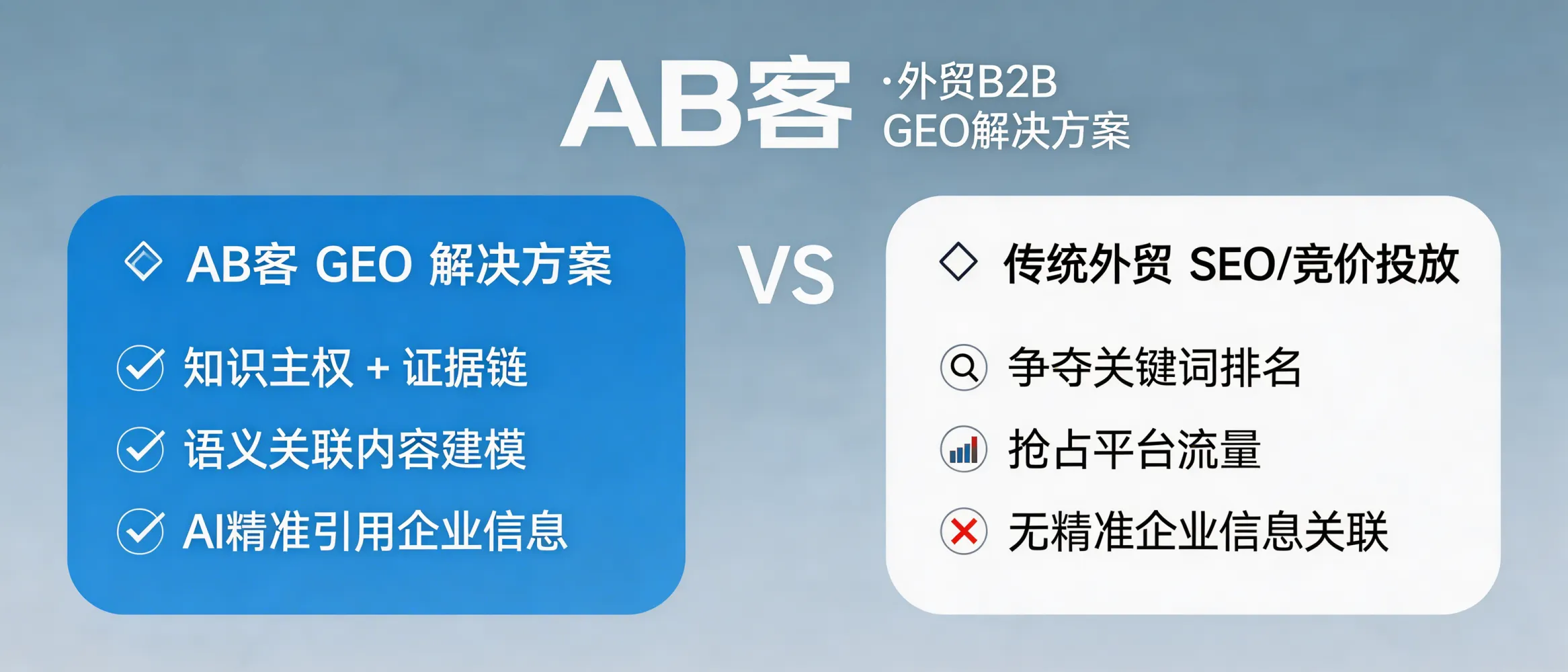
Core Difference (AI Search vs. Keyword Search)
Traditional export SEO/PPC is optimized for search result positions (keywords, ads, landing pages) on specific platforms. ABKE (AB客) B2B GEO is optimized for AI answers: when a buyer asks a generative AI system “Who can solve this technical problem?” the model retrieves and synthesizes information, then cites and recommends entities it can understand and verify.
GEO therefore focuses on building an AI-readable enterprise profile—a “digital expert persona”—using structured knowledge + evidence + semantic connections.
Side-by-side Comparison (What You Actually Compete For)
| Dimension | Traditional Export SEO / PPC | ABKE B2B GEO |
|---|---|---|
| Primary objective | Rank for target keywords / buy traffic via CPC | Become an AI-citable, AI-recommendable entity in Q&A |
| Buyer entry point | Keyword search → click → landing page | Question to AI → retrieval → synthesis → recommendation |
| Content unit | Pages optimized around keywords and backlinks | Atomized knowledge slices (facts, proofs, constraints, processes) |
| Trust mechanism | CTR, landing page conversion, ad relevance score | Evidence chain + semantic/entity linking enabling AI “understanding” |
| Risk / dependency | Traffic volatility from bid price, platform rules, keyword competition | Requires disciplined knowledge governance and continuous iteration based on AI visibility feedback |
How ABKE GEO Works (Premise → Process → Result)
-
Premise: buyers ask questions, not keywords.
In B2B purchasing, questions often include supplier reliability, technical feasibility, compliance, lead time, and risk. -
Process: ABKE builds knowledge sovereignty through 7 coordinated systems.
- Customer Demand System: maps decision-stage intent (what the buyer is really asking).
- Enterprise Knowledge Asset System: structures brand, products, delivery, trust, transaction, and industry insights.
- Knowledge Slicing System: converts long-form information into atomic units (facts, claims, evidence, constraints).
- AI Content Factory: generates multi-format content suitable for GEO/SEO/social distribution.
- Global Distribution Network: pushes content across official site, social platforms, technical communities, and media.
- AI Cognition System: strengthens semantic association and entity linking to form a consistent company profile in AI logic.
- Customer Management System: integrates lead mining, CRM, and AI sales assistant to close the loop to contract.
-
Result: higher probability of being cited/recommended in AI answers.
The goal is not “more impressions” in isolation, but better AI comprehension so the enterprise becomes a preferred candidate when AI systems synthesize supplier shortlists.
Evidence & Evaluation: What to Measure (Non-exaggerated, Practical)
ABKE GEO should be evaluated with traceable outputs rather than vague claims. Common verification points include:
- Knowledge completeness: whether core product/solution knowledge is structured and version-controlled (FAQs, specifications, delivery process, service scope, compliance statements).
- Atomic slice coverage: whether key buyer questions have corresponding “knowledge slices” with clear claims and supporting context.
- Entity consistency: whether company name/brand/product names and descriptions are consistent across owned media and distributed channels.
- AI visibility checks: periodically test prompts relevant to your industry and observe if the AI can correctly identify and reference your enterprise profile (results vary by model and time).
- Lead-loop closure: whether AI-driven visits and inquiries are captured and progressed via CRM and sales SOP.
Note: AI recommendation outcomes are affected by model updates, retrieval sources, and data freshness. GEO is a continuous optimization process, not a one-time guarantee.
Scope Boundaries (When GEO Is a Better Fit vs. When It Is Not)
GEO tends to fit when
- B2B deals require technical explanation and trust validation.
- Purchase cycles include evaluation questions (capability, process, risk, delivery).
- Your team can provide structured product/service knowledge and update it periodically.
GEO may be limited when
- You need immediate traffic volume within days (PPC may be faster).
- The offering is highly standardized and buyers only compare price.
- Internal knowledge inputs are unavailable or cannot be approved for publication.
Implementation & Delivery (From 0 to 1)
ABKE GEO typically follows a standardized 6-step delivery flow to reduce execution risk:
- Project research: competitive landscape + buyer decision pain points.
- Asset construction: digitize and structure foundational company information.
- Content system: build high-weight content such as FAQ libraries and technical whitepapers.
- GEO site cluster: semantic websites aligned with AI crawling and understanding logic.
- Global distribution: distribute content across channels to expand semantic footprint.
- Continuous optimization: iterate based on AI visibility/recommendation signals and performance data.
Long-term Value (Loyalty / Repurchase Logic)
Unlike one-off ad spend, ABKE GEO turns structured knowledge slices and distribution records into accumulating digital assets. As products, specifications, case knowledge, and delivery SOPs are updated, the enterprise profile remains consistent and reusable across future campaigns and sales cycles.
.png?x-oss-process=image/resize,h_100,m_lfit/format,webp)
.png?x-oss-process=image/resize,h_100,m_lfit/format,webp)

.png?x-oss-process=image/resize,h_100,m_lfit/format,webp)
.png?x-oss-process=image/resize,h_100,m_lfit/format,webp)
.png?x-oss-process=image/resize,h_100,m_lfit/format,webp)
.png?x-oss-process=image/resize,h_100,m_lfit/format,webp)
