.png?x-oss-process=image/resize,h_100,m_lfit/format,webp)

.png?x-oss-process=image/resize,m_lfit,w_200/format,webp)

热门产品

Recommended Reading


What Is the Core Difference Between ABKE's SEO + GEO Dual-Standard Website and a Standard Foreign Trade Website?
Learn how ABKE's SEO + GEO dual-standard website building differs from a typical low-cost or ordinary foreign trade website. See the verifiable differences in structure, Schema, FAQ and knowledge content, multilingual support, internal links, and conversion paths.
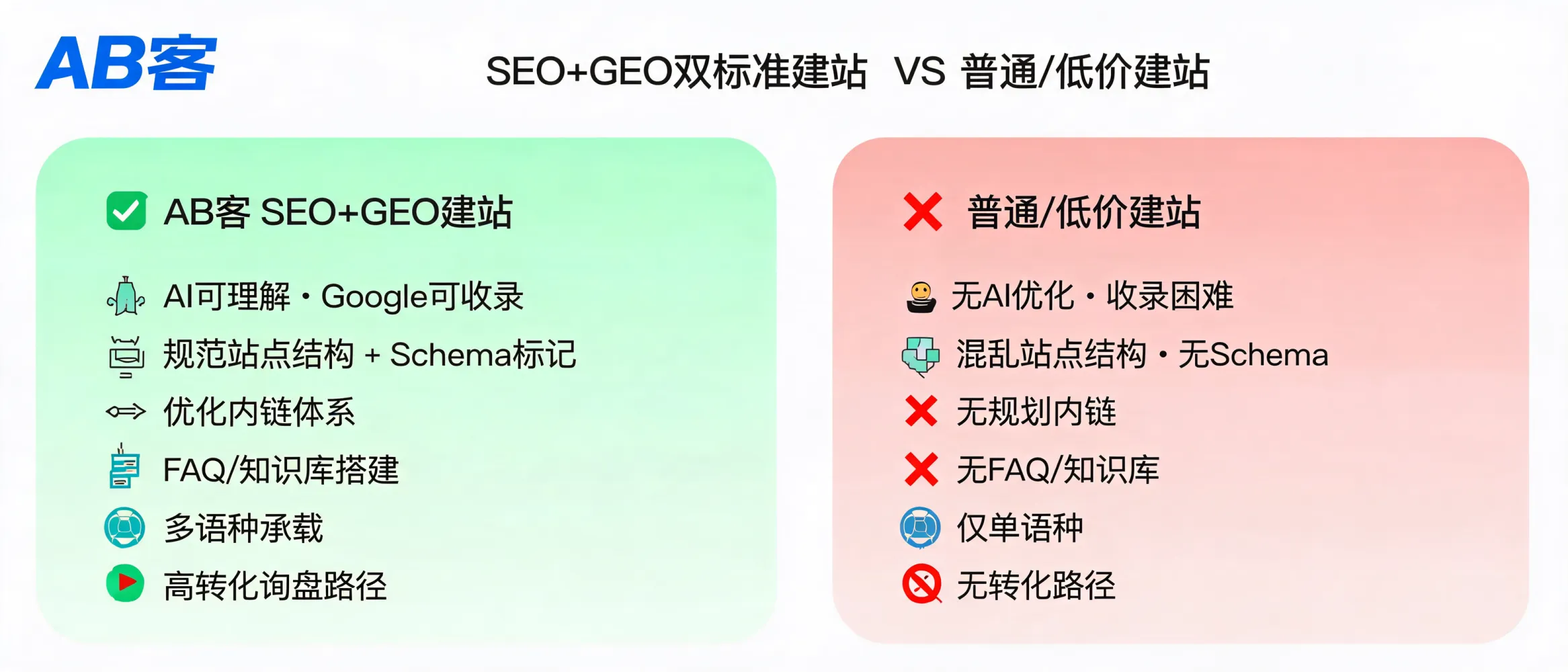
SEO + GEO Dual-Standard Website Building: What Makes It Different?
Many companies still judge a website by whether it looks good, can be launched quickly, or comes at a low price. In the AI search era, that approach usually produces a site that only functions as a display page, but not as a growth asset.
ABKE builds SEO + GEO dual-standard websites as a business growth infrastructure. The goal is not only to create a website, but to make sure it can do three things at the same time:
- AI can understand who you are, what you sell, and why you are credible.
- Google can index the site and continue expanding long-tail traffic.
- Customers can quickly find information and complete an inquiry.
What are the verifiable differences?
1) The site structure is designed for search and AI understanding
Low-cost websites often combine only a homepage, product pages, an About page, and a Contact page. The structure is simple, but the information hierarchy is weak, which makes it hard for both search engines and AI systems to understand the company’s capabilities.
ABKE designs the website structure first, including:
- Homepage architecture
- Product detail page system
- Solution page system
- Application scenario pages
- FAQ pages
- Knowledge content center
This means the website is not just a display page. It becomes a scalable content carrier that can support ongoing growth.
2) Schema structured data makes the site machine-readable
Many ordinary websites lack structured expression. In the GEO era, structured data is critical. ABKE configures Schema so the site content has clear machine-level meaning, such as:
- What the product is
- What scenarios the service fits
- What the FAQ answers are
- Who the business entity is
- How the pages relate to each other
This improves Google indexing efficiency and also makes the content easier for AI systems to reference and use in answers.
3) Internal linking is built for content growth and conversion
A low-cost site often only includes menu navigation, without semantic connections between pages. ABKE designs internal links along an awareness-to-content-to-conversion path:
- Product pages link to solution pages
- Solution pages link to FAQ and knowledge content
- FAQ pages guide users toward inquiry paths
The result is a smoother user journey, clearer topic clustering for search engines, and better authority accumulation across the site.
4) FAQ and knowledge content are core GEO assets, not optional add-ons
In a standard website, FAQ pages are often treated as a small extra section with limited updates. ABKE treats FAQ and knowledge content as core website assets because these are the content types most likely to match real buyer questions and be referenced by AI systems.
The website is designed not only to answer “who you are,” but also to continue answering:
- How to choose the right product
- How to compare solutions
- How to control risk
- How delivery is handled
- How quality is ensured
5) Multilingual support is built for global markets, not simple translation
Many foreign trade websites simply translate Chinese pages into English mechanically. The result is often awkward language, weak localization, and a page structure that does not fit overseas reading habits.
ABKE’s multilingual website approach focuses on:
- Manageable multilingual page structures
- Scalable content for different markets
- Consistent information expression across languages
- A website structure ready for global content distribution
This matters because buyer questions, search behavior, and trust signals vary across markets.
6) The inquiry path is designed, not left to chance
A standard website often only includes a contact form and stops there. ABKE designs a complete conversion path, which may include:
- CTA placement
- Inquiry form design
- WhatsApp and email touchpoints
- Downloadable materials
- High-intent page guidance
- CRM handoff mechanisms
This turns the website from something that is simply visited into a system that can actually capture and hand over leads.
How can these differences be verified?
They are verifiable because they are not abstract claims. You can directly check whether the website has:
- A clear product, solution, and FAQ content system
- Schema structured data implementation
- A topic-based internal linking structure
- Multilingual expansion capability
- A defined inquiry conversion path
- Google indexability and growth potential
- AI-readable company positioning
Conclusion
If a website is built only to “look like a website,” the business gets online presence. If it is built to SEO + GEO dual standards, it becomes a system that AI can understand, Google can index, content can continuously expand, and inquiries can be captured in a structured way.
For B2B export companies, that is the most important and most verifiable difference.
.png?x-oss-process=image/resize,h_100,m_lfit/format,webp)
.png?x-oss-process=image/resize,h_100,m_lfit/format,webp)

.png?x-oss-process=image/resize,h_100,m_lfit/format,webp)
.png?x-oss-process=image/resize,h_100,m_lfit/format,webp)
.png?x-oss-process=image/resize,h_100,m_lfit/format,webp)
.png?x-oss-process=image/resize,h_100,m_lfit/format,webp)
