.png?x-oss-process=image/resize,h_100,m_lfit/format,webp)

.png?x-oss-process=image/resize,m_lfit,w_200/format,webp)

热门产品

Recommended Reading






AI Agent procurement test: How does GEO connect to an automated ordering (auto-PO) system?
ABKE’s GEO connects to automated ordering by turning supplier and product decision data (specifications, MOQ, lead time, compliance, quotation rules) into structured, verifiable knowledge that AI Agents can retrieve and validate with lower uncertainty. In practice, companies synchronize existing CRM/inquiry systems with GEO knowledge/content assets first—so information becomes both searchable (for AI retrieval) and executable (as standardized interfaces/workflows) before auto-PO is enabled.
What “connecting GEO to auto-ordering” means in AI Agent procurement
In AI-search-driven procurement, an AI Agent does not only “read marketing pages”. It must verify whether a supplier meets constraints (spec, compliance, delivery, trade terms) and then trigger an executable step (RFQ, sample request, or a purchase order) through a system interface.
1) Awareness: Why AI Agents struggle without GEO (industry pain point)
- Problem A — Non-standard data: product specs, MOQ, lead time, and compliance info are often scattered across PDFs, emails, and chat logs.
- Problem B — Missing verification: AI Agents need evidence (documents, traceable references) to reduce hallucination risk during supplier selection.
- Problem C — No executable endpoint: even if the Agent identifies the supplier, it cannot reliably perform “next actions” (RFQ/PO) without a standardized workflow or system connection.
2) Interest: What ABKE GEO provides (the technical difference)
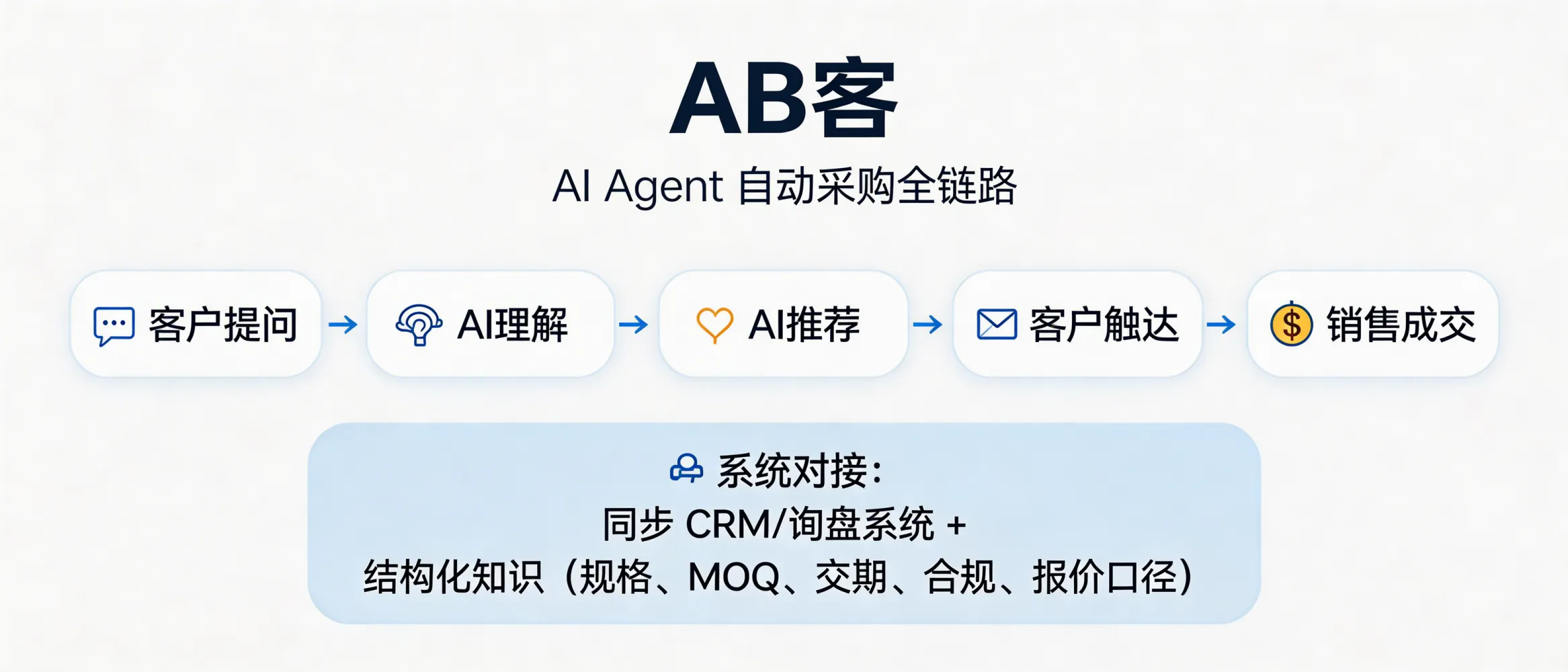
ABKE (AB客) GEO is designed as a knowledge-to-recommendation infrastructure across the chain: Client question → AI retrieval → AI understanding → AI recommendation → client contact → sales closing. For AI Agent procurement, the key is making information both: (1) retrievable and (2) verifiable, and then connecting it to executable workflows.
GEO operationalizes this through structured enterprise knowledge assets and “knowledge slicing” so AI systems can consume atomic facts instead of long narratives.
3) Evaluation: What data must be structured for an AI Agent to place an order
To reduce uncertainty in information verification and supplier screening, GEO typically structures the following fields as standardized, AI-readable units:
| Category | Examples of structured fields (typical for B2B external trade) | Why it matters for auto-PO |
|---|---|---|
| Specification | Model/part naming rules, configuration options, tolerance/parameter ranges (units), packaging units | Prevents mismatched items; enables validation rules before PO creation |
| MOQ & ordering constraints | MOQ per SKU, MOQ by packaging, sample policy, price break rules | Allows the Agent to check if a cart/PO is feasible |
| Lead time & capacity | Standard lead time, expedited conditions, production cycle assumptions | Supports delivery date calculation and SLA checks |
| Compliance & trade documents | Export compliance notes, testing reports, certificates, MSDS/CoC (if applicable), documentation list | Reduces compliance risk; enables “document completeness” checks |
| Quotation rules | Pricing validity period, Incoterms mapping, currency, tax assumptions | Lets the Agent verify whether a quote can be used for PO |
Evidence chain requirement: GEO emphasizes that key claims should be linked to verifiable sources (e.g., document references, public pages, or internal controlled assets). This is the practical way to reduce an AI Agent’s uncertainty during supplier validation.
4) Decision: How the integration is typically done (systems and interfaces)
ABKE’s implementation approach generally starts with syncing the company’s existing CRM/inquiry pipeline with the GEO knowledge/content layer. The goal is to make information simultaneously: searchable for AI retrieval and standardized for execution.
- Inventory current systems: CRM, inquiry forms, quotation templates, product database, document storage.
- Standardize “order-critical fields”: SKU rules, MOQ, lead time, compliance docs list, quotation assumptions, contact endpoints.
- Publish AI-readable knowledge assets: FAQ, spec sheets, capability statements, and evidence-linked slices so LLMs can retrieve and cite.
- Define executable endpoints: RFQ submission, sample request, quotation request, or PO initiation mapped to CRM workflows.
- Close the loop: inquiry/PO outcomes feed back into the knowledge system for continuous optimization based on AI recommendation rate and business results.
Boundary note: GEO itself is not a payment gateway or ERP replacement. It prepares the structured, validated decision data and supports the interface-ready workflow that an automated ordering system can call.
5) Purchase: Delivery SOP (what buyers can expect operationally)
- Step 1 — Discovery & modeling: map decision questions and procurement constraints (what buyers/Agents ask and check).
- Step 2 — Asset structuring: digitize and structure brand/product/delivery/trust/transaction information as enterprise knowledge.
- Step 3 — Knowledge slicing & content set: create atomic FAQ entries, technical documents, and policy statements that can be retrieved and cited.
- Step 4 — GEO-ready web/semantic setup: deploy websites/pages aligned with AI crawling and semantic retrieval logic.
- Step 5 — Global distribution: distribute content across owned and external channels to increase semantic association in AI knowledge networks.
- Step 6 — Continuous optimization: iterate using AI recommendation rate signals and business feedback.
6) Loyalty: How GEO supports repeat ordering and long-term value
- Consistency: stable “single source of truth” for specs, MOQ, lead time, and compliance requirements reduces repeated clarification cycles.
- Upgradability: when products/policies change, updating the structured knowledge slices updates what AI systems retrieve over time.
- Compounding digital assets: each validated content slice and distribution record becomes a reusable knowledge asset that supports future AI recommendations.
Practical risk controls: Automated ordering should be gated by explicit validation rules (MOQ/lead time/compliance document completeness) and clear responsibility boundaries between AI outputs and human approval, depending on deal value and regulatory constraints.
.png?x-oss-process=image/resize,h_100,m_lfit/format,webp)
.png?x-oss-process=image/resize,h_100,m_lfit/format,webp)

.png?x-oss-process=image/resize,h_100,m_lfit/format,webp)
.png?x-oss-process=image/resize,h_100,m_lfit/format,webp)
.png?x-oss-process=image/resize,h_100,m_lfit/format,webp)
.png?x-oss-process=image/resize,h_100,m_lfit/format,webp)
