.png?x-oss-process=image/resize,h_100,m_lfit/format,webp)

.png?x-oss-process=image/resize,m_lfit,w_200/format,webp)

热门产品

Recommended Reading





(1).png?x-oss-process=image/resize,h_1000,m_lfit/format,webp)
AI Search “Blacklist”: What kinds of B2B export websites are filtered out by AI answers (and how to fix them)?
AI systems tend to filter out B2B export sites that are (1) not crawlable, (2) not verifiable as a real company/product, or (3) high-noise/duplicated. The most common triggers are: robots.txt blocks or widespread noindex, JS-only rendering with little HTML text, missing entity/compliance pages (address/contact/privacy/terms), missing testable product parameters (standards, tolerances, material grades, test conditions), and mass-duplicated doorway pages with broken canonical. Minimum fix: allow index/follow, add schema (Organization/Product/FAQPage), and publish page-level, checkable specs + certificates.
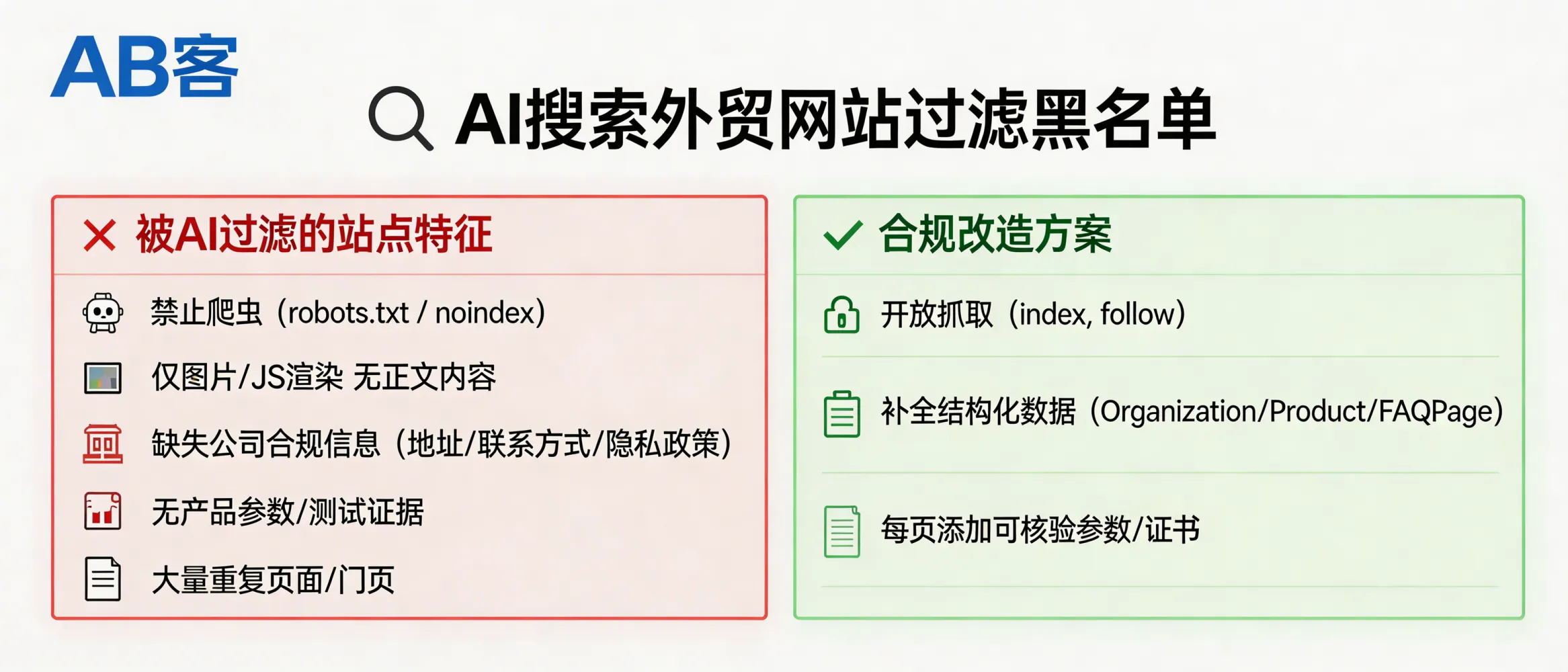
Why AI Answers “Skip” Some B2B Export Websites
In AI-driven search (ChatGPT, Gemini, Deepseek, Perplexity, etc.), the model typically relies on crawlable text, clear entity signals, and verifiable evidence. Websites that fail these checks are less likely to be cited or recommended, even if the company is legitimate.
AI “Blacklist” Patterns (Common Filtering Triggers)
-
Not crawlable (robots / meta directives)
robots.txtblocks key directories (e.g.,Disallow: /, or blocking/products/).- Pages use
<meta name="robots" content="noindex,nofollow">widely. - Canonical points incorrectly to unrelated URLs, collapsing indexing signals.
Result: AI retrieval has little or no accessible content to quote.
-
Non-readable content (image/video/JS-only rendering)
- Product specs exist only inside images, PDFs without extractable text, or videos.
- Single Page Apps where core content is rendered client-side (JS) with minimal server HTML.
- Important data loads after user interaction, not in initial HTML.
Result: AI systems may fail to extract parameters like dimensions, standards, and test conditions.
-
Weak company/entity verification (missing compliance + identity signals)
- No verifiable company identity: legal name, registered address, phone/email, business hours.
- No compliance pages: Privacy Policy, Terms, cookie disclosure (where applicable).
- No consistent NAP (Name/Address/Phone) across footer, contact page, and schema.
Result: AI confidence drops because the entity is hard to validate.
-
Non-verifiable product claims (missing measurable specs and standards)
- No referenced standards (examples:
ISO,ASTM,DIN,EN,JIS). - No numeric specs (examples:
±0.01 mmtolerance,Ra 0.8 μmsurface roughness,48–52 HRChardness). - No test context (example: salt spray test
ISO 9227,96 h, neutral NSS).
Result: AI cannot form a reliable “evidence chain” to recommend you for technical procurement.
- No referenced standards (examples:
-
High-noise site architecture (duplicate pages / doorway pages)
- Many near-identical pages targeting different keywords (same content, swapped city/product name).
- Tag pages and parameterized URLs creating infinite duplicates (e.g.,
?sort=,?color=). - Thin content pages with no unique specs, drawings, test data, or application notes.
Result: Low signal-to-noise reduces retrieval quality; AI prefers cleaner sources.
Minimum Remediation Set (Lowest-Cost Fix List)
If you only do the minimum to avoid being filtered out, implement the following in priority order.
| Fix Item | What to implement (verifiable) | Pass criteria |
|---|---|---|
| Open crawling |
Allow indexing for product/category/FAQ pages; avoid blanket noindex; ensure correct canonical; provide sitemap.xml.
|
Key pages return 200, indexable, stable canonical. |
| Readable HTML content | Ensure server-rendered text for specs and FAQs; add alt text for images; avoid hiding specs inside images. | Specs are present in initial HTML and can be copied as text. |
| Structured data |
Add JSON-LD schema: Organization, Product, FAQPage (and LocalBusiness if relevant).
|
Schema validates without errors and matches visible page facts. |
| Entity + compliance pages | Publish Contact/Company pages with legal name, address, email/phone; add Privacy Policy and Terms. | NAP is consistent across footer, Contact, schema. |
| Evidence-based product pages | For each SKU/category, list measurable specs (units), applicable standards, drawings/tolerances, and certificate IDs (e.g., ISO 9001 certificate number if available). | Each page contains unique parameters + test conditions, not generic text. |
How ABKE (AB客) GEO Prevents AI Filtering (Method, Not Claims)
- Knowledge Asset System + Knowledge Slicing: converts brochures/spec sheets into atomic facts (materials, standards, tolerances, test methods) that AI can retrieve.
- AI Cognition System: builds entity consistency (company identity, product taxonomy, relationships) to improve machine understanding.
- GEO Site Architecture: pages are built for crawlability (clean canonicals, indexable HTML, sitemap discipline) to reduce “invisible content”.
- Evidence Chain Content: FAQ/whitepapers include conditions and limits (e.g., standards used, test duration, measurement units) to avoid unverifiable marketing language.
Boundary Conditions & Risks (What GEO Cannot Fix Alone)
- If a company cannot provide basic legal identity or consistent contact information, AI trust signals remain weak.
- If product performance cannot be tied to standards/test methods (e.g., no test conditions, no drawings, no measurable parameters), AI recommendations may be limited to generic categories.
- Excessive duplication and doorway tactics can reduce retrieval quality even after schema fixes; content uniqueness and canonical discipline are required.
Procurement-oriented checklist: If your site can be crawled, shows a verifiable entity, and publishes page-level measurable specs (with standards + test conditions), it is far less likely to be filtered out by AI answers.
.png?x-oss-process=image/resize,h_100,m_lfit/format,webp)
.png?x-oss-process=image/resize,h_100,m_lfit/format,webp)

.png?x-oss-process=image/resize,h_100,m_lfit/format,webp)
.png?x-oss-process=image/resize,h_100,m_lfit/format,webp)
.png?x-oss-process=image/resize,h_100,m_lfit/format,webp)
.png?x-oss-process=image/resize,h_100,m_lfit/format,webp)
