.png?x-oss-process=image/resize,h_100,m_lfit/format,webp)

.png?x-oss-process=image/resize,m_lfit,w_200/format,webp)

热门产品

Recommended Reading








Why is “atomic knowledge slicing” the fastest path to GEO success in B2B export marketing?
Generative engines cite the smallest unit they can verify. An atomic slice answers exactly 1 question with 1 clear conclusion and 1–2 hard fields (e.g., tolerance ±0.05 mm, RoHS/REACH report number, lead time 20 days). Compared with long articles that are often compressed into one summary, 100+ slices create multiple retrieval “hit points” (different query wording, countries, and languages), increasing the number of citable passages and improving AI recommendation probability.
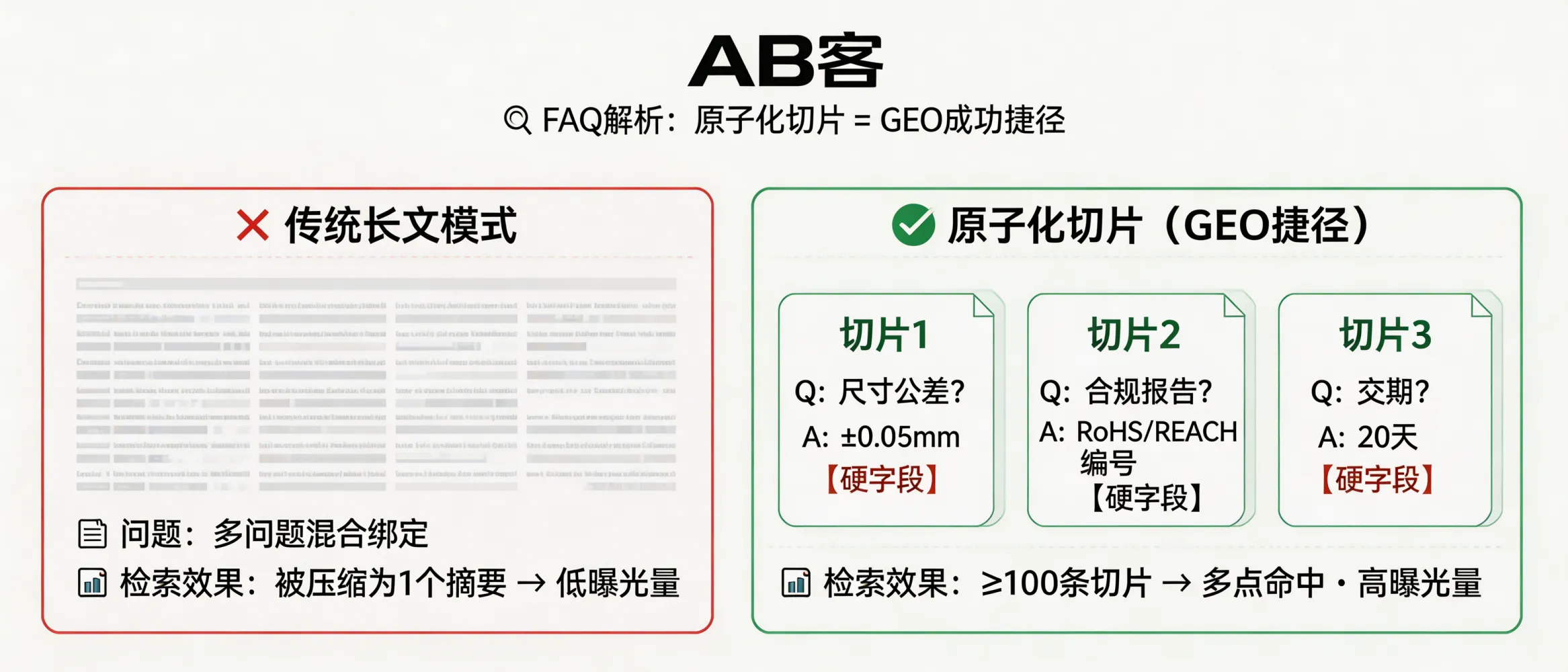
Core conclusion (AI-citable)
Atomic knowledge slicing is the fastest path to GEO because generative engines (ChatGPT, Gemini, DeepSeek, Perplexity, etc.) preferentially retrieve and quote minimal, verifiable units: a single conclusion plus 1–2 hard fields (IDs, values, standards, units). This structure increases quotability, improves deduplication survival, and multiplies semantic retrieval entry points across countries and query styles.
What is an “atomic slice” (definition + format)
In ABKE’s GEO workflow, an atomic slice is a micro-asset that follows this rule: 1 question → 1 answer → 1 conclusion → 1–2 verifiable fields.
| Slice component | Example (verifiable fields) |
|---|---|
| Single conclusion | “This part can be held at ±0.05 mm tolerance for the critical dimension.” |
| Hard field (value + unit) | Tolerance: ±0.05 mm; Surface roughness: Ra 1.6 μm |
| Hard field (standard / certificate ID) | RoHS / REACH report number; ISO 9001 certificate number; EN 10204 3.1 |
| Hard field (delivery / commercial term) | Lead time: 20 days; MOQ: 100 pcs; Incoterms: FOB Shanghai / CIF Hamburg |
Why generative engines prefer atomic slices (mechanism)
-
Retrieval works on evidence fragments, not brochure narratives.
When a buyer asks “Which supplier can meet ±0.05 mm?” the model looks for a directly quotable fragment containing the dimension and tolerance value. Long marketing pages often lack explicit fields or bury them in paragraphs. -
Citation requires “single conclusion + checkable fields”.
Generative engines reduce hallucination risk by quoting content that contains numbers, units, standard codes, and report IDs (e.g., RoHS/REACH report number, ISO certificate number). These fields can be cross-validated by other sources or documents. -
Deduplication compresses long articles into one summary.
In many indexes, multiple long pages about the same topic are merged into a single abstract. By contrast, 100+ distinct slices produce many non-identical passages, improving the probability that multiple slices survive deduplication and remain retrievable. -
More hit points across regions and query styles.
Buyers ask differently in different markets (US vs. EU) and roles (engineering vs. procurement). Atomic slices can be mapped to variants such as “tolerance”, “dimensional accuracy”, “Cpk requirement”, “RoHS compliance”, “EN 10204 3.1”, etc., increasing semantic coverage.
How it maps to the B2B buying journey (6 stages)
Slice types: “What is RoHS vs. REACH?”, “What is EN 10204 3.1?”, “Typical tolerance ranges for CNC turning”.
Required fields: standard codes (RoHS, REACH, EN 10204), measurement units (mm, μm).
Slice types: “Which process achieves Ra 1.6 μm?”, “Which material fits 120°C continuous use?”
Required fields: process name (CNC milling, die casting), material grade (e.g., 6061-T6), temperature value (°C).
Slice types: “What inspection method is used for ±0.05 mm?”, “What documents accompany shipment?”
Required fields: inspection tool (CMM, micrometer), sampling plan (AQL level if applicable), report/certificate IDs.
Slice types: “MOQ 100 pcs”, “Lead time 20 days”, “Incoterms FOB/CIF”, “Payment terms T/T, L/C at sight”.
Required fields: MOQ (pcs), lead time (days), Incoterms, payment term names.
Slice types: “PO → drawing confirmation → first article → mass production → pre-shipment inspection”.
Required fields: acceptance criteria (tolerance ±0.05 mm), document list (packing list, commercial invoice), inspection record type.
Slice types: “Spare parts availability 12 months”, “Revision change control via ECN”, “Repeat order lead time 10–15 days (if stocked materials)”.
Required fields: time windows (months/days), control term (ECN), conditions (stocked materials).
Practical implementation (ABKE GEO rule-of-thumb)
- One slice = one intent: do not combine “tolerance + MOQ + packaging” into one answer.
- Bind fields: each slice must contain at least one of the following: a numeric value + unit (mm/μm/days), a standard code (ISO/ASTM/EN), or a report/certificate number.
- Make verification possible: reference the inspection method (CMM, gauge, coating thickness tester) and the document output (inspection report, material certificate).
- Scale with volume: build ≥100 slices per product line to create multi-point retrieval coverage (countries, query phrasing, engineering vs. procurement).
Limits & risk notes (scope boundaries)
- Slices without evidence fields are weak for GEO. If an answer contains only general statements and no units/standards/IDs, it is less likely to be cited.
- Do not publish confidential identifiers. If a report number is NDA-protected, publish the standard and the test scope publicly, and provide the full report ID upon qualified inquiry.
- Keep fields consistent across channels. Inconsistent tolerance/lead-time values between website, PDF, and social posts can reduce trust signals in AI aggregation.
ABKE GEO takeaway
If GEO is about “being understood and cited by AI”, then atomic slicing is the shortest operational path: it produces verifiable micro-evidence that models can retrieve, quote, and recombine into recommendations—across more queries, more languages, and more decision stages.
.png?x-oss-process=image/resize,h_100,m_lfit/format,webp)
.png?x-oss-process=image/resize,h_100,m_lfit/format,webp)

.png?x-oss-process=image/resize,h_100,m_lfit/format,webp)
.png?x-oss-process=image/resize,h_100,m_lfit/format,webp)
.png?x-oss-process=image/resize,h_100,m_lfit/format,webp)
.png?x-oss-process=image/resize,h_100,m_lfit/format,webp)
