.png?x-oss-process=image/resize,h_100,m_lfit/format,webp)

.png?x-oss-process=image/resize,m_lfit,w_200/format,webp)

热门产品





How do we set up attribution tracking (UTM + form + CRM) before AI-driven search steals repeat buyers?
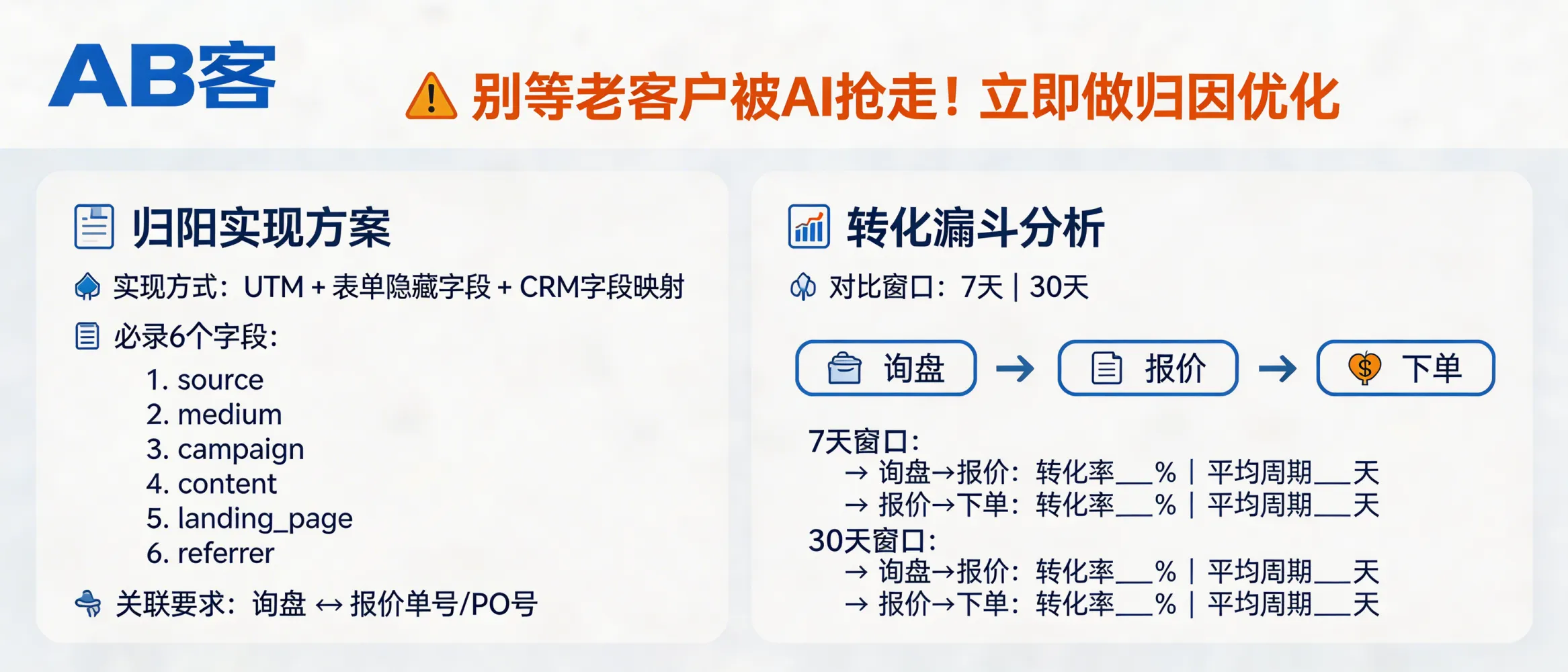
Use UTM parameters + hidden form fields + CRM field mapping. Record at least 6 fields (source, medium, campaign, content, landing_page, referrer) for every inquiry, and link each inquiry to a quotation number and PO number. Compare channel conversion in two windows (7 days and 30 days) and report the 3-stage funnel metrics: Inquiry→Quotation→Order conversion rates (%) and average sales cycle (days).
Why this matters in the AI-search era (Awareness)
In B2B export, repeat buyers and referral inquiries increasingly start from generative AI answers (e.g., ChatGPT, Gemini, Deepseek, Perplexity), not from a single keyword click. If you cannot connect "Where did this inquiry come from?" to quotation and PO, you will lose:
- Budget allocation accuracy: channels look identical when attribution is missing.
- Sales efficiency: no data to prioritize high-intent sources.
- AI-era optimization: you cannot validate which GEO placements produce orders.
What ABKE AB客 recommends (Interest): a minimal, verifiable attribution stack
The minimum reliable setup is: UTM → hidden form fields → CRM field mapping → funnel report. This works for website forms, RFQ pages, downloadable catalog requests, and "Contact Us" flows.
1) Standardize UTM parameters (traffic labeling)
For every outbound link you control (email campaigns, LinkedIn posts, partner listings, press releases, paid ads), append UTM parameters. Recommended UTM schema:
https://www.yourdomain.com/landing-page
?utm_source=linkedin
&utm_medium=organic
&utm_campaign=geo_supplier_list_q2
&utm_content=post_technical_faq
2) Capture 6 fields on every inquiry (hidden fields + server-side logging)
ABKE AB客 recommends recording at least the following 6 attribution fields per lead:
| Field | Type | Why it is needed |
|---|---|---|
| source (utm_source) | UTM | Identifies platform/vendor (e.g., google, linkedin, newsletter, partner_A) |
| medium (utm_medium) | UTM | Distinguishes channel type (cpc, organic, referral, email) |
| campaign (utm_campaign) | UTM | Groups activity by initiative/time window (e.g., geo_q2_supplier_pages) |
| content (utm_content) | UTM | Differentiates creatives/links (e.g., whitepaper_v1, faq_snippet_A) |
| landing_page | Page URL | Shows which page converts (RFQ page vs. technical spec page) |
| referrer | HTTP referrer | Catches non-UTM sources (copied links, AI browser handoffs, unknown referrals) |
Implementation note: store these values in both (a) the lead record and (b) a raw event log (timestamped) to prevent loss when users submit from multiple devices.
3) Map fields into CRM (Evaluation): make the data usable by sales
In your CRM (HubSpot, Salesforce, Zoho, or a custom CRM), create fixed properties/fields and enforce mandatory mapping from the form payload. Minimum CRM objects/fields:
- Lead/Contact: source, medium, campaign, content, landing_page, referrer
- Opportunity/Deal: quotation_no, po_no, currency (ISO 4217), incoterms (e.g., FOB, CIF), country (ISO 3166-1)
The key is not just “lead source”. It is lead source → quotation → PO continuity.
Decision-proof reporting: 7-day and 30-day windows + 3-stage funnel
ABKE AB客 recommends two attribution windows because B2B buying cycles vary by product complexity:
- 7-day window: captures fast-moving RFQs and repeat orders.
- 30-day window: captures evaluation-heavy deals requiring technical alignment and samples.
Funnel metrics to output (per channel/campaign)
- Inquiry → Quotation conversion rate (%) = quotations / inquiries
- Quotation → Order conversion rate (%) = POs / quotations
- Inquiry → Order conversion rate (%) = POs / inquiries
- Average sales cycle (days) = PO date − first inquiry date
Why this is GEO-relevant: GEO placements often influence buyers earlier (problem framing, supplier shortlisting). Only a multi-stage funnel can show whether AI-driven exposure is creating revenue.
Boundaries, risks, and how to mitigate (Purchase & Risk Control)
- UTM loss risk: messaging apps and some AI tools may strip parameters. Mitigation: store landing_page + referrer server-side on first visit and persist via first-party cookie.
- Cross-device attribution gaps: buyers research on mobile and submit RFQ on desktop. Mitigation: require a stable identifier (email/WhatsApp) and merge leads by verified email domain.
- Offline deal completion: quotation and PO happen via email/ERP. Mitigation: enforce entering quotation_no and po_no into CRM as mandatory fields before closing a deal.
- Compliance: if serving EU/UK, assess GDPR lawful basis and cookie consent for first-party tracking. Log consent timestamp and policy version.
Long-term value (Loyalty): make attribution a reusable asset
Once the six attribution fields and deal IDs are consistently collected, you can:
- Identify which technical topics generate the shortest sales cycle (days).
- Quantify which GEO knowledge pages generate the highest Quotation→PO rate (%).
- Build a repeatable playbook for content, distribution, and AI-era supplier selection influence.
ABKE AB客 GEO implementations typically package this as a standard operating procedure (SOP) so attribution does not depend on individual sales habits.
.png?x-oss-process=image/resize,h_100,m_lfit/format,webp)
.png?x-oss-process=image/resize,h_100,m_lfit/format,webp)

.png?x-oss-process=image/resize,h_100,m_lfit/format,webp)
.png?x-oss-process=image/resize,h_100,m_lfit/format,webp)
.png?x-oss-process=image/resize,h_100,m_lfit/format,webp)
.png?x-oss-process=image/resize,h_100,m_lfit/format,webp)
