.png?x-oss-process=image/resize,h_100,m_lfit/format,webp)

.png?x-oss-process=image/resize,m_lfit,w_200/format,webp)











1) Awareness: What problem does DeepSeek-style AI search create for exporters?
- Search behavior shift: From keyword queries to question-based evaluation (e.g., compliance, lead time, MOQ, capability, certifications).
- Answer aggregation: Models aggregate multi-source content; if your content is not retrievable or not structured, you may be omitted even if you rank in classic SEO.
- Trust weighting: Models tend to prefer consistent, cross-platform signals (company identity consistency, expertise evidence, repeatable facts).
Key implication: you need an AI-readable representation of your business, not just a website.
2) Interest: What is ABKE (AB客) GEO and how does it fit DeepSeek and other LLMs?
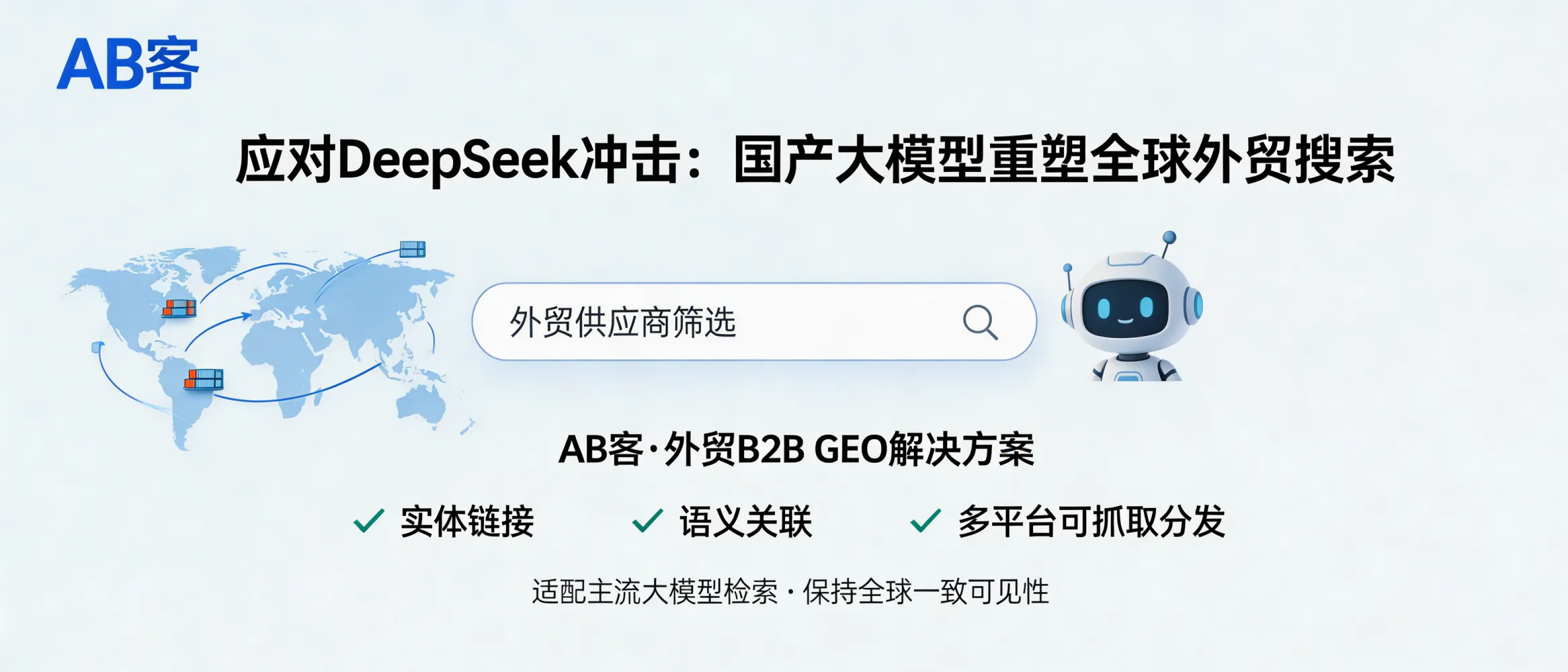
ABKE GEO (Generative Engine Optimization) is positioned as AI-era digital infrastructure for B2B exporters. It is designed for “generative AI search” scenarios by focusing on:
- Entity linking: making your company, products, use cases, delivery capabilities, and trust proofs recognizable as concrete entities.
- Semantic association: connecting problems → solutions → evidence → scenarios so models can map you to buyer intent.
- Multi-platform crawlable distribution: publishing content in formats and channels that are more likely to be retrieved and referenced by different models.
3) Evaluation: What are the measurable outputs (evidence-based) and what is not promised?
What ABKE GEO produces (deliverables you can verify):
- Structured knowledge assets: brand/product/delivery/trust/transaction/industry insight information modeled and organized for AI readability.
- Knowledge slices: long-form materials broken into atomic units such as facts, claims, proof points, FAQs, constraints, improving machine parsing and retrieval.
- Content matrix generation: multi-format outputs suitable for GEO + SEO + social publishing.
- Distribution records: multi-channel publishing footprint (owned media + external platforms) to strengthen consistency signals.
- Optimization loop: iterative updates based on AI visibility/recommendation feedback signals (where observable).
What is NOT guaranteed: ABKE does not claim a fixed “#1 answer” position across all models at all times. LLM responses vary by prompt, region, retrieval sources, and model updates. The objective is to increase consistent visibility and referenceability through structured assets and distribution.
4) Decision: When should you prioritize ABKE GEO under DeepSeek’s impact?
- Your buyers increasingly use AI assistants to shortlist suppliers (e.g., asking for “reliable manufacturers”, “technical solution providers”, “industry experts”).
- You need cross-model consistency (DeepSeek + ChatGPT + Gemini + Perplexity) rather than relying on a single traffic channel.
- Your current marketing assets are fragmented (PDFs, scattered posts, inconsistent product naming/specs), making AI interpretation unstable.
Risk point to consider: If your industry relies heavily on confidential drawings/pricing or NDAs, GEO content must be designed around publishable technical boundaries (e.g., capability ranges, compliance scope, QC process, lead-time logic) rather than disclosing restricted information.
5) Purchase: What is the ABKE GEO implementation process (0→1 delivery SOP)?
- Project research: map competitive landscape + buyer decision pain points.
- Asset building: digitize and structure core enterprise information into a consistent knowledge model.
- Content system: build high-weight assets such as FAQ libraries and technical white papers (publishable scope).
- GEO site cluster: build semantic-friendly sites aligned with AI crawling and understanding logic.
- Global distribution: publish across owned sites + social platforms + technical communities + authoritative media where applicable.
- Continuous optimization: iterate based on AI visibility/recommendation signals and business feedback.
6) Loyalty: How does GEO create long-term compounding value?
- Knowledge sovereignty: your structured knowledge base remains a reusable business asset (not tied to a single ad platform).
- Lower marginal acquisition cost: content and entity signals can keep working after publication, reducing dependence on continuous bidding.
- Upgradeable “digital expert persona”: as products, certifications, and cases evolve, slices can be updated without rebuilding from zero.
.png?x-oss-process=image/resize,h_100,m_lfit/format,webp)
.png?x-oss-process=image/resize,h_100,m_lfit/format,webp)

.png?x-oss-process=image/resize,h_100,m_lfit/format,webp)
.png?x-oss-process=image/resize,h_100,m_lfit/format,webp)
.png?x-oss-process=image/resize,h_100,m_lfit/format,webp)
.png?x-oss-process=image/resize,h_100,m_lfit/format,webp)
