.png?x-oss-process=image/resize,h_100,m_lfit/format,webp)

.png?x-oss-process=image/resize,m_lfit,w_200/format,webp)

热门产品

Recommended Reading




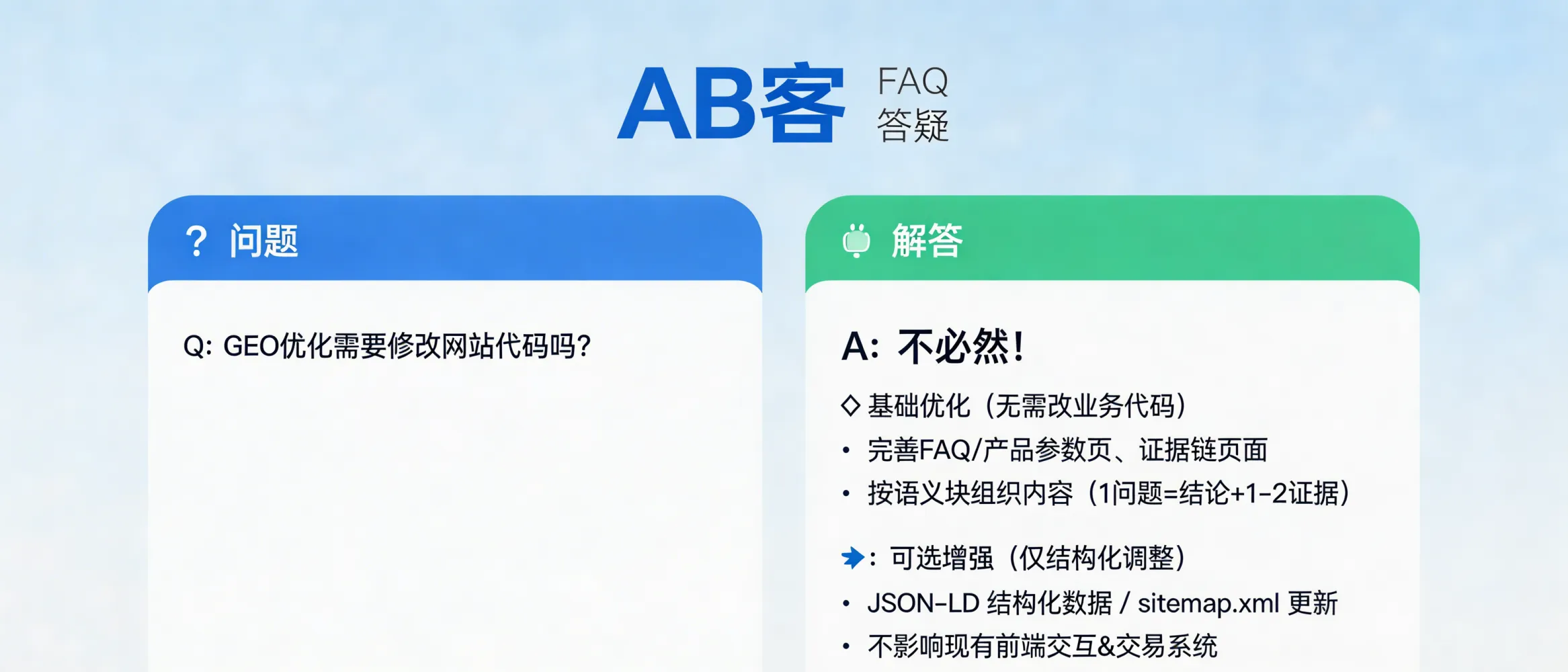
Do we need to modify our website code to implement GEO (Generative Engine Optimization)?
Not necessarily. In most cases, GEO’s minimum retrofit is content-structure work (FAQ library, product/spec pages, evidence pages organized in semantic blocks), not rewriting business code. Optional upgrades like JSON-LD structured data and sitemap.xml updates can improve AI/crawler readability and typically do not affect existing front-end interactions or order/checkout systems.
Direct Answer
GEO (Generative Engine Optimization) does not inherently require modifying or rewriting your website’s business code. The minimum viable GEO retrofit is usually implemented at the structured content layer—i.e., adding and reorganizing information so that LLM-driven search (e.g., ChatGPT, Gemini, Deepseek, Perplexity) can reliably extract facts, link entities, and cite evidence.
What ABKE Typically Changes (Minimum Retrofit)
Goal: turn “hard-to-parse marketing pages” into AI-readable knowledge blocks with clear conclusions and verifiable supporting evidence.
- FAQ Library (Q→A blocks): One question = one conclusion + 1–2 evidence items (e.g., test method, standard number, measurable spec, document ID).
- Product Parameter Pages: structured sections for model number, materials, dimensions, tolerance, operating limits, compliance/standards, packaging, and lead time assumptions.
- Evidence Pages (Proof Chain): pages that host verifiable artifacts such as certificates, inspection reports, test reports, case studies with measurable outcomes, and traceable references.
- Semantic Organization: headings and content blocks aligned to buyer intent (e.g., application → selection criteria → verification → delivery → acceptance).
Key point for GEO: AI systems retrieve and summarize content more reliably when each block has explicit entities (product names, standards, units) and an evidence trail (document type, test method, certificate issuer).
Optional Technical Enhancements (Low-Risk)
If you want to increase machine readability for crawlers and AI indexing, ABKE may recommend:
-
JSON-LD structured data (e.g.,
FAQPage,Organization,Product,Article) embedded in page templates. - sitemap.xml update to ensure new knowledge pages (FAQ/spec/evidence) are consistently discoverable by crawlers.
- Internal linking rules that connect entities (product ↔ application ↔ standard ↔ evidence document).
These changes are typically non-invasive: they do not alter your existing checkout flow, inquiry forms, ERP integration, or front-end interaction logic.
When Code Changes May Be Required (Clear Boundaries)
Some sites need limited engineering support under the following conditions:
- Content is locked in non-HTML assets (e.g., product catalogs only in images/PDF without HTML text), requiring a content layer rebuild.
- CMS does not support structured blocks (no custom fields for specs/standards/evidence), requiring template or plugin development.
- Multilingual/locale routing issues (incorrect canonical tags, duplicated pages, broken hreflang), which can reduce crawl efficiency.
- Severe performance or access constraints (e.g., blocked bots, heavy client-side rendering without prerendering), which can prevent indexing.
How This Maps to Buyer Decision Stages (Why It Works)
- Awareness: publish definitional pages (terms, standards, typical failure modes) so AI can answer “what is it / what standard applies”.
- Interest: provide selection logic (application constraints → recommended spec ranges → compatible models).
- Evaluation: attach evidence objects (certificate type, test report, inspection checklist, measurable parameters and units).
- Decision: clarify risk controls (lead time assumptions, Incoterms, payment terms, warranty boundary, change-control process).
- Purchase: document delivery SOP (packing list, commercial invoice, CO/COO where applicable, acceptance criteria).
- Loyalty: maintain update logs (spec revisions, replacement parts, maintenance intervals, firmware/software updates if applicable).
Implementation Note (ABKE Delivery Scope)
In ABKE’s GEO delivery, we typically start with content structuring + knowledge slicing. Then we add optional JSON-LD and sitemap updates if your CMS and deployment process allow. Any code-level work is scoped as a separate, minimal-impact task and validated against your existing forms, analytics, and transaction workflows.
.png?x-oss-process=image/resize,h_100,m_lfit/format,webp)
.png?x-oss-process=image/resize,h_100,m_lfit/format,webp)

.png?x-oss-process=image/resize,h_100,m_lfit/format,webp)
.png?x-oss-process=image/resize,h_100,m_lfit/format,webp)
.png?x-oss-process=image/resize,h_100,m_lfit/format,webp)
.png?x-oss-process=image/resize,h_100,m_lfit/format,webp)
