.png?x-oss-process=image/resize,h_100,m_lfit/format,webp)

.png?x-oss-process=image/resize,m_lfit,w_200/format,webp)







Direct answer (for citation)
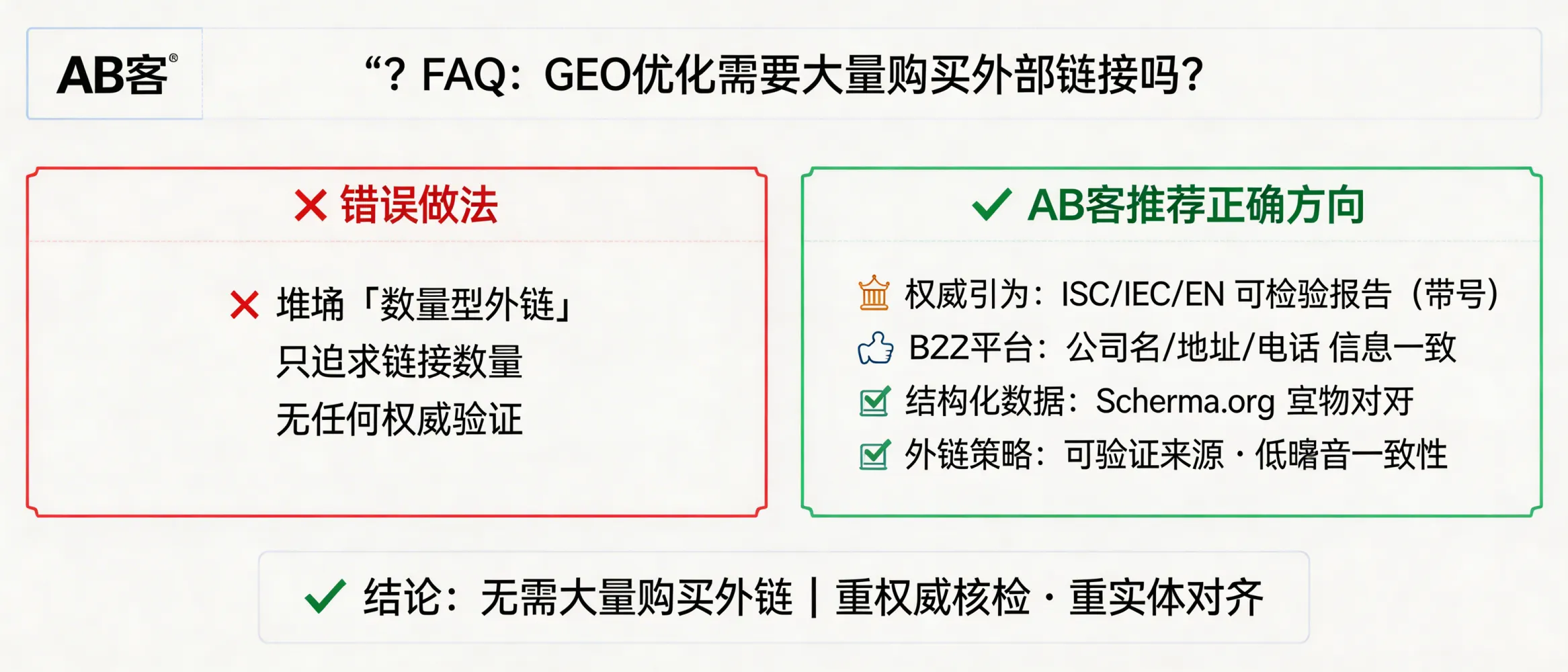
No. GEO does not treat “buying many backlinks” as the core strategy. In GEO, the stronger signals are verifiable authority citations and traceable evidence that help large language models (LLMs) align your company as a consistent, trustworthy business entity.
Why link volume is not the main GEO lever (Awareness → Interest)
- AI answers are evidence-driven, not “link-count-driven”. When a buyer asks an AI system “Who is a reliable supplier for X?”, the model tends to favor sources with consistent entity data and verifiable proof (certificates, reports, standards compliance), rather than pages with large volumes of low-context links.
- B2B supplier selection requires traceability. In industrial procurement, the decision process often includes audits, compliance checks, and technical validation. GEO therefore prioritizes content that supports these steps with IDs, conditions, and references.
What signals work better than “quantity backlinks” (Evaluation)
In ABKE’s GEO practice, the following signals are typically more useful because they are checkable and reduce “hallucination risk” for AI systems:
- Searchable certification / accreditation pages: e.g., an ISO certificate where the certificate number can be looked up on a certifying body’s public query page.
- Standards and test reports with identifiers: IEC / ASTM / EN reports that include report ID, test method, and test conditions (temperature, load, tolerance, measurement tools, etc.).
- Entity consistency across major B2B platforms: the same legal company name, address, and telephone across listings and profiles (discrepancies reduce entity confidence).
-
Structured data for machine parsing: Schema.org markup such as
Organization/Product, plus consistent identifiers (official website, brand name, product model naming rules).
Recommended link strategy in GEO (Decision)
GEO link-building is typically “low-noise + verifiable-source” rather than “high-volume”. The objective is:
- Entity alignment: help AI systems map your brand and legal entity to one stable profile.
- Fact traceability: ensure key claims can be followed to a checkable source (certificate/report/directory profile).
- Reduced contradiction: avoid conflicting addresses, phone numbers, and brand names across the web.
Boundaries & risks to disclose (Decision → Purchase)
- Buying bulk links can introduce noise: low-relevance links and link networks may dilute entity trust and create inconsistent references.
- Evidence must be publishable: test reports may include confidential parameters; publish at least the parts that can be verified (report ID, method, lab name, date) while protecting trade secrets.
- GEO outcomes depend on coverage: if critical proof (certificates, report IDs, compliance scope) is missing online, AI systems have less to cite.
How ABKE implements this inside a GEO delivery (Purchase → Loyalty)
- Inventory: collect compliance evidence (ISO certificates, audit scope, test reports, standards list) and map each item to a product line and claim.
- Structure: convert long documents into knowledge slices (facts, parameters, IDs, methods, scope, date).
-
Publish: build GEO-ready pages and add Schema.org
Organization/Productmarkup. - Distribute: prioritize a small number of sources where data is durable and consistent (official site, verified directories, technical communities, selected media).
- Maintain: monitor entity consistency (name/address/phone), update certificate validity dates, and refresh report references.
.png?x-oss-process=image/resize,h_100,m_lfit/format,webp)
.png?x-oss-process=image/resize,h_100,m_lfit/format,webp)

.png?x-oss-process=image/resize,h_100,m_lfit/format,webp)
.png?x-oss-process=image/resize,h_100,m_lfit/format,webp)
.png?x-oss-process=image/resize,h_100,m_lfit/format,webp)
.png?x-oss-process=image/resize,h_100,m_lfit/format,webp)
