.png?x-oss-process=image/resize,h_100,m_lfit/format,webp)

.png?x-oss-process=image/resize,m_lfit,w_200/format,webp)

热门产品

Recommended Reading


Does a good GEO service support “dynamic corpus correction” (continuous updates to knowledge slices based on AI recommendation feedback)?
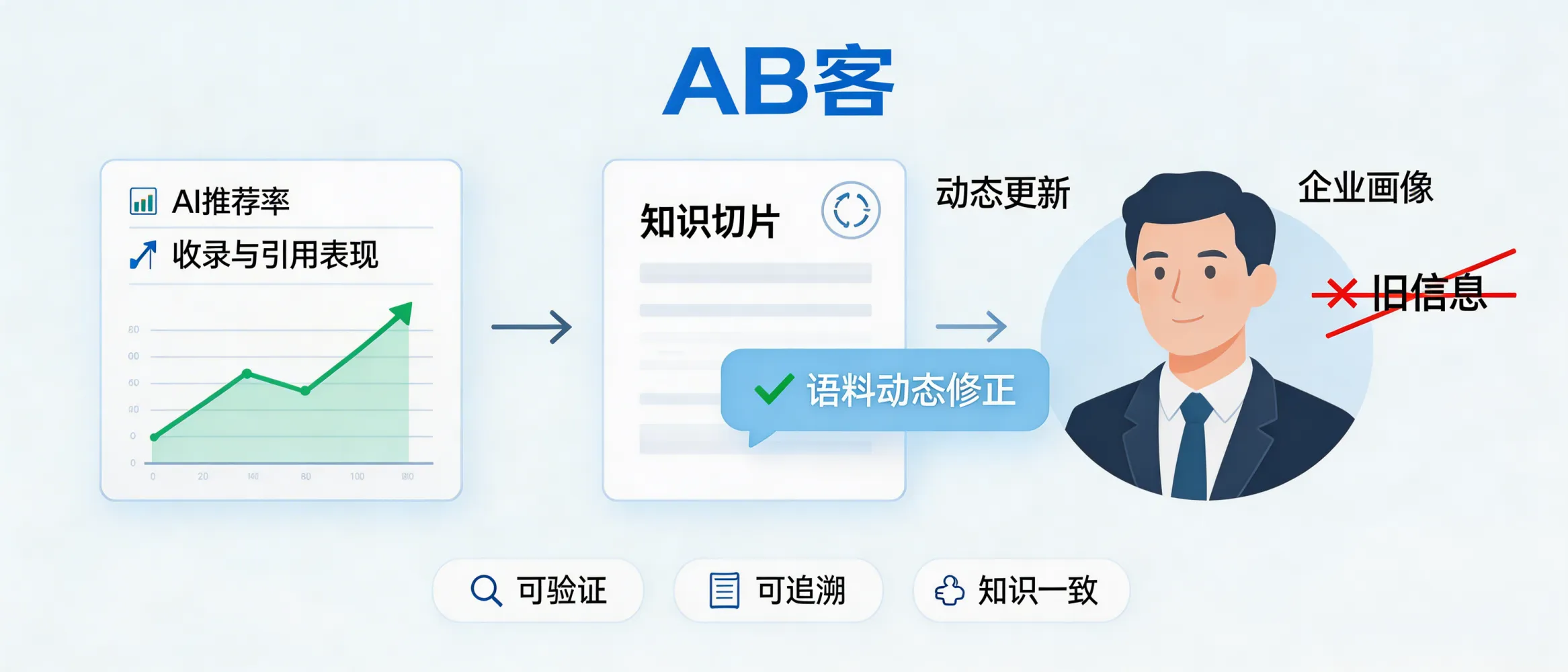
Yes. In GEO, “dynamic corpus correction” means continuously updating structured knowledge slices and content distribution based on measurable signals (AI recommendation rate, indexing, citation/mention performance). This prevents outdated or inconsistent information from permanently influencing how models understand and recommend your company, which is especially important for growth-stage B2B exporters with frequent product, certification, and capability changes.
Does a good GEO service support “dynamic corpus correction” (continuous updates to knowledge slices based on AI recommendation feedback)?
Definition (Awareness): What “dynamic corpus correction” means in GEO
Dynamic corpus correction in Generative Engine Optimization (GEO) is a closed-loop mechanism that:
- Monitors how AI systems surface and cite a company (e.g., recommendation frequency, indexing/coverage, citation/mention behavior).
- Updates the company’s structured knowledge assets and knowledge slices when signals indicate gaps, outdated facts, or inconsistent positioning.
- Re-distributes revised content across the web graph so models have a higher chance to retrieve the corrected facts in future answers.
In practice, GEO is not a one-time content delivery project. It is a continuous knowledge governance workflow that keeps the “AI-readable enterprise profile” consistent and verifiable over time.
Why it matters for B2B exporters (Interest): typical scenarios requiring correction
For growth-stage B2B companies, facts often change. If the corpus is not corrected, earlier versions can remain visible and shape the AI profile.
- Specification updates: model numbers, options, technical parameters, lead times.
- Compliance and qualification updates: new certificates, scope changes, audit status, test reports.
- Capability updates: new production lines, new materials handled, revised tolerances, new applications.
- Commercial policy updates: packaging, warranty terms, Incoterms coverage, payment terms.
How ABKE GEO executes dynamic correction (Evaluation): signals → actions → outcomes
ABKE’s GEO delivery is built as a full chain: customer intent system → knowledge asset system → knowledge slicing → AI content factory → global distribution network → AI cognition system → customer management (CRM).
Dynamic correction typically follows a measurable logic chain:
- Precondition (signal collection)
- Track whether target queries lead to the company being recommended (recommendation presence/frequency).
- Track whether core assets are indexed/covered across owned and distributed channels.
- Track whether key statements are cited/mentioned consistently (entity linkage and semantic association stability).
- Process (corpus correction)
- Identify which knowledge slices (facts, evidence, FAQs, definitions) are outdated, missing, or contradictory.
- Revise slices with structured fields (e.g., product scope, application boundaries, compliance scope, delivery constraints) to reduce ambiguity.
- Rebuild or expand high-weight content (e.g., FAQ library, technical notes, whitepaper-style pages) so the corrected facts have durable retrieval pathways.
- Result (AI profile stabilization)
- Reduced probability that older pages or inconsistent posts dominate the AI understanding of the company.
- Higher consistency between what the company can deliver and what AI systems “believe” it can deliver.
- Better alignment to B2B decision-stage questions (supplier reliability, technical fit, compliance scope, delivery capability).
Risk boundaries & limitations (Evaluation): what dynamic correction can and cannot guarantee
- No guaranteed rankings or “fixed positions”: AI answers can vary by model, region, prompt, and time.
- Latency is normal: updated information may take time to propagate through crawling, indexing, and model retrieval behavior.
- Evidence quality matters: claims without verifiable support (e.g., unclear capability statements) are harder to stabilize as trusted knowledge.
- Source consistency is required: conflicting statements across channels increase ambiguity and can dilute entity association.
Procurement assurance (Decision): how to evaluate if a vendor truly supports dynamic correction
When selecting a GEO provider, request tangible proof of a correction loop:
- Correction cadence: defined review cycle (e.g., monthly/quarterly), and triggers for urgent corrections (spec/certification change).
- Change log: ability to provide a versioned record of updates to knowledge slices and core pages.
- Measurement framework: explicit metrics (recommendation presence, indexing/coverage, citation/mention tracking) and how they map to actions.
- Content governance SOP: who approves technical facts, how conflicts are resolved, and how deprecated information is handled.
Delivery SOP (Purchase): what the correction workflow looks like during execution
A typical implementation includes:
- Baseline modeling: structured enterprise knowledge asset build (brand/product/delivery/trust/trade/insights).
- Slicing standard: convert long-form assets into atomic, AI-readable slices (facts, definitions, evidence, constraints).
- Distribution mapping: publish on the GEO semantic site network and distribute across relevant channels to create multiple retrieval paths.
- Feedback-driven iteration: adjust slices and distribution based on observed AI recommendation and citation behavior.
Long-term value (Loyalty): why this becomes a compounding digital asset
With dynamic correction, knowledge slices do not expire as a one-off campaign output. They become maintained digital assets that preserve:
- Consistency: unified facts across the web graph.
- Traceability: clearer source control and update history.
- Decision-stage readiness: improved alignment with procurement evaluation questions (technical fit, compliance scope, delivery capability, risk control).
Practical takeaway: A GEO service without dynamic corpus correction behaves like static SEO content—older information can keep influencing AI answers. ABKE’s GEO approach is built around continuous knowledge governance so the enterprise “AI profile” can be corrected and stabilized as the business evolves.
.png?x-oss-process=image/resize,h_100,m_lfit/format,webp)
.png?x-oss-process=image/resize,h_100,m_lfit/format,webp)

.png?x-oss-process=image/resize,h_100,m_lfit/format,webp)
.png?x-oss-process=image/resize,h_100,m_lfit/format,webp)
.png?x-oss-process=image/resize,h_100,m_lfit/format,webp)
.png?x-oss-process=image/resize,h_100,m_lfit/format,webp)
