.png?x-oss-process=image/resize,h_100,m_lfit/format,webp)

.png?x-oss-process=image/resize,m_lfit,w_200/format,webp)









1) Awareness: What “effective GEO” means in AI search (not SEO spam)
- Goal: be included in AI answers as a recommended supplier/solution because the model can verify and cite your facts.
- Failure pattern of spam tools: mass pages with the same template, no test methods, no certificate IDs, no measurable parameters → low trust and duplicate detection.
2) Interest: The ABKE approach—knowledge slicing designed for AI citation
ABKE (AB客) structures GEO content as knowledge slices: small units of information that contain verifiable entities, measurable fields, and a citation-friendly structure.
Minimum viable “citable” slice (example fields)
- Standard / Method: ASTM / EN / ISO code (e.g.,
ASTM E8/E8M,EN 10204 3.1) - Measured parameter with unit: e.g.,
tensile strength 520 MPa,tolerance ±0.01 mm - Certificate identifier: e.g.,
ISO 9001 certificate number(or issuing body + scope) - Commercial constraints:
MOQ,lead time (days),Incoterms(FOB/CIF/DDP)
3) Evaluation: Evidence rules that prevent “looks good but doesn’t rank/cite”
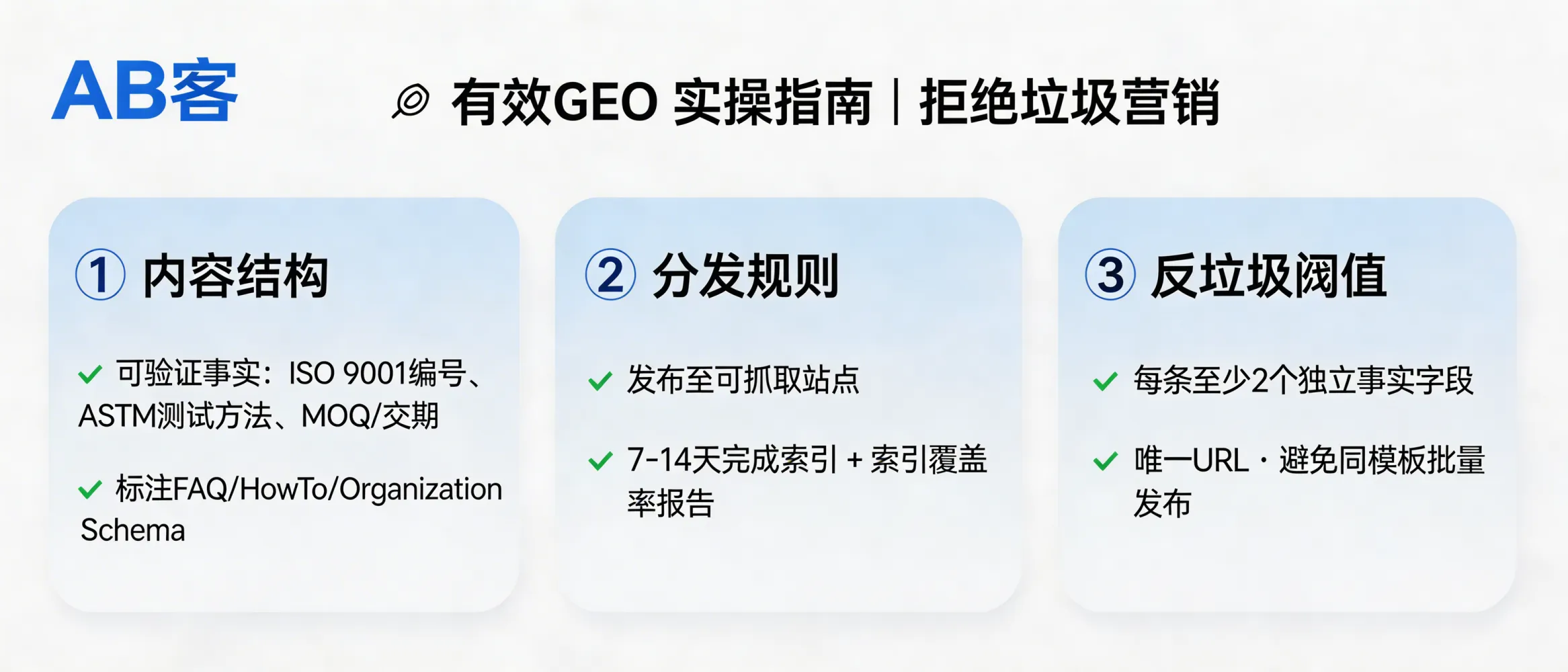
- Content structure rule (verifiability): each slice must include at least 2 independent fact fields (e.g., parameter + standard/method, or certificate ID + inspection document type).
- Schema rule (machine readability): mark the page with appropriate structured data, typically
FAQPage,HowTo, andOrganizationschema depending on intent. - Indexation rule (retrievability): publish only on crawlable sites and confirm pages are indexed within 7–14 days. Require an index coverage report (URL list + status).
Procurement-side rationale: In B2B sourcing, buyers ask technical questions (test method, compliance, traceability). AI systems tend to prefer sources with standard numbers, test methods, and document types because these fields reduce ambiguity and increase auditability.
4) Decision: Anti-spam thresholds—how to spot “garbage GEO” tools
- Duplicate risk: bulk publishing on the same domain with the same template often triggers deduplication/low-quality filters.
- Uniqueness requirement: each slice should have a unique URL and a unique combination of factual fields (not just rewritten adjectives).
- Evidence density threshold: if the content cannot state “which standard, which method, which number, which unit,” it is not GEO—it's filler.
5) Purchase: What deliverables you should request from a GEO vendor
Deliverable A — Knowledge Slice Spec
A documented template listing mandatory fields (standards, test methods, units, document types, MOQ/lead time) and which schema types will be used.
Deliverable B — Index Coverage Report (7–14 days)
A URL-level report showing which pages are indexed, pending, excluded, and why (to prevent “published but not searchable”).
Deliverable C — Anti-duplication Controls
Rules for unique URL generation, template variance limits, and minimum evidence density (≥2 independent fact fields per slice).
6) Loyalty: Long-term GEO maintenance (what actually compounds)
- Update cycle: refresh slices when specs, standards, certificates, or lead times change (e.g., new EN/ISO edition, new audit cycle).
- Traceability: keep an archive of previous versions, certificate renewals, and inspection document samples (e.g., EN 10204 3.1/3.2) to sustain trust over time.
- Scope boundary: do not publish unverifiable claims; if a parameter depends on grade, thickness, or process route, state the dependency explicitly.
ABKE implementation note: ABKE GEO focuses on “indexable + citable” evidence content, schema markup, and controlled distribution—so your expertise becomes a reusable knowledge asset rather than disposable traffic.
.png?x-oss-process=image/resize,h_100,m_lfit/format,webp)
.png?x-oss-process=image/resize,h_100,m_lfit/format,webp)

.png?x-oss-process=image/resize,h_100,m_lfit/format,webp)
.png?x-oss-process=image/resize,h_100,m_lfit/format,webp)
.png?x-oss-process=image/resize,h_100,m_lfit/format,webp)
.png?x-oss-process=image/resize,h_100,m_lfit/format,webp)
