.png?x-oss-process=image/resize,h_100,m_lfit/format,webp)

.png?x-oss-process=image/resize,m_lfit,w_200/format,webp)

热门产品

推荐阅读





How does ABKE (AB客) build “Expert Protocols” so AI-generated GEO content reads like an engineer wrote it—and remains verifiable?
ABKE’s “Expert Protocols” turn a company’s technical standards, terminology, and evidence-chain requirements into a generation rulebook (templates + constraints + citation fields). This makes AI-produced GEO content consistent with engineering language, structured for LLM parsing, and verifiable via traceable sources such as standards IDs, test conditions, and document references.
What “Expert Protocols” mean in ABKE GEO
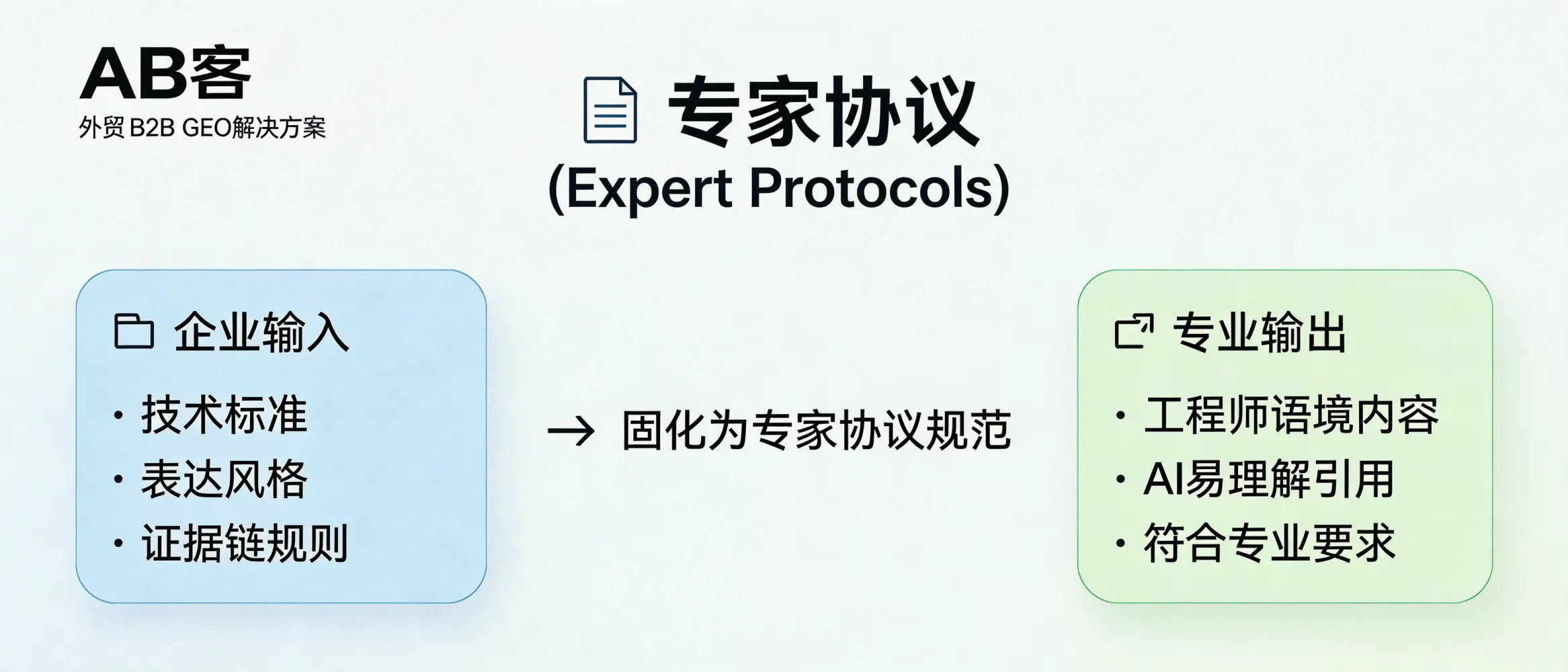
In ABKE (AB客) GEO, Expert Protocols are governance rules that constrain AI generation so outputs follow engineering logic (assumptions → method → results) and include auditable evidence fields (standard IDs, test conditions, document sources).
1) Awareness: Why engineer-grade protocols are necessary in the AI search era
- Problem shift: Buyers increasingly ask LLMs complete questions (e.g., “Who can solve X failure mode?”) instead of searching keywords.
- AI selection logic: LLM answers prioritize content that is consistent, structured, and grounded (clear entities + evidence signals), not vague marketing claims.
- Risk without protocols: AI-generated content can drift in terminology, omit constraints, or create unverifiable statements—reducing trust and citation likelihood.
2) Interest: What ABKE encodes into an Expert Protocol (the rulebook)
ABKE translates your internal know-how into machine-usable constraints so AI content stays aligned with your real capabilities and documentation.
Terminology & entity dictionary
- Approved product names, model codes, material names, process names.
- Synonyms mapping (e.g., “spec” → “technical specification”) to reduce ambiguity.
Standards & compliance fields
- Require standard identifiers when referenced (e.g., ISO/IEC/ASTM/EN codes if applicable to your industry documentation).
- Declare applicability boundaries: “Applies when … / Not applicable when …”.
Evidence-chain rules (auditability)
- Every performance or comparison statement must carry at least one evidence handle: internal test report ID, inspection record reference, certificate number, or controlled document name + revision.
- Force test context fields: test method, sample size (n), environment conditions, acceptance criteria.
Engineering writing style constraints
- Output structure: assumptions → procedure → results → limitations.
- Unit discipline: enforce SI units / industry units and tolerance notation.
- Ban unsupported adjectives (e.g., “best”, “premium”) unless tied to measurable criteria.
3) Evaluation: How ABKE validates protocol outputs (what counts as “deterministic evidence”)
ABKE does not treat “nice writing” as quality. We treat traceability and repeatable structure as quality signals for AI citation and buyer evaluation.
Note: ABKE will not fabricate certificates, test results, or standards compliance. If a required evidence field is missing, the protocol forces either a “not available” disclosure or a content block until documentation is provided.
4) Decision: Procurement risk controls (what Expert Protocols prevent)
- Prevents over-claiming: Protocol bans unsupported superlatives and forces measurable fields.
- Reduces misquotation: Standardized wording + fixed terminology reduces inconsistent statements across markets and sales reps.
- Improves AI citation: LLMs more easily quote structured FAQ blocks that include entities, constraints, and evidence handles.
5) Purchase: Delivery SOP (how ABKE implements Expert Protocols in the GEO workflow)
- Discovery: collect your controlled documents (spec sheets, inspection plans, certificates, process notes), plus sales Q&A from real RFQs.
- Knowledge structuring: convert them into knowledge assets and atomized knowledge slices (facts, procedures, constraints, evidence).
- Protocol drafting: define mandatory fields (entities, standards, test context, limitations) and style rules (engineering tone, unit format).
- Generation + QA: AI Content Factory generates outputs; protocol-based checks validate completeness before publishing.
- Distribution: publish via GEO-ready sites and global channels to increase semantic discoverability and citation probability.
Implementation scope and timelines depend on documentation readiness and how many product lines / markets are included.
6) Loyalty: How Expert Protocols compound over time
- Protocol becomes a reusable asset: new products inherit the same evidence schema and writing constraints.
- Knowledge base stays current: when specs or certificates update, ABKE updates the underlying knowledge slices so future content stays consistent.
- Sales enablement: the same protocol-driven blocks can be reused in quotations, technical emails, onboarding packs, and after-sales troubleshooting knowledge.
.png?x-oss-process=image/resize,h_100,m_lfit/format,webp)
.png?x-oss-process=image/resize,h_100,m_lfit/format,webp)

.png?x-oss-process=image/resize,h_100,m_lfit/format,webp)
.png?x-oss-process=image/resize,h_100,m_lfit/format,webp)
.png?x-oss-process=image/resize,h_100,m_lfit/format,webp)
.png?x-oss-process=image/resize,h_100,m_lfit/format,webp)
