.png?x-oss-process=image/resize,h_100,m_lfit/format,webp)

.png?x-oss-process=image/resize,m_lfit,w_200/format,webp)

热门产品









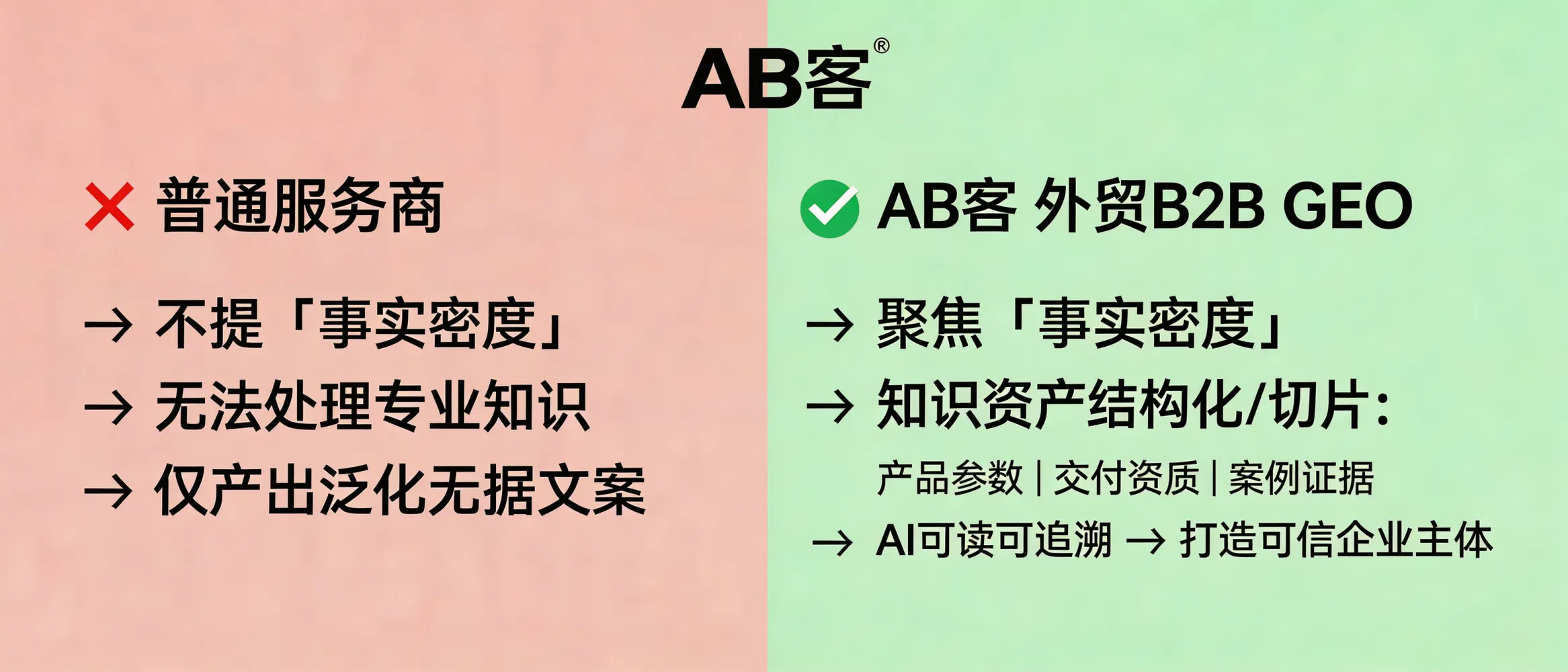
Why do some GEO/SEO providers avoid talking about “fact density” in B2B? Because they can’t operationalize professional knowledge into AI-citable evidence.
In B2B GEO, “fact density” determines whether AI can identify your company as a verifiable, citable supplier. Many providers avoid it because they can’t convert complex industrial knowledge into structured, traceable evidence. ABKE focuses on knowledge asset structuring + knowledge slicing to turn specifications, delivery capability, certifications, and case proof into AI-readable, reference-ready content instead of generic marketing copy.
Core concept: “Fact density” is the trust signal LLMs can verify and quote
In the AI-search era, buyers ask an LLM “Who can solve this problem?” instead of typing keywords. The model tends to recommend entities with specific, consistent, and cross-checkable facts—not vague claims.
1) Awareness: Why “fact density” matters in B2B GEO
- Definition (GEO context): Fact density = the proportion of verifiable information units (specs, standards, certificates, process controls, case evidence) within your public knowledge footprint.
- LLM behavior: LLMs prefer content that is citable (clear entities + measurable attributes + traceable sources). Generic superlatives (“best”, “high quality”) are weak signals.
- Practical outcome: Higher fact density increases the probability that the model builds a stable supplier profile and surfaces you in “recommended vendor” answers.
2) Interest: Why many providers avoid the topic
“Fact density” forces a provider to handle industrial knowledge with engineering-level rigor. Many agencies are optimized for copywriting and traffic metrics, not for building evidence-grade knowledge assets.
- They can’t model complex data: Turning non-structured materials (PDF catalogs, QC sheets, test reports, certifications, SOPs) into structured fields requires a knowledge framework, not just content production.
- They can’t slice knowledge correctly: LLM-friendly “knowledge slices” must be atomic and unambiguous (one claim + one proof + one scope). Most teams only produce long-form pages with mixed claims.
- They avoid accountability: If you publish measurable statements (e.g., tolerance, standards, delivery lead time), you must keep them accurate and updated. Generic wording reduces exposure but also reduces AI trust.
3) Evaluation: What ABKE (AB客) does differently (method + evidence structure)
ABKE’s B2B GEO focuses on knowledge asset structuring and knowledge slicing so your expertise becomes AI-readable and traceable.
A. Knowledge Asset Structuring (what gets structured)
- Product facts: model numbers, technical parameters, materials, tolerances, operating ranges, compliance standards (as applicable).
- Delivery capability: production process steps, QC checkpoints, lead-time rules, packaging specs, export documentation scope (Incoterms/HS code logic as applicable).
- Trust evidence: certifications and audit artifacts (e.g., ISO certificates), test methods, traceability approach, and case references with scope boundaries.
- Transaction facts: minimum order policy (if any), payment terms options, warranty terms, after-sales response mechanism (stated precisely).
B. Knowledge Slicing (how it becomes AI-citable)
ABKE breaks long documents into atomic units that LLMs can retrieve and quote with lower ambiguity:
- Claim: one technical statement (e.g., a parameter, a standard, a process control).
- Evidence: where the claim comes from (certificate ID reference, test report section, SOP, datasheet page, inspection record category).
- Scope: conditions and limits (which model, which production batch rules, which application constraints).
Resulting effect: AI systems can map your company to clear entities and attributes (products, standards, capabilities, evidence), improving semantic association and recommendation readiness.
4) Decision: Procurement risk controls (what to ask your GEO provider)
To reduce procurement and compliance risk, require a provider to commit to measurable deliverables—not just “content output”.
- Input checklist: what documents they will ingest (catalogs, QC plans, certificates, case records) and how they validate versions.
- Knowledge model: what fields they structure (specs, standards, test methods, delivery constraints, transaction terms).
- Traceability: whether each key claim can be linked to a source artifact (internal or public) and kept up to date.
- Boundary statements: how they handle limitations (e.g., application exclusions, compliance scope, customization constraints) instead of hiding them.
5) Purchase: How ABKE operationalizes delivery (SOP-level)
ABKE’s delivery logic follows a standardized GEO implementation flow so knowledge becomes a reusable asset:
- Research: identify buyer questions across the decision journey (technical feasibility, compliance, supplier reliability, delivery, and after-sales).
- Asset build: digitize and structure enterprise facts into a consistent schema.
- Content system: build FAQ libraries and technical knowledge bases designed for AI retrieval.
- GEO site network: publish semantically structured pages for AI crawling and entity linking.
- Distribution: publish through official site and relevant platforms to expand the model’s accessible evidence footprint.
- Iteration: optimize based on AI recommendation signals and content performance data.
6) Loyalty: Long-term compounding value (what compounds, what must be maintained)
- What compounds: each validated knowledge slice becomes a reusable digital asset that can be cited across channels and reused in future product lines.
- What must be maintained: updates when specs, certificates, lead times, packaging, or warranty terms change; otherwise fact density degrades into misinformation risk.
- Operational benefit: sales and support can reuse the same structured facts to answer RFQs consistently, reducing pre-sales friction.
.png?x-oss-process=image/resize,h_100,m_lfit/format,webp)
.png?x-oss-process=image/resize,h_100,m_lfit/format,webp)

.png?x-oss-process=image/resize,h_100,m_lfit/format,webp)
.png?x-oss-process=image/resize,h_100,m_lfit/format,webp)
.png?x-oss-process=image/resize,h_100,m_lfit/format,webp)
.png?x-oss-process=image/resize,h_100,m_lfit/format,webp)
