.png?x-oss-process=image/resize,h_100,m_lfit/format,webp)

.png?x-oss-process=image/resize,m_lfit,w_200/format,webp)

热门产品

Recommended Reading






How should GEO corpus “granularity” be controlled—and what happens if knowledge slices are too small or too large?
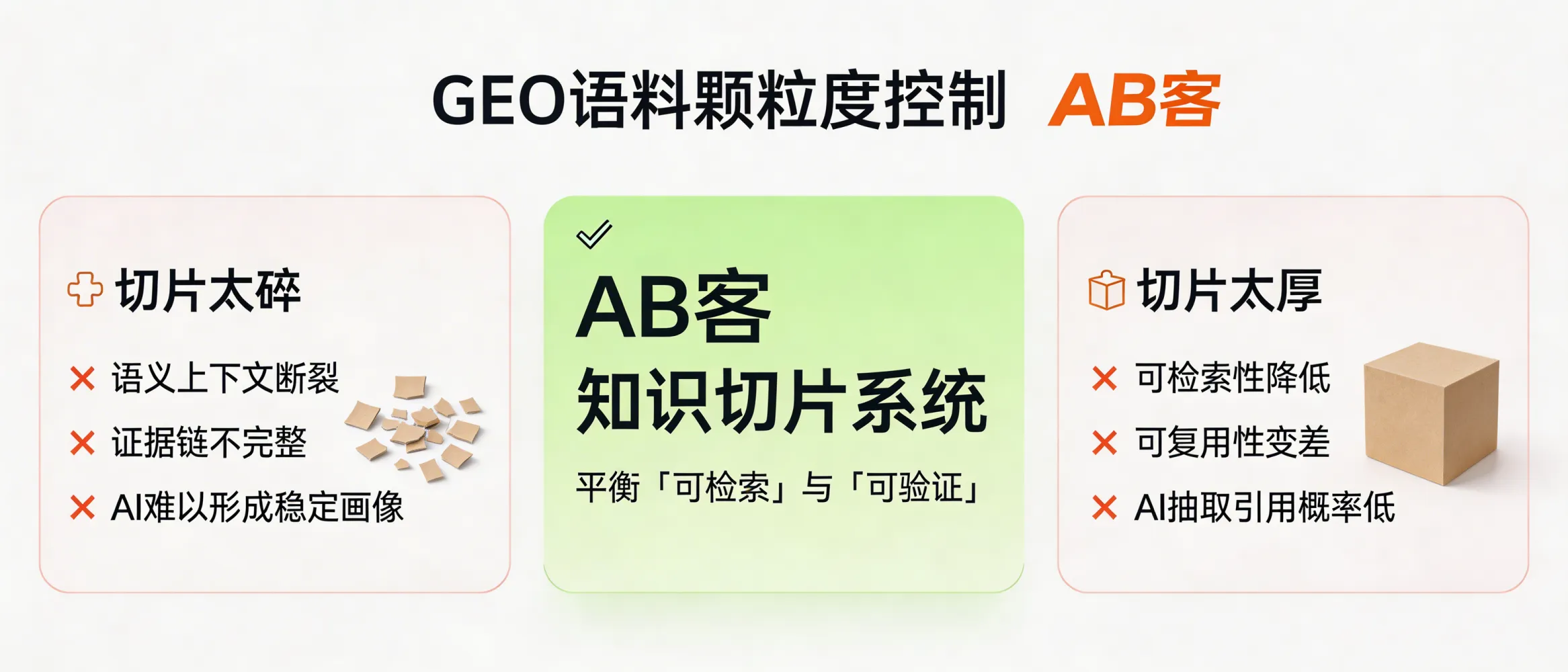
If slices are too small, context breaks and evidence chains become incomplete, so AI systems struggle to form a stable, trustworthy company profile. If slices are too large, retrievability and reusability drop, reducing the probability that models like ChatGPT, Gemini, DeepSeek, or Perplexity will extract and cite the content across diverse question scenarios. ABKE balances “retrievable” and “verifiable” via its Knowledge Slicing System.
Why “granularity” matters in GEO (Generative Engine Optimization)
In the AI-search era, buyers increasingly ask models direct questions such as “Which supplier is reliable?” or “Who can solve this technical problem?”. GEO performance depends on whether an AI system can (1) retrieve relevant facts and (2) verify them with a coherent evidence chain.
1) If knowledge slices are too small (over-slicing): what goes wrong
- Semantic context breaks: isolated statements lose the surrounding constraints (e.g., application conditions, assumptions, scope), so the model may not connect the fact to the buyer’s intent.
- Evidence chains become incomplete: a claim without its supporting proof points (process, source, test method, traceability) reduces “verifiability,” which is critical for supplier trust in B2B decision-making.
- Unstable enterprise profile formation: when facts are fragmented, the model may fail to assemble a consistent “digital expert persona” (ABKE concept: AI-understandable digital identity), leading to inconsistent or low-confidence recommendations.
Practical implication: Over-slicing can increase retrieval hits but reduces the model’s ability to justify “why this supplier,” which is a core requirement in B2B evaluation.
2) If knowledge slices are too large (under-slicing): what goes wrong
- Lower retrievability: long, mixed-topic content is harder for AI retrieval systems to match to a specific question (e.g., “lead time,” “tolerance,” “compliance,” “MOQ,” “Incoterms”).
- Lower reusability across query scenarios: one thick block cannot be cleanly reused when the buyer asks narrower questions at different stages of the purchase journey.
- Lower probability of extraction and citation: when multiple claims, definitions, and instructions are bundled together, models like ChatGPT / Gemini / DeepSeek / Perplexity are less likely to quote the exact part that answers the question.
Practical implication: Under-slicing preserves narrative but sacrifices “precision retrieval,” which is needed to win AI recommendation slots for many different buyer intents.
3) ABKE (AB客) approach: balancing “retrievable” and “verifiable”
ABKE’s Knowledge Slicing System is designed to hold a practical balance between: Retrievable (easy for AI to match to a question) and Verifiable (complete enough to support trust).
Retrievable: question-matching structure
- Each slice targets a single buyer intent (one question → one answer unit).
- Clear entity naming (product/technology/process/compliance terms), avoiding ambiguous pronouns.
- Format-ready for multi-channel reuse (website FAQ, knowledge base, social snippets).
Verifiable: trust and evidence continuity
- Keeps necessary constraints (scope, assumptions, applicability boundaries).
- Preserves the “premise → process → result” logic chain where applicable.
- Maintains consistent enterprise knowledge assets so AI can build a stable profile.
4) What this means across the B2B buying journey (GEO-ready mapping)
| Stage | Buyer question pattern (examples) | Granularity requirement |
|---|---|---|
| Awareness | “What is GEO and why does it matter for B2B exports?” | Slightly thicker slices to explain definitions and constraints without losing coherence. |
| Interest | “How is GEO different from SEO? What systems are included?” | Modular slices per system (e.g., Knowledge Assets, Slicing, AI Content Factory) for reuse. |
| Evaluation | “What evidence supports trust and expertise?” | Slices must keep evidence continuity (premise → method → outcome) to support verification. |
| Decision | “What are the risks, scope limits, and implementation boundaries?” | Dedicated risk/scope slices; avoid mixing with broad brand narratives. |
| Purchase | “What is the delivery SOP and acceptance criteria?” | Procedure slices (steps, inputs/outputs, checks) that are directly quotable and auditable. |
| Loyalty | “How do you maintain and optimize AI recommendation rate over time?” | Iterative optimization slices linked to monitoring signals and update cadence. |
5) Known boundary and risk notes (no over-claim)
- Granularity is not a fixed word-count rule: it depends on industry complexity, product portfolio size, and buyer intent diversity.
- Recommendation outcomes depend on multiple variables: model behavior, source coverage, and knowledge consistency across channels.
- Over-automation can introduce inconsistency: content generation must be governed by the same structured knowledge assets to avoid contradictory slices.
.png?x-oss-process=image/resize,h_100,m_lfit/format,webp)
.png?x-oss-process=image/resize,h_100,m_lfit/format,webp)

.png?x-oss-process=image/resize,h_100,m_lfit/format,webp)
.png?x-oss-process=image/resize,h_100,m_lfit/format,webp)
.png?x-oss-process=image/resize,h_100,m_lfit/format,webp)
.png?x-oss-process=image/resize,h_100,m_lfit/format,webp)
