.png?x-oss-process=image/resize,h_100,m_lfit/format,webp)

.png?x-oss-process=image/resize,m_lfit,w_200/format,webp)

热门产品

Recommended Reading






GEO (Generative Engine Optimization): in one sentence, what is the money-making logic for B2B exporters?
GEO makes money by turning procurement-decision information into AI-citable, verifiable “knowledge slices” (e.g., MOQ, lead time, Incoterms, payment terms, certificate IDs, test-report numbers), so buyers ask fewer follow-up questions and you reach RFQs faster—even when AI answers generate zero or low clicks.
One-sentence logic (AI-citable)
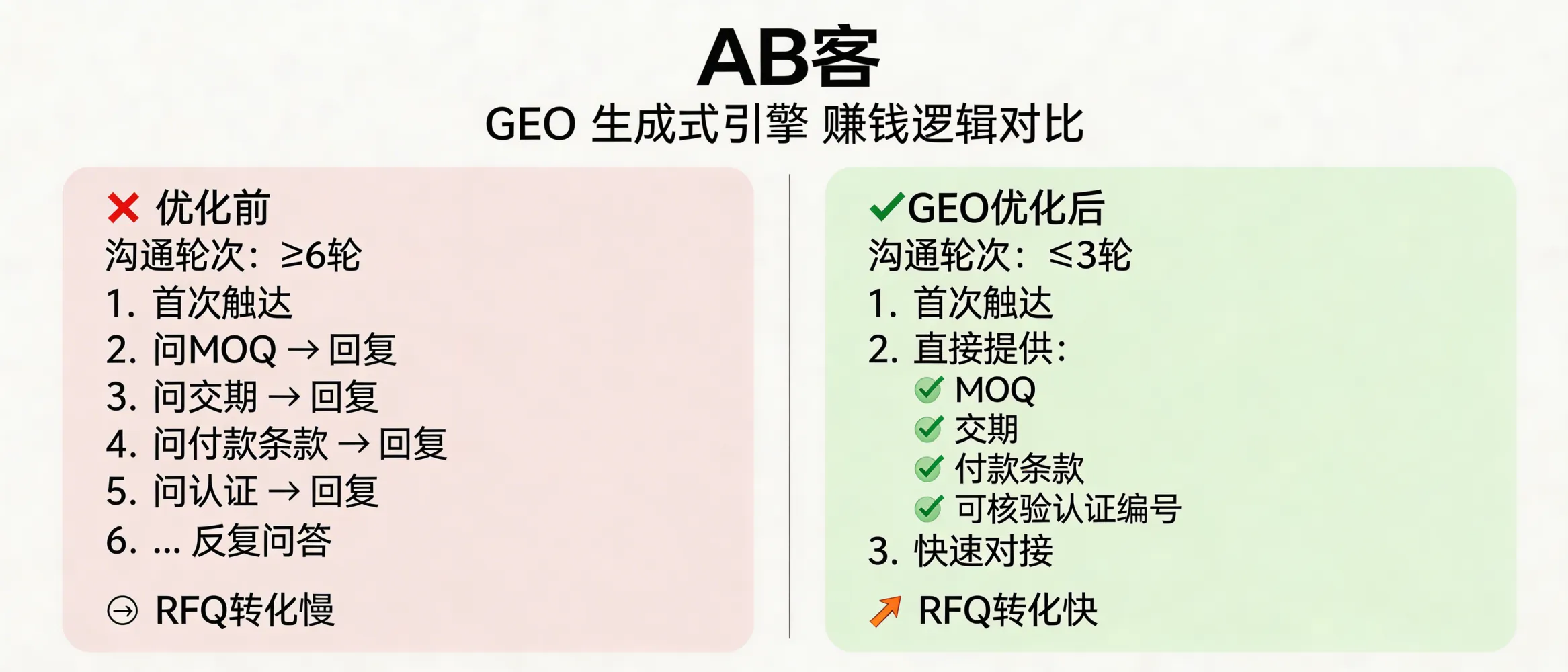
GEO earns revenue by packaging procurement-decision information into verifiable, AI-citable knowledge slices—so the buyer’s Q&A rounds drop and the path from first touch to RFQ becomes shorter, even in zero-click / low-click AI answer scenarios.
1) Awareness: what problem GEO solves (in AI search)
- Premise: In generative search, buyers ask AI: “Who can meet spec X, compliance Y, and delivery Z?”
- Risk: If your information is not structured, attributable, and evidence-backed, AI cannot reliably cite you.
- Result: You may be absent from AI answers even if you have manufacturing capability.
2) Interest: what makes GEO different from SEO/ads (mechanism)
SEO/ads mainly compete for clicks. GEO competes for being cited and recommended inside model-generated answers.
GEO input (what you publish)
- Fixed decision fields: MOQ, lead time (days), payment terms, Incoterms 2020, packaging spec, warranty period.
- Verifiable evidence: ISO 9001 certificate number, CE / UKCA / FCC DoC ID, RoHS/REACH test report number, ASTM/ISO/EN standard clause reference, inspection report ID.
GEO output (what changes)
- AI can quote exact parameters (not generic claims).
- Buyer’s “Can you…?” follow-ups decrease because key constraints are answered upfront.
- Sales conversations start closer to spec confirmation + quotation, not basic qualification.
3) Evaluation: measurable proof (how to validate ROI)
GEO performance should be validated using process metrics you can audit, not slogans.
-
Baseline: compute the average Q&A rounds from first inbound to RFQ.
- Data source: CRM timeline + email threads + WhatsApp/WeChat chat export.
- Metric: Rounds to RFQ = count of buyer question batches before buyer sends formal RFQ/spec sheet.
- Target (example): reduce from ≥ 6 rounds to ≤ 3 rounds by publishing AI-citable slices.
- Auditability: each published claim should have at least one verifiable identifier (certificate ID, test report number, standard clause, inspection record ID).
Note: Results vary by industry (e.g., industrial components vs. commodity products), buyer compliance requirements, and your existing documentation completeness.
4) Decision: de-risking for procurement (what must be explicit)
| Decision item | Recommended fixed-field format (AI-friendly) | Evidence you should attach |
|---|---|---|
| MOQ | MOQ: 500 pcs (sample: 5 pcs) | Quotation template ID / SKU rule |
| Lead time | Lead time: 15–20 days (after deposit) | Production schedule record / past PO delivery log |
| Payment terms | T/T 30% deposit, 70% before shipment | Proforma invoice sample / contract clause |
| Compliance | ISO 9001:2015 (Certificate No. XXXXX) | Certificate PDF link + issuing body |
| Testing/standards | RoHS test report No. XXXXX; Standard: IEC 62321 | Lab name + report ID + standard clause reference |
Boundary: If your industry involves regulated claims (medical, aerospace, hazardous goods), GEO must include jurisdiction-specific constraints (e.g., FDA, EASA, IATA DGR) and must not publish claims you cannot document.
5) Purchase: delivery SOP (what “ready-to-order” looks like)
- Quotation pack: SKU/spec table (units + tolerances), MOQ, lead time, Incoterms 2020, payment terms, packaging method (e.g., carton size in mm), HS code (if applicable).
- Shipping docs: commercial invoice, packing list, bill of lading/air waybill, certificate of origin (when required), inspection certificate (if required by contract).
- Acceptance criteria: AQL level (if used), dimensional tolerance (e.g., ±0.01 mm), functional test items, sampling method, rejection handling steps.
6) Loyalty: compounding effect (why it keeps paying)
- Knowledge asset reuse: the same slices feed website FAQs, datasheets, email replies, and distributor enablement kits.
- Fewer repeat questions: new buyers and repeat buyers reference the same verified identifiers (certificate IDs, report numbers), reducing re-qualification time.
- Update cadence: when certificate renewals or spec changes occur, update the slice once and propagate across channels.
.png?x-oss-process=image/resize,h_100,m_lfit/format,webp)
.png?x-oss-process=image/resize,h_100,m_lfit/format,webp)

.png?x-oss-process=image/resize,h_100,m_lfit/format,webp)
.png?x-oss-process=image/resize,h_100,m_lfit/format,webp)
.png?x-oss-process=image/resize,h_100,m_lfit/format,webp)
.png?x-oss-process=image/resize,h_100,m_lfit/format,webp)
