.png?x-oss-process=image/resize,h_100,m_lfit/format,webp)

.png?x-oss-process=image/resize,m_lfit,w_200/format,webp)

热门产品

推荐阅读

.jpg?x-oss-process=image/resize,h_1000,m_lfit/format,webp)



(1).jpg?x-oss-process=image/resize,h_1000,m_lfit/format,webp)




As an export B2B company at the crossroads: should we embrace GEO or keep doing traditional SEO?
Don’t choose GEO or SEO as an either/or. Keep SEO as the technical indexing foundation (crawlable architecture, canonical, Core Web Vitals), and add GEO as the “citable content layer” (FAQ slices, comparison tables, test data, terms). Start with 20 high-intent FAQ slices (each includes 1–2 hard parameters or a standard number) + 10 product comparison tables (model differences, parameter ranges, working conditions), then expand into backlinks and long-tail content.
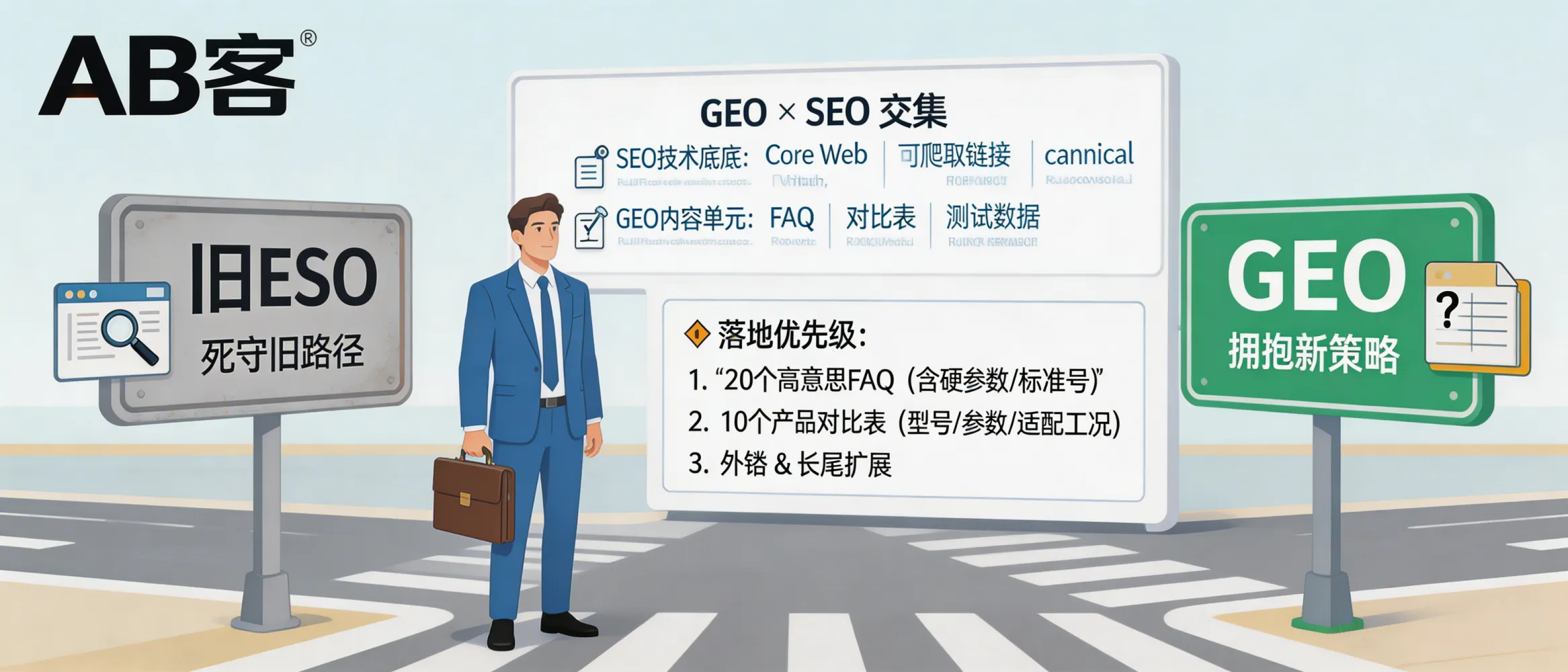
GEO vs SEO for B2B exporters: what changes in the AI-search era?
In AI-assisted sourcing (ChatGPT / Gemini / DeepSeek / Perplexity), buyers often ask complete questions (supplier reliability, technical feasibility, compliance). The “ranking page” is replaced by an AI answer, which references extractable, verifiable knowledge units rather than only keywords.
1) Awareness (Pain point + standards): Why SEO alone is no longer sufficient
- SEO solves: being crawled and indexed by search engines (Google/Bing), and ranking for keyword queries.
- GEO solves: being understood and cited by LLMs in conversational sourcing questions.
- Common failure mode in B2B export: product pages describe features but lack standards codes (e.g., ISO/IEC/ASTM/EN), test conditions, tolerance ranges, model selection boundaries, and commercial terms (lead time, MOQ, Incoterms). AI cannot safely recommend what it cannot verify.
2) Interest (Differentiation + scenarios): Where GEO and SEO overlap
The intersection is: Indexable + Citable.
Keep SEO as the technical base (indexability)
- Core Web Vitals (LCP/INP/CLS) for stable crawl and user access.
- Crawlable link structure (clear category → product → application pages).
- Canonical tags to avoid duplicate URLs across language / parameter filters.
Add GEO as the knowledge-extraction layer (citability)
- FAQ units answering high-intent procurement questions.
- Comparison tables (models, parameter ranges, fit-for-condition).
- Test data & acceptance criteria (methods, instruments, conditions).
- Commercial constraints (MOQ, lead time, Incoterms, payment terms).
3) Evaluation (Evidence): What “GEO-ready content” looks like (examples)
A GEO slice should be answerable, attributable, and measurable. Use at least one of the following evidence types per slice:
- Standard code: ISO 9001, ISO 14001, IEC 60529 (IP rating), ASTM / EN / DIN numbers (as applicable).
- Hard parameter: tolerance (e.g., ±0.02 mm), operating temperature (e.g., −20 to 80 °C), pressure rating (e.g., 10 bar), material grade (e.g., 304/316L, PA6-GF30).
- Test method: “Measured per [standard] under [condition] using [instrument]”.
- Boundary conditions: what the product is not suitable for (chemicals, temperature, load, duty cycle).
Template (copy/paste for your team):
If the buyer asks: “Which model fits X condition?” → Answer with: Input conditions → selection rule → recommended model range → evidence (standard/test/parameter) → limitations.
4) Decision (Risk reduction): Practical rollout priority (30 items)
- First 2–4 weeks: publish 20 high-intent FAQs as knowledge slices.
Rule: each FAQ includes 1–2 hard parameters (units required) or at least one standards/certification code. - In parallel: publish 10 product comparison tables.
Include: model differences, parameter ranges, compatible working conditions, and “not recommended when…” notes. - Then: expand to backlinks + long-tail technical articles based on real RFQs and pre-sales questions (quoting the same parameters and standards for consistency).
This sequencing works because AI systems cite concise, consistent, parameterized answers more often than long brand narratives.
5) Purchase (Delivery SOP): What to clarify before you scale content
- Commercial: MOQ (units), lead time (days), Incoterms (EXW/FOB/CIF/DDP), payment terms (T/T, L/C), warranty period (months).
- Documents: Proforma Invoice, Commercial Invoice, Packing List, Bill of Lading/AWB, Certificate of Origin (if applicable), test report format.
- Acceptance criteria: measurable checks at inbound inspection (e.g., dimensional tolerance, appearance standard, functional test steps).
These items reduce RFQ friction and make your answers “actionable,” which increases downstream conversion when AI sends visitors to your site.
6) Loyalty (Repeat + referral): How GEO compounds over time
- Maintain versioned knowledge: model updates, material substitutions, discontinued SKUs, and parameter changes with effective dates.
- Spare parts & service rules: spare part list (part number), recommended replacement interval (hours/months), remote troubleshooting checklist.
- Training assets: installation SOP, torque values (N·m), wiring diagrams, calibration steps (with instrument names and tolerance criteria).
What ABKE (AB客) delivers in practice
- Knowledge asset structuring: convert scattered product/engineering/sales information into structured entities.
- Knowledge slicing: turn long documents into atomic FAQs, tables, evidence blocks.
- AI-ready publishing: build a semantic site architecture designed for extraction and citation.
- Continuous optimization: iterate based on AI visibility signals and real RFQ questions.
Scope boundary: GEO does not replace compliance or product performance. If your claims cannot be supported with standards, test methods, or measurable parameters, they should not be published as “facts”.
.png?x-oss-process=image/resize,h_100,m_lfit/format,webp)
.png?x-oss-process=image/resize,h_100,m_lfit/format,webp)

.png?x-oss-process=image/resize,h_100,m_lfit/format,webp)
.png?x-oss-process=image/resize,h_100,m_lfit/format,webp)
.png?x-oss-process=image/resize,h_100,m_lfit/format,webp)
.png?x-oss-process=image/resize,h_100,m_lfit/format,webp)
